One voice and a remarkable partner
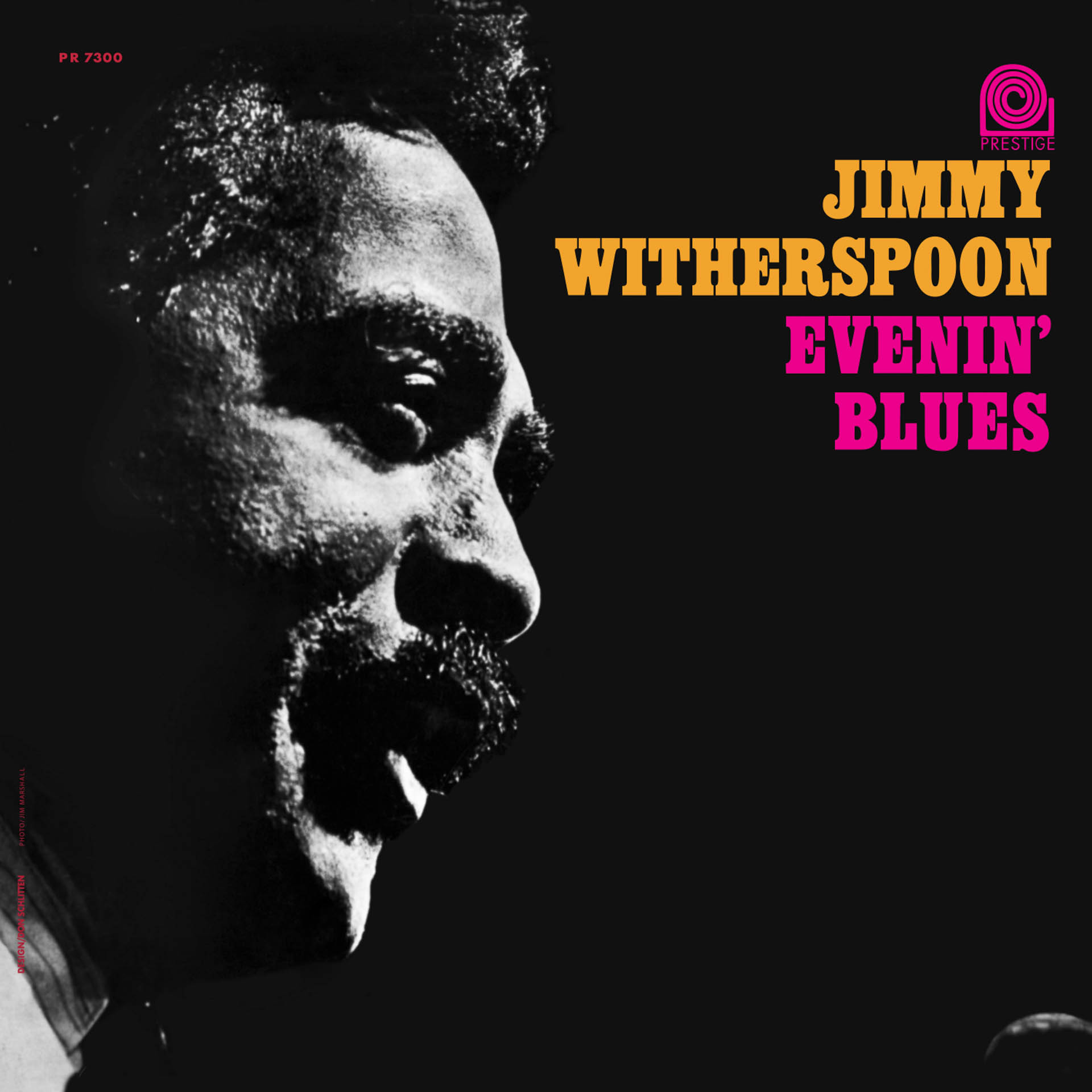
Jimmy Witherspoon and T-Bone Walker on the same record: that encounter alone makes Evenin’ Blues an attractive prospect. One is a major voice on the border between blues and jazz, the other a formative figure in electric blues guitar. They do not appear here as separate attractions. Walker plays within Witherspoon’s band, placing his guitar in the service of the songs. The session offers a chance to hear a celebrated instrumentalist in a particularly attentive role: partnering a singer whose phrases require space, support and individual responses.
The recording took place in Los Angeles on 15 August 1963. David Axelrod supervised the production, and the album appeared on Prestige in 1964 as PR 7300, or PRST 7300 in stereo. Although part of the Prestige catalogue, it was not made at Rudy Van Gelder’s New Jersey studio. That geographical distinction is historically useful. The records issued by a label do not all represent a single recording environment. Evenin’ Blues preserves a Los Angeles encounter with its own personnel and background, different from the numerous East Coast sessions so strongly associated with Prestige.
By this point, Witherspoon brought almost two decades of recording experience to the microphone. His early sessions with Jay McShann date from 1945, and Ain’t Nobody’s Business became an important success in 1949. After more difficult years for the great blues shouters, his appearance at the Monterey Jazz Festival in 1959 had brought renewed attention. Evenin’ Blues therefore belongs to a period of renewed visibility. This is not a singer still trying to establish an identity, but an experienced storyteller capable of maintaining his own continuity across different repertoires and forms of accompaniment.

T-Bone Walker, Clifford Scott and the ensemble
In 1963, T-Bone Walker was already a central figure in electric blues guitar. His recordings of the 1940s, including Call It Stormy Monday, had shown younger musicians how independently an amplified guitar could speak within the blues. On this album, his place inside the band is especially interesting. A guitar does not have to occupy the foreground continuously to make its character felt. An entrance between vocal lines, a brief melodic reply or the emphasis placed on a single note can affect the course of a song. Those details invite attention alongside Witherspoon’s delivery.
Clifford Scott contributes another distinctive instrumental voice. The saxophonist had worked with Bill Doggett and is associated with Honky Tonk. Earlier employers included Jay McShann and Roy Brown. This creates telling connections within the present record: McShann also belongs to Witherspoon’s early history, while Roy Brown’s Good Rockin’ Tonight appears in the programme. The credits become a network of musical relationships rather than a row of unrelated names. Performers and songs touch shared experiences in blues, rhythm and blues and the practical work of small bands, lending the session a history beyond its recording date.
The session documentation lists Scott on tenor saxophone. The label additionally highlights his alto on Grab Me a Freight and flute on Evenin’. Flute is a particularly interesting extension of the expected blues instrumentation, bringing another kind of attack and a different airiness to the surroundings of a strong male voice. It is a good reason to consider the title song as more than a vocal performance and to follow its accompanying colours. A small ensemble can alter its sound without the addition of a larger cast or elaborate orchestration.
Bert Kendrix on organ, Clarence Jones on double bass and Wayne Robertson on drums complete the personnel. Supplementary sources also credit Kendrix with piano. The relationship between keyboard, guitar, bass and drums matters to this group: it can support the singer while remaining flexible enough to accommodate the horn’s responses. Accompanying an experienced vocalist is an active responsibility. The band must be sensitive to the length of a line, a delayed entrance or a change in emphasis. Together, the six musicians create the setting in which each song takes on its particular form.

Ten songs between everyday life and departure
Money’s Gettin’ Cheaper opens the album with a title whose everyday observation remains immediately understandable. It is followed by Grab Me a Freight, Jesse Stone’s Don’t Let Go! and I’ve Been Treated Wrong, before Evenin’ closes the first side. The sequence brings together movement, complaint, intimacy and an evening mood without forcing them into an artificial plot. Witherspoon’s task is to give each song its own verbal attitude. Listening can therefore focus not only on melody but also on where a word falls against the beat and how a line is brought to its end.
Side two begins with Cane River. Baby, How Long brings in material associated with Brownie McGhee, while Good Rocking leads back to Roy Brown’s Good Rockin’ Tonight. The shortened title used on this LP does not obscure the song’s connection with rhythm-and-blues history. Such pieces already possess a past when Witherspoon records them. Their interest lies in hearing them brought together through his voice and this particular band. An interpretation does not acquire value only by choosing an unfamiliar song; established material can reveal the individuality of a singer and his partners just as effectively.
Jerry Leiber and Mike Stoller’s Kansas City supplies another widely familiar song, and Drinking Beer brings the record to a close. Alongside compositions by other writers are pieces credited to Witherspoon himself, including Cane River and Drinking Beer. The programme consequently presents him as more than an interpreter. Its combination of original material and songs from elsewhere reflects a singer building a personal repertoire from several sources. Unity comes from his presence and the ensemble surrounding him, rather than from the involvement of a single composer throughout the album.
The LP’s ten selections constitute the original album programme. Later CD releases added alternate versions belonging to a different edition. Here the emphasis remains on the sequence that presents Witherspoon’s encounter with these musicians as an album. For collectors, that is a useful distinction between documentation and programme shape. Additional takes can have considerable interest, while the original order retains a coherence of its own. Evenin’ Blues can be approached as a complete session with changing moods, allowing the songs themselves to establish their relationships before attention turns to variants and supplementary material.
The stereo LP in the Prestige series
Analogue Productions publishes this edition as APRJ 7300. Kevin Gray at Cohearent Audio is credited with mastering from the original analogue master tapes, and Quality Record Pressings with manufacture. The current edition is offered on 180-gram vinyl; earlier pressings of the title used 200-gram vinyl. The album belongs to the Prestige Stereo series and is presented in a traditional tip-on jacket. For a collection, the central attractions are the particular recording, the treatment of its analogue source and the preservation of the complete album sequence.
The single 33⅓ rpm record maintains five selections on each side. That is an appropriate arrangement for a programme built around songs: several small stories can unfold before the side change provides a natural pause. The alternation between familiar material and more personal contributions benefits from a sustained sequence. The music does not have to be spread over additional sides for the reissue to be carefully considered. Here the format suits an album whose expression develops through the singer, concise instrumental responses and the rhythm shared by the whole band.
Evenin’ Blues is especially rewarding for listeners who already know Witherspoon and Walker separately. It shows what their meeting can offer within an ensemble while also directing attention towards Clifford Scott, Bert Kendrix, Clarence Jones and Wayne Robertson. All help the singer bring different songs into a common musical world. For a collection spanning blues, jazz and rhythm and blues, the record has a specific historical interest and an intimate scale: a clearly defined group of musicians whose individual histories meet in one Los Angeles session. Its appeal rests on that encounter as much as on the names above the title.
You order from Michael 45 in Germany. We arrange the US import and dispatch from Hilden.
Customer question: Buying Analogue Productions records in Europe
Series: Analogue Productions Prestige – all 50 records, musicians and session paths
Musicians
Participants and documented credit status. Track references correspond to the tracklist.
- Jimmy WitherspoonvocalsParticipation: Album personnel
- T-Bone WalkerguitarParticipation: Album personnel
- Clifford Scotttenor saxophone, alto saxophone (A2, supplementary source), flute (A5, supplementary source)Participation: Album personnel
- Bert Kendrixorgan, piano (supplementary source)Participation: Album personnel
- Clarence Jonesdouble bassParticipation: Album personnel
- Wayne RobertsondrumsParticipation: Album personnel


Recorded in Los Angeles, 15 August 1963; the exact studio and recording engineer are unconfirmed. Supervision: David Axelrod. Liner notes: Francis Squibb. AP mastering: Kevin Gray. Scott’s alto/flute assignments and Kendrix’s additional piano credit come from supplementary sources.

Reviews
There are no reviews yet.