A storyteller who brings his own sense of time
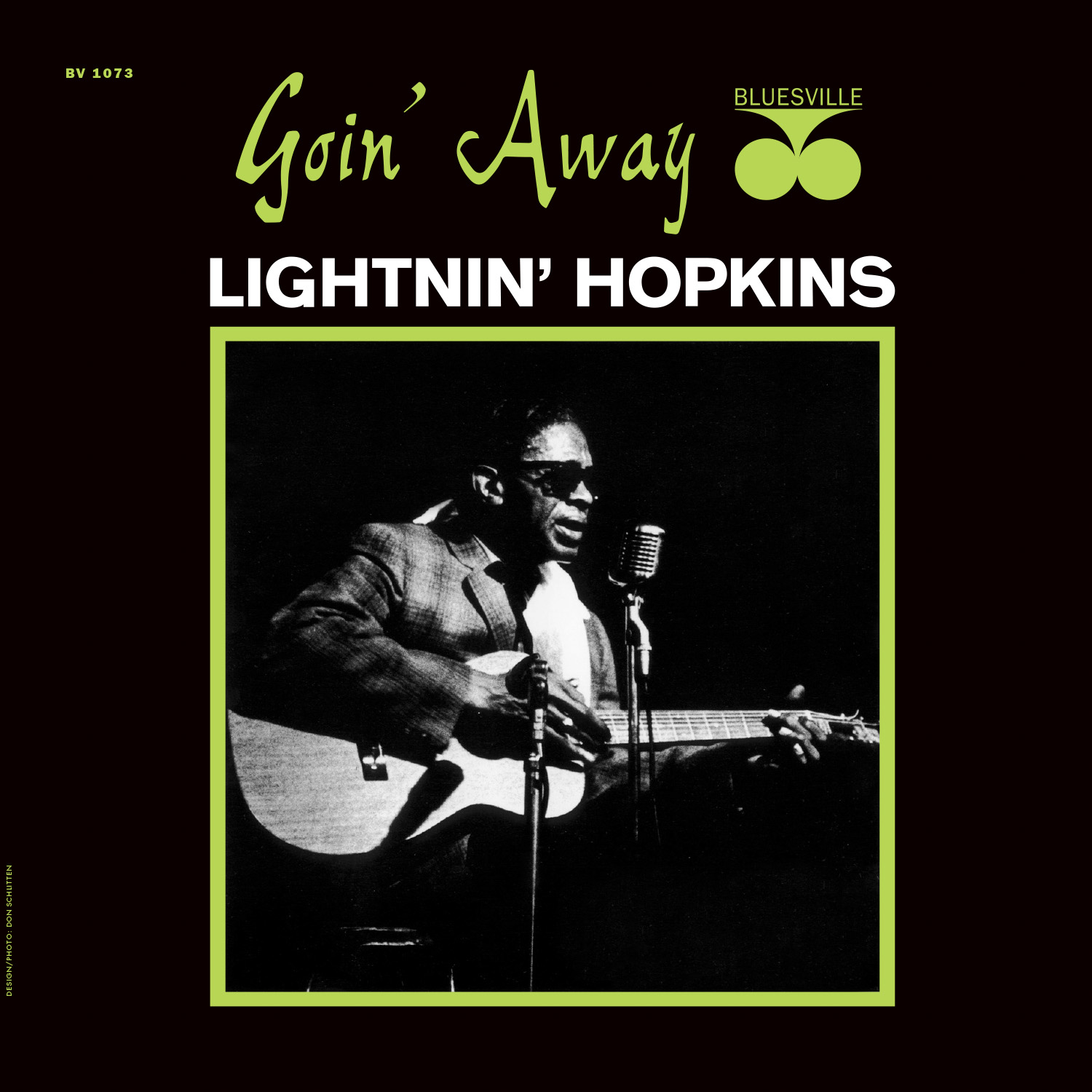
Some musicians need a large ensemble to fill a room with life. Lightnin’ Hopkins needs a voice, a guitar and the next sentence. On Goin’ Away, a small rhythm section joins him, but the centre remains this distinctive storyteller from Texas. Recorded on 4 June 1963 at Rudy Van Gelder’s studio in Englewood Cliffs, the album appeared that year on Bluesville, Prestige’s blues imprint. Eight pieces, all credited to Hopkins, make up a record whose richness does not depend on elaborate arrangements. It comes from a personality able to turn everyday encounters, complaints, warnings and passing observations into music.
Born in Centerville in 1912, Hopkins had encountered the blues long before the folk audience of the sixties discovered him. Blind Lemon Jefferson and his older cousin Texas Alexander belonged to his early musical world. That background matters more to Goin’ Away than the idea of a neatly bounded genre. Blues could be dance music, entertainment, reportage and an assertion of independence at the same time. A singer had to reach his listeners, and doing so did not necessarily require a form fixed down to its final bar. The story itself helped determine how much time a thought was allowed to take.
By the time of this recording, Hopkins had entered another chapter of his career. Mack McCormick’s advocacy from 1959 and the growing interest of the folk audience opened new opportunities to perform. On 14 October 1960, he appeared at Carnegie Hall on a programme that included artists such as Joan Baez and Pete Seeger. Goin’ Away belongs to that period without turning Hopkins into a different musician. Behind the new audience remained the experience of an artist whose standard was not the expectation of a concert hall, but the persuasive power of his own musical language.

Three musicians and a flexible centre
The complete personnel is wonderfully manageable: Hopkins sings and plays guitar, Leonard Gaskin plays double bass, and Herbie Lovelle plays drums. The label specifically describes Hopkins’ instrument on this recording as an acoustic guitar. That distinguishes the setting from the amplified performances in Houston juke joints that also formed part of his history. It would therefore be misleading to tell the story of this particular album entirely through the image of an electric blues guitarist. This session foregrounds another aspect of the same musical personality: voice and strings, supported by two musicians who make room for them.
Gaskin and Lovelle have more to do than provide a regular background. The publisher’s account specifically praises their ability to follow Hopkins when he treats conventional groups of bars freely or brings a thought to an unexpected close. That calls for a particular kind of attention. An accompanist needs to recognise a movement before it has been fully expressed. Gaskin’s bass provides orientation without dictating the singer’s use of time. The brushes mentioned in the label’s review of Lovelle’s playing belong naturally to this flexible, relatively light accompaniment. With so few musicians, the relationship between leading and responding becomes the central musical event.
Recording at Van Gelder’s also creates an intriguing connection between blues and the wider Prestige catalogue. No large orchestra is involved, and this does not become a jazz session featuring a blues guest. Instead, a self-contained blues artist is given a concentrated studio setting. Ozzie Cadena supervised the recording, Van Gelder handled the engineering, Dan Morgenstern wrote the notes, and Don Schlitten supplied design and photography. These names indicate the editorial attention Bluesville brought to the music. Hopkins was being presented as an artist capable of sustaining a complete album, rather than simply a source of individual numbers.

Eight pieces between direct address and departure
The titles immediately suggest how directly Hopkins addresses his world. Wake Up Old Lady opens the first side, followed by Don’t Embarrass Me, Baby. These are not abstract headings but sentences that imply a situation and another person. Following the relationship between the sung words and the answering guitar offers a particularly rewarding way into this music. The guitar is more than decoration between verses. It belongs to the way the story is told, able to extend a thought or leave room for the next sentence. In an ensemble this small, keeping these functions connected is especially worthwhile.
Stranger Here and Little Sister’s Boogie bring two further perspectives to the first side. Their very juxtaposition moves from the figure of an outsider towards the physical impulse of the boogie tradition. Side B begins with the title piece, lasting almost six minutes, before continuing with You Better Stop Her, Business You’re Doin’ and I’m Wit’ It. Longer stretches of storytelling thus alternate with more compact pieces without a change of personnel or musical identity. All eight compositions are credited to Hopkins. Their unity comes from his voice as both writer and performer, rather than from a concept imposed on them afterwards.
Some of these performances also circulated beyond the LP. Bluesville paired Business You’re Doin’ with Wake Up Old Lady, and Goin’ Away with You Better Stop Her, on singles. That is a reminder that the music could reach listeners directly through individual songs while also sustaining a longer album. For collectors today, this double perspective is part of the attraction. This is a piece of blues history that is neither merely a document nor an exercise in preserving repertoire. These songs were contemporary statements by a working musician. Their historical importance should not bury that immediacy under a layer of museum-like reverence.
The Analogue Productions stereo LP
This edition presents Goin’ Away as APRJ 1073 within the Analogue Productions Prestige Stereo series. The original album appeared as Bluesville BVLP 1073. The reissue places the eight tracks on one LP playing at 33⅓ RPM. That arrangement particularly suits this programme: four pieces form each side, with the move to the title track marking a natural new chapter. Several songs can unfold in sequence without additional side changes interrupting Hopkins’ storytelling. Here, 33⅓ RPM is consequently more than a technical specification; it provides a comfortable way of experiencing this concentrated programme as an album.
Kevin Gray mastered the record at Cohearent Audio from the analogue masters, and Quality Record Pressings manufactures the LP. Gary Salstrom is credited for plating. The presentation includes a traditional tip-on jacket, with printed paper mounted onto a substantial card core. The current manufacturer’s description specifies 180-gram vinyl. Earlier editions of this title are also documented as 200-gram pressings; that history does not establish the weight or numbering of an individual copy in stock. The relevant identifiers here are the catalogue number, the stereo presentation and the single-LP format, rather than an assumption about a particular manufacturing batch.
For a collection interested in acoustic blues, the record offers a direct and personal encounter with Hopkins. It presents neither an isolated soloist nor a band forcing his delivery into a rigid shape. The musical space is created between a storyteller and two attentive companions. That manageable setting is a good reason to spend time with details: the passage from a word to a string, the role of the bass, and the degree to which the drums participate. The appeal lies in the relationships as much as in any individual part. You order from Michael 45 in Germany. We arrange the US import and dispatch from Hilden.
More by Lightnin’ Hopkins: Lightnin’ · Soul Blues
Customer question: Buying Analogue Productions records in Europe
Series: Analogue Productions Prestige – all 50 records, musicians and session paths
Musicians
Participants and documented credit status. Track references correspond to the tracklist.
- Lightnin’ HopkinsPortrait 1960svocals, acoustic guitar (label credit)Participation: All tracks
- Leonard GaskinPortrait 1960double bassParticipation: All tracks
- Herbie Lovelledrums (brushes, label review)Participation: All tracks


4 June 1963, Van Gelder Studio, Englewood Cliffs. Ozzie Cadena: supervision; Rudy Van Gelder: engineer; Dan Morgenstern: liner notes; Don Schlitten: design/photography. Trio on all eight tracks. Acoustic guitar and brushes according to the publisher’s account.

Reviews
There are no reviews yet.