



Two French views of the sea
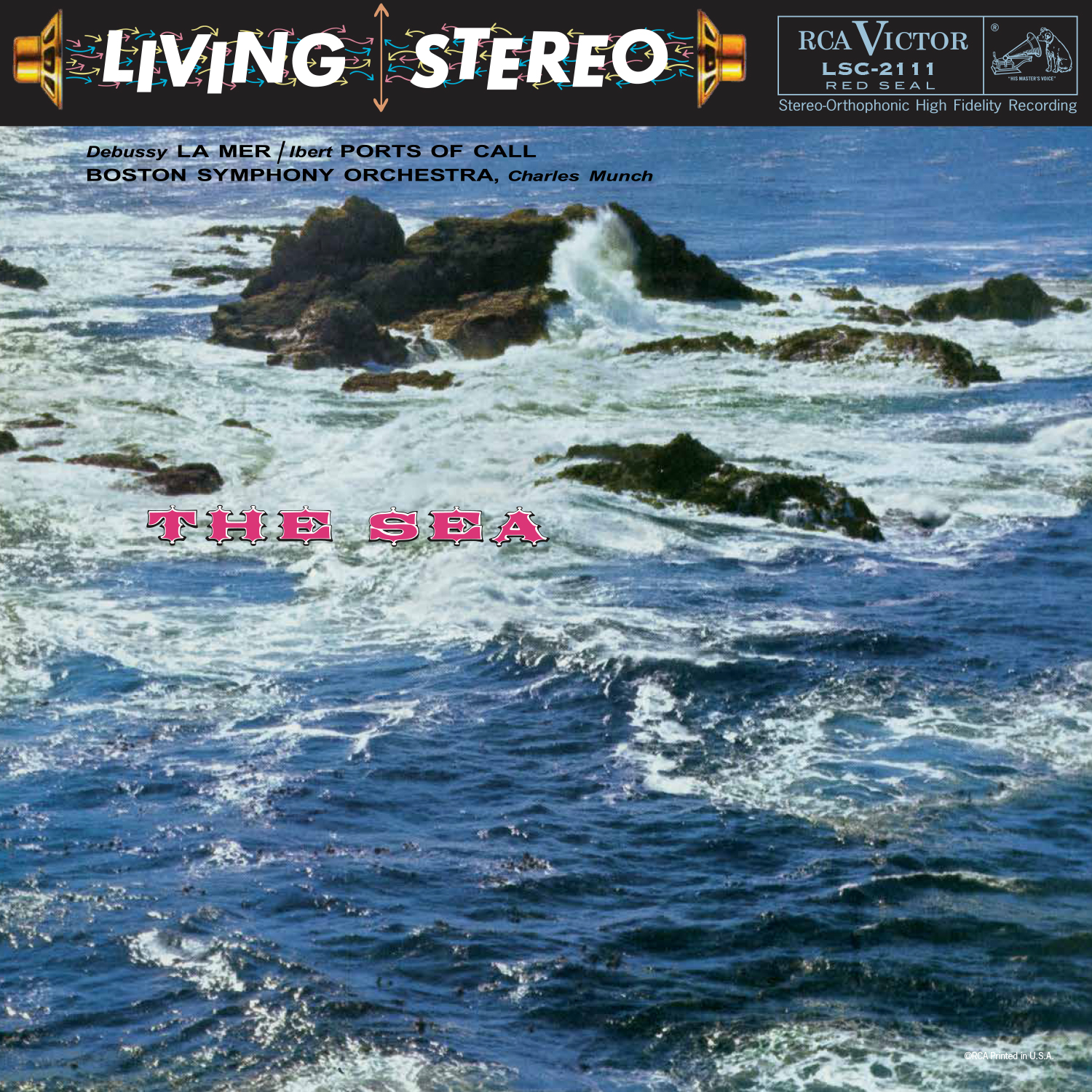
Debussy’s La Mer and Ibert’s Escales belong together without telling the same story about the sea. For Debussy, it becomes the subject of three symphonic sketches: morning light, moving waves and a dialogue between wind and water. Ibert turns towards named places, ports and Mediterranean landscapes. This RCA recording brings both works together under Charles Munch with the Boston Symphony Orchestra. A large and widely familiar orchestral score is paired with a shorter journey possessing colours and a character of its own. The second side is considerably more than an attractive supplement to the first.
Munch was a particularly interesting conductor for this repertoire. Born in Strasbourg in 1891, he initially worked as a violinist and had served as concertmaster of the Leipzig Gewandhaus Orchestra. From 1949 to 1962 he was music director of the Boston Symphony Orchestra. His career thus connected different European traditions with the leadership of a major American ensemble. French music occupied an important place in his repertoire. With Debussy and Ibert, the task involves more than building great climaxes: movement, transparency and the individual colours of instrumental sections are central to the works’ identities.
The recording was made at Boston’s Symphony Hall in December 1956; the stereo LP appeared in 1958 as RCA Victor LSC-2111. Those dates mark different stages of the record’s history. The orchestra had already worked with Munch for several years when the tapes were made. Collecting this title as part of Living Stereo therefore means encountering more than a celebrated technical label. The recording preserves a specific period in a conductor’s relationship with his orchestra, expressed through two works that make his connection with French repertoire particularly clear and allow that partnership to be heard across a complete programme.

Charles Munch, Boston and Ralph Gomberg’s oboe
A large orchestra can easily be perceived as a single name. This coupling encourages closer attention to the individual voices within the Boston Symphony Orchestra. Strings, woodwinds, brass and percussion do not maintain fixed functions throughout. A colour can emerge briefly, pass a movement to another section and then become part of a larger texture again. The conductor’s responsibility is to connect those events into a musical form. Following the movement between instrumental groups consequently reveals something of the architecture of each score, as well as the character of the ensemble performing it.
One player is specifically named as a soloist: Ralph Gomberg, oboe, in Ibert’s Escales. Gomberg was principal oboist of the Boston Symphony Orchestra from 1950 to 1987. That long tenure makes him an important figure in Boston’s orchestral history. Here his name has a direct musical significance, because Ibert gives the oboe a distinctive individual voice. It creates an engaging contrast with the scale of the full ensemble: within a richly coloured orchestral journey, a single wind instrument can draw the attention towards itself and give a passage an unusually personal character.
The oboe is more than an additional colour in this work. In Tunis–Nefta, the second section of Escales, its singing line is central to a particular atmosphere. Ibert drew on impressions of Tunisia for this movement. The music need not be treated as an exact picture of a place for its attraction to be apparent. The interest lies in how an orchestra creates a setting around a solo voice through accompanying figures, layers of sound and the relationship between activity and stillness. Gomberg therefore belongs in the account of this record alongside the conductor, rather than disappearing into an anonymous orchestral credit.
Munch and the Boston Symphony Orchestra perform both scores, enabling a comparison within the same artistic partnership. Debussy’s extended design and Ibert’s shorter character pieces demand different forms of continuity. On one side, motives and movements develop across a broad span; on the other, three named destinations stand beside one another. The instrumental body remains the full orchestra while its tasks change. That distinction gives a complete traversal of both sides a musical purpose, allowing the shared performers to connect two different approaches to the sea without making them sound conceptually interchangeable.

From Debussy’s sketches to Ibert’s ports
Debussy worked on La Mer between 1903 and 1905. Remarkably, part of that work was undertaken in Burgundy, far from the coast. The sea appears here as memory and imagination as well as directly observed nature. A connection with visual art is also tangible: Hokusai’s celebrated wave was used for the score’s cover. Yet the music is not merely an illustration of a picture. It establishes its own unfolding order, in which small movements grow, colours change and larger relationships emerge. That gives the score its fascination beyond any single image of the sea that a listener may bring to it.
De l’aube à midi sur la mer moves from dawn to noon at sea. Jeux de vagues turns towards the play of the waves, followed by Dialogue du vent et de la mer as the third sketch. These titles provide orientation without determining every musical event. One rewarding approach is to listen for transformation. When does a small movement become part of a larger current? Which instruments carry an idea onwards? How does a returning colour change its effect in a new setting? Such questions leave the maritime imagery open while directing attention towards the way the music is built.
The first performance took place in Paris in 1905, given by the Orchestre Lamoureux under Camille Chevillard, and met an initially reserved response. This now-familiar score had to establish its place. Ibert, a generation younger, completed Escales in 1922; its premiere followed in 1924 under Paul Paray, also with the Lamoureux orchestra. His Mediterranean impressions grew out of a journey made in 1921. The three destinations are Rome–Palerme, Tunis–Nefta and Valencia, providing a geography different from Debussy’s sea, which is not tied to a sequence of named ports.
Ibert’s itinerary moves from Italy through North Africa to Spain. Those places are starting points for an orchestral imagination, rather than a claim to offer a complete musical representation of their cultures. Rhythm, melodic character and instrumentation distinguish the destinations from one another. Following La Mer, that change of viewpoint can be especially attractive: the sea remains present while the perspective shifts. The coupling gives a collection two independent works that illuminate each other. Debussy’s expansive sketches and Ibert’s port scenes turn a shared subject into a varied programme, sustained by the same conductor and orchestra.
Living Stereo as a continuous orchestral LP
This Analogue Productions edition carries catalogue number AAPC 2111. Ryan K. Smith at Sterling Sound undertook the remastering and lacquer cutting from the original master tape. The label identifies Gary Salstrom for plating and Quality Record Pressings for manufacturing the 180-gram LP. This is a stereo vinyl record playing at 33⅓ rpm. Those details describe the particular vinyl edition; the separately available SACD is another format. The focus of the LP is the preservation of the complete RCA coupling across two sides, bringing its two orchestral works together in their established programme.
Debussy’s La Mer occupies the first side and Ibert’s Escales the second. That arrangement has a clear musical advantage: each work can be heard without an additional side change interrupting it. Debussy’s three sketches retain their larger span, while Ibert’s three destinations remain a continuous journey. For orchestral music, this is a persuasive reason for choosing 33⅓ rpm. The format supports the shape of the compositions, allowing the natural conclusion of a work to become the appropriate moment to turn the record, rather than inserting a pause within its development.
For lovers of French orchestral music, the recording brings together several rewarding elements: Munch’s Boston years, a major Debussy score, Ibert’s independent orchestral imagination and Ralph Gomberg’s specifically credited solo contribution. For Living Stereo collectors, it is also a reminder that every catalogue number represents musicians, compositions and decisions about a programme. The sea supplies a common horizon. The record’s continuing interest lies in the different ways two composers, interpreted by the same musicians, fill that horizon with music. Its historical identity and its programme belong to the same listening experience.
You order from Michael 45 in Germany. We arrange the US import and dispatch from Hilden.
Also on SACD: Debussy: La Mer (The Sea) / Ibert: Port Of Call
Customer question: Buying Analogue Productions records in Europe
Musicians
Participants and documented credit status. Track references correspond to the tracklist.
- Charles MunchconductorParticipation: Debussy and Ibert
- Boston Symphony OrchestraorchestraParticipation: Debussy and Ibert
- Ralph Gombergoboe soloParticipation: Ibert: Escales


Recorded at Symphony Hall, Boston, December 1956; discographic records give 9/10 December. Original RCA LSC-2111 release: 1958. Original liner notes: John N. Burk. AP remastering/lacquer cutting: Ryan K. Smith, Sterling Sound; plating: Gary Salstrom; pressing: Quality Record Pressings. Original producer and recording engineer remain unconfirmed.

Reviews
There are no reviews yet.