


Chopin’s youthful departure, heard through a long musical life
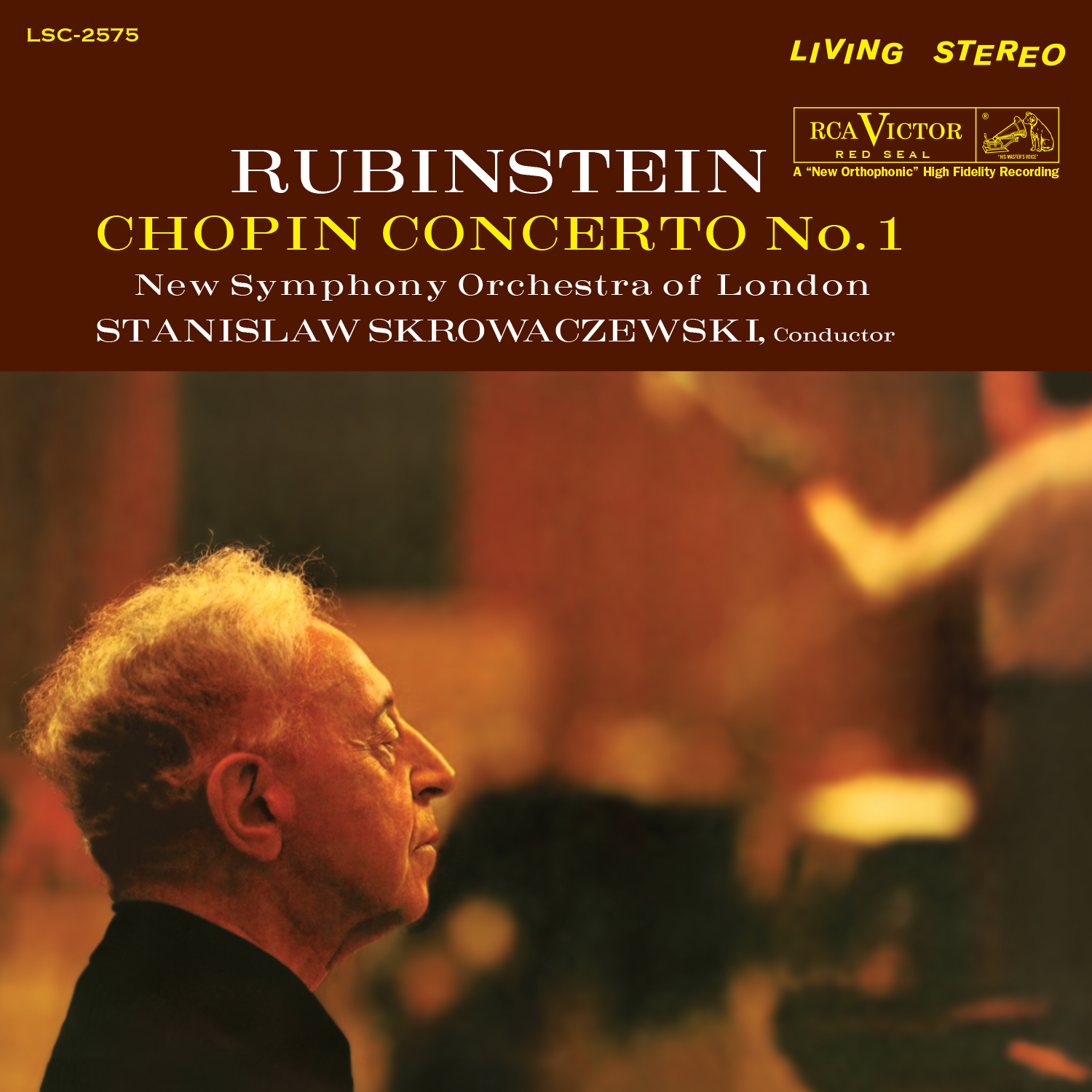
Chopin wrote his First Piano Concerto in 1830, when he was twenty. Arthur Rubinstein recorded it in 1961 with the New Symphony Orchestra of London under Stanisław Skrowaczewski, at the age of seventy-four. The distance between those two ages offers an appealing way into this record: youthful invention interpreted by a pianist whose engagement with Chopin already extended across decades. A work associated with departure and possibility is approached through a long musical biography. That combination gives the recording a distinctive place in Rubinstein’s extensive catalogue.
The conductor belonged to another generation. Born in 1923 in what was then the Polish city of Lwów, Skrowaczewski had become music director of the Minneapolis Symphony in 1960. This English recording belongs to the early years of his American career. He and Rubinstein shared a Polish background, but their experience and circumstances were very different. The meeting is therefore more interesting than a simple national association: a world-famous pianist and a much younger conductor working together at quite different stages of their lives.
The original RCA LP, LSC-2575, names the New Symphony Orchestra of London. That is also the correct orchestra designation for this reissue. Max Wilcox produced the recording, Kenneth Wilkinson was the engineer, and Sol Hurok supplied the original liner notes. For listeners interested in classical records, these are useful identifying details. They place the performance within a particular production history and distinguish it from Rubinstein’s other recordings of the same concerto.
Chopin’s central position in Rubinstein’s repertoire provides a welcoming point of entry, but familiarity need not replace curiosity. A famous name may prompt us to play a record; the lasting interest lies in the questions raised by the music. How much space is allowed to a melody? How does the pulse remain present beneath ornament? How do piano and orchestra respond to one another as the solo part moves between lyrical storytelling and virtuoso activity? Those are questions worth carrying into the performance itself.

The First Concerto was composed second
The numbering can be misleading. The Concerto in E minor, Op. 11, was written after the F minor concerto later published as No. 2. Publication order, rather than composition order, determined the familiar sequence. Chopin himself played the E minor work in Warsaw in October 1830, shortly before leaving Poland. It is dedicated to Friedrich Kalkbrenner. Behind the everyday title “Piano Concerto No. 1” lies a composition from a very particular transition: still closely connected with Warsaw, yet poised at the beginning of an international future.
The Allegro maestoso provides a substantial formal setting for the solo instrument. Listeners who principally know Chopin’s shorter piano pieces encounter a different scale here. The pianist has to do more than shape individual ideas beautifully; those ideas must remain related across an extended movement. The orchestra participates in that framework, establishing connections, assigning weight and changing the perspective on the piano line. A rewarding listening question is where the keyboard seems to continue a thought already under way, and where its entrance changes the direction of the conversation.
The second movement is called Romanze. Larghetto. In a letter, Chopin described its character in terms of calm, melancholy and reverie; the moonlit imagery often associated with it therefore has a biographical foundation. We need not imagine a fixed scene to appreciate the music. More useful is the particular attention demanded by restrained motion. When the outward effect becomes smaller, the length of a phrase and the relationship between ornament and melodic substance become increasingly significant.
Dance comes more clearly into view in the Rondo. Vivace. Its rhythmic world draws on the Krakowiak, a dance associated with the Kraków region. That background directs attention towards the movement’s rhythmic flexibility. Virtuosity here concerns more than the number of fast notes; it also involves shifting accents, lightness and forward movement. Taken together, the three movements make a varied journey: an expansive opening, an inward-looking Romanze and a finale that opens the perspective outwards again.

Rediscovering Rubinstein through a particular partnership
Classical record collections often begin with favourite works. Other performers follow, and eventually perhaps several recordings by the same soloist. This Rubinstein LP can be approached at any of those stages. As a single record, it offers a complete major work by Chopin. Within a Rubinstein collection, it documents his collaboration with Skrowaczewski. Beside performances with other conductors, it becomes an invitation to notice musical relationships without immediately converting every difference into a ranking.
With Chopin it is tempting to concentrate on the right hand and the singing upper line. There is much to gain from occasionally directing attention lower: towards the accompanying motion, the relationship between the hands and the transitions into the orchestra. That is one way a familiar name becomes a concrete listening experience which each listener can explore independently. A record description can suggest this approach without prescribing an emotional response or claiming that one pressing must defeat every alternative.
A comparison with Rubinstein’s Rachmaninoff recording under Reiner is also attractive. There, Chicago in 1956; here, England in 1961. A different conductor and concerto place the pianist in a different musical relationship, with Chopin bringing his own mixture of keyboard lyricism and dance. The records show separate aspects of the same long career. Collecting through these connections can gradually form a personal route across the repertoire, in which the relationship between albums matters as much as completing a numbered reissue series.
The 33⅓ RPM format supports a straightforward listening routine. The three-movement concerto occupies one LP, so following the work does not involve moving through four short sides. A side change remains part of the medium, but the physical process stays manageable. For a concerto built around extended developments, that is a useful practical consideration. Rotational speed cannot substitute for performance or mastering quality, although it does influence the rhythm of an evening spent listening to records.
RCA Living Stereo, recut at Sterling Sound
Analogue Productions issues this recording as AAPC 2575 within its second RCA Living Stereo series. Ryan K. Smith cut the lacquers at Sterling Sound, with the publisher specifying the original two-track master tapes as the source. Pressing is handled by Quality Record Pressings. The edition offered here is a stereo LP at 33⅓ RPM. Those details distinguish it from other formats and earlier reissues rather than treating every release of the same performance as interchangeable.
The Stoughton jacket refers back to the original RCA presentation. That physical connection is part of the attraction: a historical recording returns through contemporary manufacture while retaining a visible relationship to its LP past. For collectors, the sleeve and printed credits are more than a protective wrapper. They make the work and its participants available as a coherent object. The period styling should nevertheless be understood as a reproduction presentation, not as evidence that the record itself is an original 1961 pressing.
The weight specifications require some distinction. An earlier Analogue Productions edition is documented at 200 grams, whereas the publisher currently lists the product as a 180-gram LP. These statements refer to different records of the edition; the precise physical specification depends on the individual copy. AAPC 2575, the stereo performance and Ryan K. Smith’s cut provide more reliable reference points for its musical and technical identity than a blanket statement covering every production batch.
The meeting of the musicians remains the essential reason to make room for the record. A young Chopin composed this concerto shortly before leaving his homeland. More than a century later, Rubinstein returned to it with a conductor whose own international life had recently changed direction. Those connections need not occupy every moment of listening. They do, however, give a familiar composition additional depth and make the reissue an invitation to spend fresh time with it.
You order from Michael 45 in Germany. We arrange the US import and dispatch from Hilden.
Customer question: Buying Analogue Productions records in Europe
Musicians
Participants and documented credit status. Track references correspond to the tracklist.
- Arthur RubinsteinpianoParticipation: all movements
- Stanisław SkrowaczewskiconductorParticipation: all movements
- New Symphony Orchestra of LondonorchestraParticipation: all movements


Recorded in England, 1961. Producer: Max Wilcox; engineer: Kenneth Wilkinson. Original liner notes: Sol Hurok. AP lacquer cutting: Ryan K. Smith, Sterling Sound; pressed at Quality Record Pressings. The work listing gives the three movements without assigning unconfirmed LP side breaks.

Reviews
There are no reviews yet.