
Two musicians, one evening in Kansas
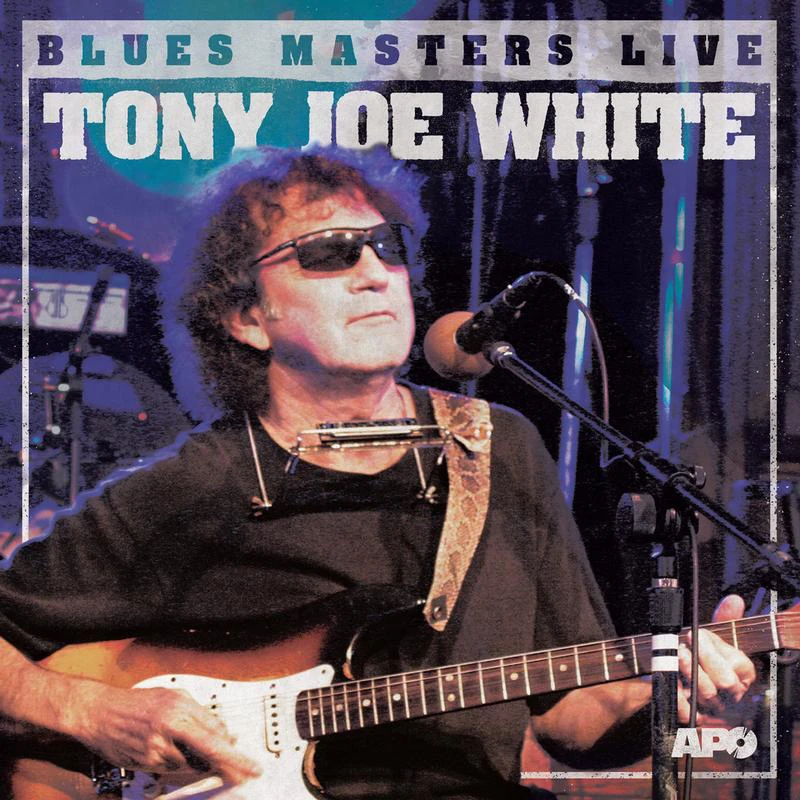
Tony Joe White brings a compact line-up to this concert recording: his voice, electric guitar and harmonica, with Marc “Boom Boom” Cohen on drums. The date is October 18, 2003; the setting is Blue Heaven Studios in Salina, Kansas, during the sixth Blues Masters at the Crossroads. Blues Masters Live presents nine songs from that evening. They introduce a songwriter through his own repertoire, taking in the widely familiar “Polk Salad Annie” alongside selections that have travelled less widely beyond his regular audience.
That small line-up offers a useful way into the record. A singer who also plays guitar has a particular relationship with a drummer: attention can move between the words, the guitar part and the rhythmic accompaniment. White’s harmonica adds another voice to that exchange. As you work through the programme, those relationships are something to listen for. There is no need to arrive with a complete knowledge of his catalogue. The concert brings the songs together in a setting where their author is also their performer.
Chad Kassem was playing this recording to visitors long before it became an album. The announcement for the series describes it as a favourite demonstration recording of his since 2003. Kassem himself wrote the liner notes for White’s release. His recollections accompany the performance, while the record gives listeners an opportunity to encounter the evening on their own terms.

Familiar songs in their writer’s company
White’s work reached audiences well beyond the people who bought his own records. “Polk Salad Annie” gave him an American Top Ten hit in 1969, while Brook Benton made “Rainy Night in Georgia” widely known the following year. The latter is not included on this LP. That distinction helps explain the programme: Blues Masters Live captures selections from a particular concert, with its own sequence and balance of familiar and less familiar material. It invites attention to an evening rather than a checklist of famous compositions.
Side A opens with “Rich Woman Blues”, followed by “Willie And Laura Mae Jones”. Kassem singles out the latter in the release announcement as a performance to which he has repeatedly returned. Next come “Undercover Agent For The Blues”, “Do You Have A Garter Belt” and “Rico”. Even their titles offer different entrances into the programme: named characters, a direct question and the suggestion of a concealed identity. Listening across the side allows those individual pieces to find a larger context.
“Steamy Windows” opens side B, before “Even Trolls Love Rock And Roll” and “Tunica Motel”. “Polk Salad Annie” closes the record. Many listeners will also associate “Steamy Windows” and “Undercover Agent For The Blues” with Tina Turner; White’s biographical account lists both among the songs he wrote that became known through her. Here they sit within their writer’s own concert repertoire. That change of perspective provides a reason to revisit familiar material: a song’s public life can encompass several performers, while an evening such as this brings its author back into view.
The church behind the recording
Blue Heaven’s setting matters to the history of this performance. The studio occupies a restored Gothic-style church. According to the official announcement, its sanctuary was designed to carry a preacher’s unamplified voice throughout the room. That original purpose helps explain why the building became a place for recording and performance. With musicians and an audience sharing the space, the room is part of the occasion, something that an equipment list alone cannot convey.
Blues Masters at the Crossroads ran from 1998 to 2018. Through the Blues Masters Live releases, Acoustic Sounds is opening its archive of previously unreleased recordings from those concerts. White’s performance dates from 2003; the companion Tab Benoit release documents October 19, 2002. The two albums share a venue and connections to Louisiana music, while preserving separate programmes and musical relationships. For White, the central relationship is the duo with Cohen. Keeping those evenings distinct is part of understanding what each record actually documents.
Engineers David Baker and Katsuhiko “Katsu” Naito recorded White live to two-track, using half-inch analogue tape running at 15 inches per second. In this recording approach, the balance feeding the two tracks is captured as the performance takes place. The announcement specifically describes the room’s natural acoustic environment as part of what the engineers preserved. These details establish the route from concert to tape without identifying every microphone or the exact tape machine used that night.

An archive performance on vinyl
Matthew Lutthans mastered this edition at The Mastering Lab from the original analogue master tapes. Issued by APO Records as AAPO 1002, it is a single 180-gram LP running at 33⅓ RPM, pressed at Quality Record Pressings. The packaging is a direct-to-board gatefold jacket. The concert and the manufacture of this edition belong to different moments: a new record gives access to an archived performance, with October 18, 2003 remaining the date at the centre of its story.
One published response comes from Michael Fremer, whose review is excerpted on the Acoustic Sounds product page. He awards the release 11 out of 11 for both music and sound. Those scores express his assessment. Your own starting point can be simpler: follow the nine songs through the two sides, attend to the two performers and consider how the sequence holds together as a document of an evening.
More from Tony Joe White: The album Tony Joe White is also offered as a 45-RPM edition (AAPR 026-45) and on SACD (CAPR 026 SA). For another performance from the same series, explore Tab Benoit – Blues Masters Live.
Customer question: Buying Analogue Productions records in Europe

Reviews
There are no reviews yet.