
A concerto in which the whole orchestra can step forward
A concerto usually brings an individual soloist to mind: the violinist standing before the orchestra, the grand piano between conductor and audience, or a single voice asserting itself against a larger body of sound. Béla Bartók’s Concerto for Orchestra distributes attention differently. The roles keep changing. One instrumental group emerges from the collective texture, becomes another group’s counterpart and returns to the ensemble. This is more than an opportunity to display the accomplishments of a large orchestra. Bartók makes the relationships between his players into the musical action itself. Virtuosity resides in passing something on as much as in stepping forward.
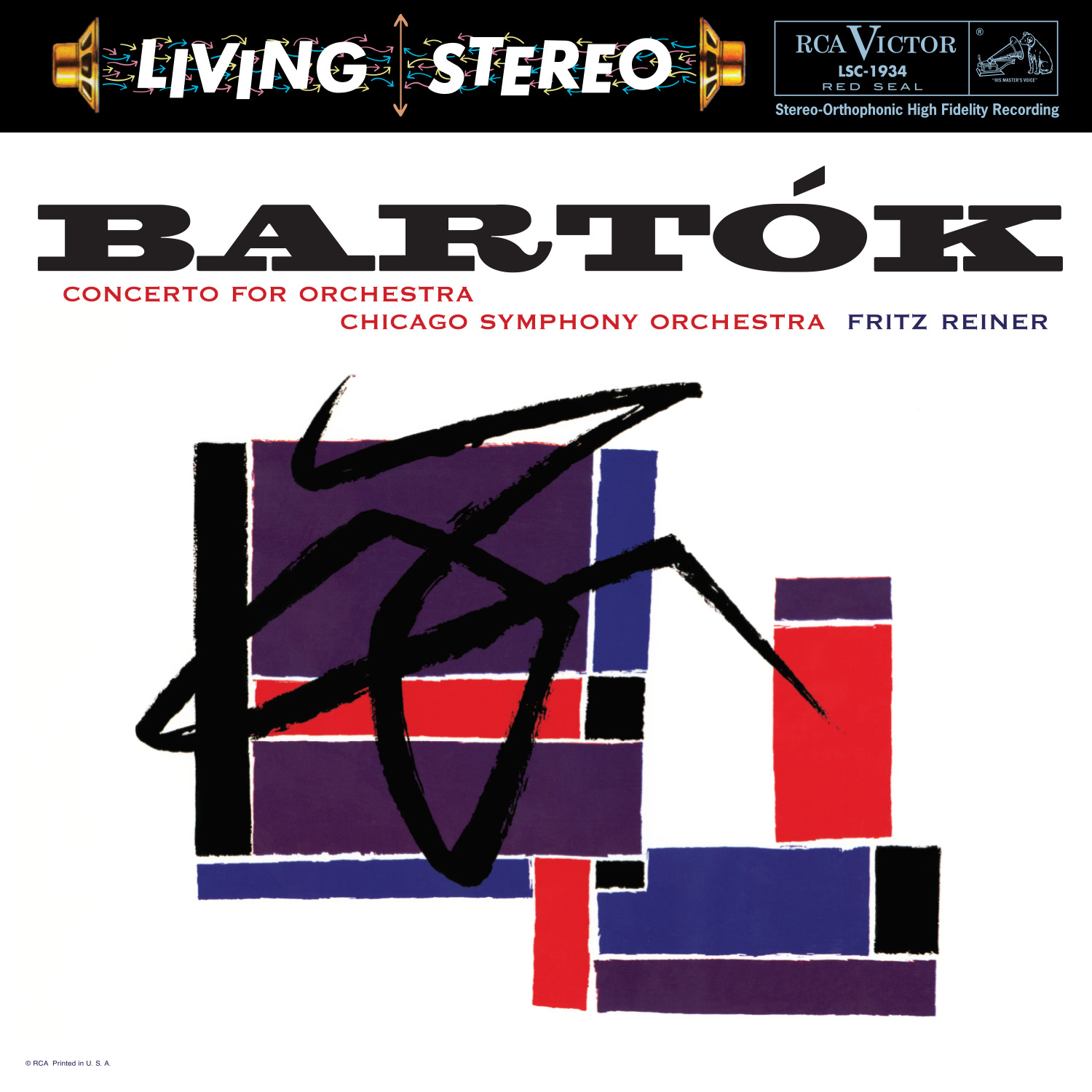
Fritz Reiner and the Chicago Symphony Orchestra recorded the work on October 22, 1955, at Orchestra Hall in Chicago. Richard Mohr produced the session and Lewis Layton was the recording engineer. The performance therefore belongs both to the early history of RCA stereo and to a particularly productive period in the partnership between Reiner and his Chicago orchestra. The connection with the composer reaches much further back than these tapes. Reiner had been Bartók’s pupil and knew his musical world through direct personal contact. His relationship with this score did not begin when he first opened it on the conductor’s desk.
For a collection, the intersection of these histories is particularly rewarding: a work from Bartók’s American years, a Hungarian conductor with a personal connection to its composer, and an American orchestra whose ensemble playing under Reiner attracted considerable attention. There is no need to turn that combination into a competition with every subsequent recording. It is more interesting to discover how this particular partnership meets the score’s constantly changing demands. A clearly defined entry, a supple woodwind answer or a phrase ending together can reveal as much as a large climax. The recording invites listeners to understand a substantial ensemble through the smaller relationships within it.

From a difficult period of life to a new orchestral work
Bartók composed the concerto in the United States in 1943. Illness and the difficult circumstances of his American exile shaped that period. Serge Koussevitzky’s commission gave him an opportunity to undertake another major orchestral score, following advocacy on his behalf by Reiner and violinist Joseph Szigeti. The composition took shape between August and October at Saranac Lake in New York State. Koussevitzky conducted the premiere on December 1, 1944, with the Boston Symphony Orchestra. That Boston beginning and the later Chicago recording are separate stages in the work’s history, connected here without being confused with one another.
The five movements form a broad trajectory. The Introduzione opens a grave, initially searching space before the movement gathers force. The presentation of instrumental pairs follows, with the Elegia providing the slow centre. The Intermezzo interrotto does more than name an interruption to an apparently orderly sequence, while the Finale places the accumulated energy in a new setting. Bartók himself described a progression from the stern beginning and the mourning of the third movement towards affirmation at the close. That direction offers a useful first approach without reducing the individual movements’ ambiguities to a simple illustrative programme.
Bartók revised the ending in 1945. Even during his final year, the shape of a work soon to become one of his best-known orchestral compositions remained an active concern. Reiner’s recording followed a decade after the composer’s death. It is neither a premiere recording nor a document of Bartók himself conducting. It is an independent interpretation of a score that had already entered public musical life. Making that distinction does not diminish the personal connection. Proximity to the composition’s origins and the later practical work of shaping it with another orchestra meet in this particular performance.

Pairs, interruptions and the art of playing together
The second movement offers an especially clear introduction to Bartók’s orchestral thinking. Bassoons, oboes, clarinets, flutes and muted trumpets appear in pairs. Each pair has its own colour, but also a different interval between its two voices. Listeners who prefer not to follow a score can nevertheless hear the organisation closely: first notice the arrival of a new pair, then the relationship between its two lines. The side drum establishes a recognisable frame. A succession of apparently small appearances becomes a carefully organised form whose wit depends on the precision of the participants.
The Elegia redirects attention. Instruments no longer appear primarily as contrasting pairs; lines, colours and decays create another kind of relationship. A useful listening approach is to distinguish foreground from surrounding texture. Which voice leads at a particular moment, which prepares its entry and which remains after it has passed? In the Intermezzo interrotto, the intrusion into the proceedings becomes an event in its own right. An apparently familiar course is knocked out of order. The contrast does not require a memorised interpretation to register. It can be followed directly as a change in the way musical ideas behave towards one another.
The Finale demands agility from the complete ensemble. Quick-moving lines, transferred motifs and large collective gestures need to come together without their detail disappearing beneath sheer volume. Reiner’s Chicago performance is consequently a welcome invitation to shift the focus of attention on successive hearings. The strings might take priority once, the exchanges between wind instruments next time, or the percussion’s contribution to the overall shape. Reiner and the Chicago Symphony Orchestra are securely identified performers here; a complete list of every desk at this session has not been reconstructed retrospectively from general orchestra rosters. The work honours many individual players, even where the album documentation does not name them separately.
The 33⅓ RPM edition: five movements on one record
This Analogue Productions edition carries catalogue number AAPC 1934 and belongs to its reissue programme of RCA Living Stereo recordings. The publisher credits Ryan K. Smith at Sterling Sound with remastering and cutting at 33⅓ RPM from the original master tape. The underlying recording is two-track, and the LP is stereo. Gary Salstrom is named for plating and Quality Record Pressings for manufacture. The specific product listing describes 200-gram vinyl. These details concern the single LP and should not be merged with the production credits for the subsequent double-LP edition.
The distinction from the separately available 45 RPM release is particularly important. That edition involves two records and different mastering; AAPC 1934 without the “-45” suffix presents the work on a single LP. For listeners who want to follow Bartók’s broad progression with fewer interruptions, the format has an understandable appeal. Five movements remain parts of a connected work, with only one side change required. A higher speed is not automatically the more suitable choice for every listening session. Careful manufacture, the preferred way of hearing the music and the precise identity of the edition belong together when making a selection.
The programme is the Concerto for Orchestra. Bartók’s Music for Strings, Percussion and Celesta is a separate recording and is not an additional work on this LP, even though related releases sometimes place the compositions together. Keeping the identification clear prevents false expectations and leaves attention on what this record actually offers: Reiner’s 1955 Chicago performance, five individually shaped movements and an orchestra turning its soloistic possibilities into a shared language. You order from Michael 45 in Germany. We arrange the US import and dispatch from Hilden.
Artist page: All titles by Fritz Reiner
Customer question: Buying Analogue Productions records in Europe
Musicians
Participants and documented credit status. Track references correspond to the tracklist.
- Fritz ReinerPortrait reference 1958conductorParticipation: All five movements
- Chicago Symphony OrchestraorchestraParticipation: All five movements; individual players unconfirmed
- Béla BartókExisting album illustration; composercomposer; not a performer on this recordingParticipation: Work composed in 1943, ending revised in 1945


Chicago, Orchestra Hall, October 22, 1955, from the previously checked P22/P41 source record; Richard Mohr: producer, Lewis Layton: engineer. Concerto for Orchestra only, five movements. Bartók is credited as composer, not performer. Individual orchestral players unconfirmed.

Reviews
There are no reviews yet.