

A symphony that keeps its secret until the end
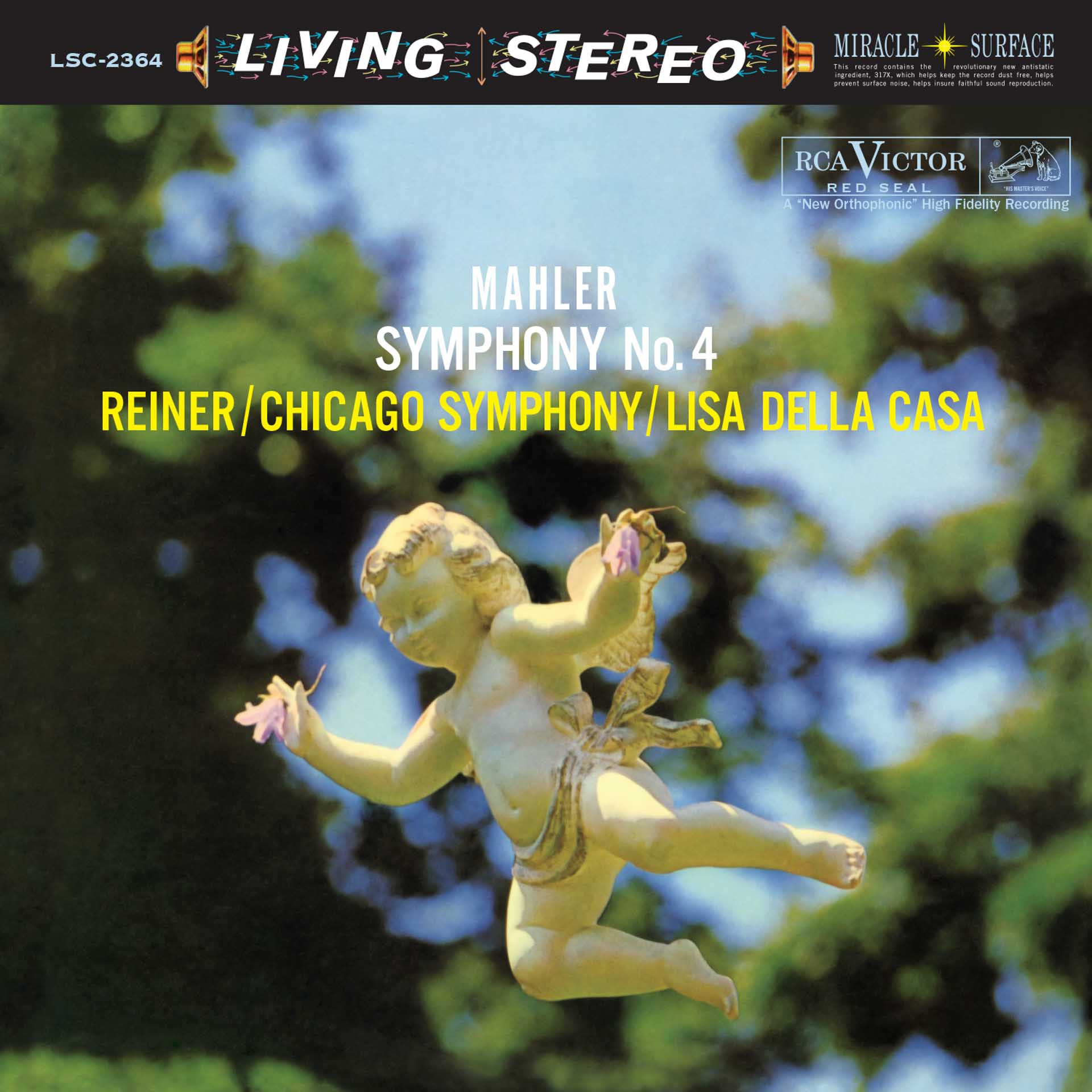
Gustav Mahler’s Fourth Symphony does not begin with the human voice. It lets us enter an orchestral world for three movements before a soprano tells of the pleasures of heavenly life in the finale. On this RCA recording, Lisa Della Casa takes that role, with Fritz Reiner conducting the Chicago Symphony Orchestra. The combination is more than a list of celebrated names. A work whose apparent simplicity repeatedly invites questions meets an orchestra and conductor whose partnership helped shape the history of RCA Living Stereo.
The recording was made in Orchestra Hall, Chicago. Richard Mohr is credited as producer and Lewis Layton as recording engineer. The stereo LP appeared in 1960 as LSC-2364, alongside the mono edition LM-2364. Its release year should not be confused with an established session date: the documentation consulted for this edition does not securely identify the recording day. The musical setting is clear, however. Reiner had taken charge of the Chicago Symphony Orchestra in 1953 and was developing the repertoire that now forms an important part of a Living Stereo collection.
Mahler composed the symphony principally in 1899 and 1900, but its final movement draws on “Das himmlische Leben”, a song written in 1892 to a text from Des Knaben Wunderhorn. In important respects, the ending therefore existed before the symphony reached its final form. That offers a rewarding point of entry. The voice arrives late, but the world it describes belongs to the work’s imaginative centre from the outset. The finale is not a vocal number added after the instrumental argument; it changes the listener’s perspective on what has already happened.
The Fourth was first performed on 25 November 1901 in Munich, by the Kaim Orchestra under Mahler, with Margarete Michalek as soloist. Listeners expecting the large forces of some other Mahler symphonies encounter a comparatively modest ensemble. There are no trombones or tuba, while instruments including sleigh bells and glockenspiel introduce distinctive colours. Less low brass does not mean less expression. It gives attention another way to travel between individual parts, between a seemingly familiar melodic gesture and the moment when its significance begins to change.

Lisa Della Casa and the Wunderhorn perspective
Lisa Della Casa sings in the fourth movement, rather than throughout the symphony. The Swiss soprano was particularly associated with Mozart, Richard Strauss and song. That relationship between stage experience and concentrated attention to words provides useful background to her participation in Mahler’s finale. The voice presents what appears to be a child’s view of the afterlife, bringing together food, dancing, music and some decidedly unusual heavenly events. Its character cannot be described solely through the beauty of an extended vocal line. The smaller transitions between word, phrase and orchestral response matter just as much.
The text is neither a liturgical profession of faith nor a description of an entirely straightforward paradise. Mahler’s decision to place it at the end of a symphony invites us to take its apparent innocence seriously while also noticing its disruptions. Follow the words first, then return with more attention to the instruments accompanying particular thoughts. Which colours seem to continue the vocal expression? Which add a comment of their own? The relationship between soprano and orchestra makes the movement more than a gently reassuring conclusion.
Della Casa’s career led from Zurich Opera and the Salzburg Festival to international recognition. She sang Zdenka in Strauss’s Arabella in Zurich in 1946, appeared at Salzburg in 1947 and made her Vienna State Opera debut that same year. Such milestones do not allow a performance to be deduced from a biography. They do give her participation a human context: this is an experienced interpreter of characters and texts whose name deserves more than an incidental place after the symphony’s title. Her contribution occupies only one movement and remains essential to the whole design.
Reiner, too, merits a closer view than a simple description of a demanding orchestral disciplinarian. The Fourth repeatedly challenges the relationship between clarity, motion and continuity. An individual accent gains meaning from its surroundings; a line needs room without allowing the larger course to dissolve. One useful approach is to follow transitions rather than concentrating only on climaxes. How does the orchestra move from one character to another? Where is an idea handed between players, and when does the music seem to begin again?

Four movements with different responsibilities
The opening movement is marked “Bedächtig, nicht eilen”: deliberate, without hurrying. Those words already challenge the idea that musical direction must be established through continuous intensification. Listen to the way returning ideas acquire different surroundings and can consequently seem changed. Orchestral colour forms part of the storytelling. A familiar melody may develop another kind of tension when it appears in a new setting. This provides an approach to the work that requires neither a score nor a reduction of the music to a series of picturesque incidents.
The second movement follows with “In gemächlicher Bewegung, ohne Hast”. Its marking describes movement that has time to unfold; it does not promise uninterrupted comfort. Compared with the opening movement, the articulation of the strings and the relationship between dance impulse and interruption are particularly useful points of attention. The third, “Ruhevoll”, opens a different span of musical time. Here the ear can stay with the length of a phrase, the preparation of an entry or the changes developing within an initially consistent character.
Only in the fourth movement, “Sehr behaglich”, does Della Casa’s soprano enter. That does not turn the preceding movements into a mere prelude. Instead, it invites a question about the connection between those instrumental experiences and the sung conclusion. On a first hearing, simply following these four different responsibilities as one progression is enough. Later encounters can bring individual voices and transitions forward. A familiar recording can retain its place in a collection through precisely this kind of attention, rather than through repeated visits to a few spectacular minutes.
For followers of RCA Living Stereo, the album also broadens the picture of Reiner’s Chicago work. The subject here is not simply orchestral weight, but a piece with deliberately limited forces and a solo voice held back until late in the design. Reiner, the Chicago Symphony Orchestra, Della Casa, Mohr and Layton give the record a specific history of collaboration. That is a starting point for comparison with other performances, not an advance ranking. Listening can determine how this partnership holds Mahler’s shifting perspectives together.
One Living Stereo LP at 33⅓ RPM
The edition offered here is AAPC 2364 from Analogue Productions, a single stereo LP at 33⅓ RPM in the second RCA Living Stereo reissue series. The publisher identifies the original three-track master tapes as the source and credits Ryan K. Smith at Sterling Sound with remastering and cutting. Gary Salstrom is named for plating and Quality Record Pressings for manufacture. The presentation includes a Stoughton tip-on jacket and follows the historical RCA appearance. These reissue responsibilities remain separate from Mohr and Layton’s work on the original recording.
The practical format choice is straightforward: the complete symphony occupies one LP. That means one side change across the programme and a compact edition for the collection. With a work whose connections develop over a long span, this can be an appealing way to play it regularly in full. It does not establish a universal sonic advantage for 33⅓ over another speed. The particular edition and the listener’s way of engaging with the work remain decisive. The accompanying work listing identifies all four movements without inventing an unverified allocation to record sides.
Analogue Productions currently describes the pressing as 180 grams. The earlier numbered 2019 edition is documented at 200 grams. Those release specifications are not equivalent to weighing every stocked copy, and no particular numbering is promised here. For collectors, AAPC 2364, the Sterling Sound cut and the single stereo LP provide the more useful identification points. They make the edition clear while leaving room for the musical journey from the opening orchestral exchanges to Della Casa’s final words. You order from Michael 45 in Germany. We arrange the US import and dispatch from Hilden.
More by Fritz Reiner: Ravel: Pictures at an Exhibition / Moussorgsky · Respighi: Pines of Rome & Fountains of Rome
Artist page: All titles by Fritz Reiner
Customer question: Buying Analogue Productions records in Europe
Musicians
Participants and documented credit status. Track references correspond to the tracklist.
- Fritz ReinerconductorParticipation: Album personnel
- Lisa Della CasasopranoParticipation: IV
- Chicago Symphony OrchestraorchestraParticipation: Album personnel


Orchestra Hall, Chicago; recording date unconfirmed. Richard Mohr, producer; Lewis Layton, engineer. Lisa Della Casa: soprano in the fourth movement. AP: Ryan K. Smith, Sterling Sound; QRP. Movement listing without unverified LP side assignments.

Reviews
There are no reviews yet.