Three players, with room between the notes
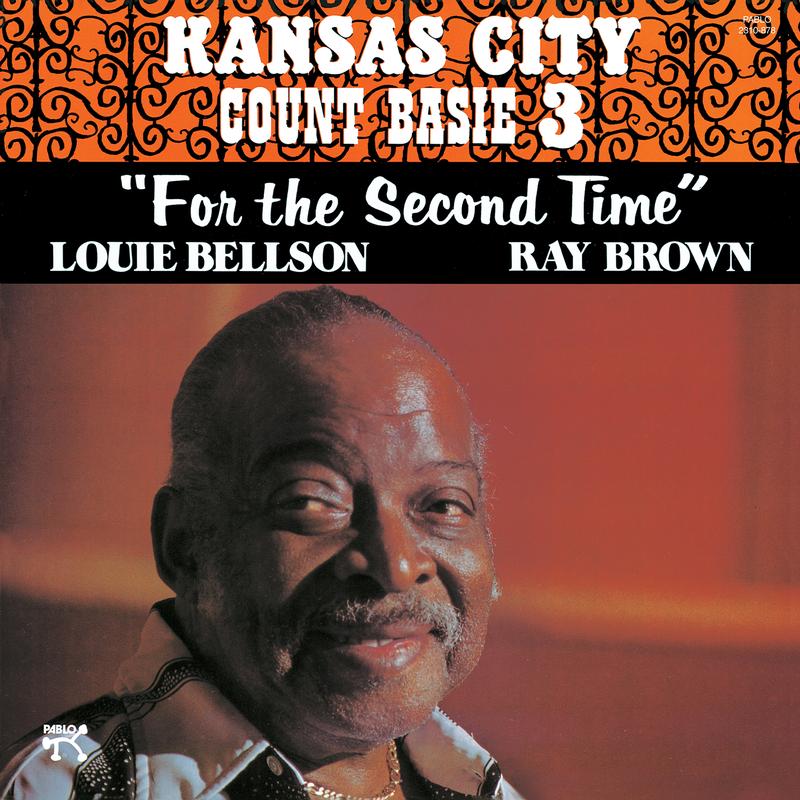
Count Basie's name can summon an entire orchestra: brass sections arriving together, a rhythm section setting the pace, and arrangements that establish their identity within a few bars. For The Second Time brings the pianist into a much smaller setting. Ray Brown plays double bass and Louie Bellson plays drums. That is the whole ensemble. The attraction lies in what this scale makes possible. Basie's economical gestures have room around them, while his partners help determine where the music goes. The piano can suggest, answer and interrupt without having to supply the weight of an absent orchestra.
The session took place at Cherokee Studios in Los Angeles on August 28, 1975. Basie had celebrated his seventy-first birthday a week earlier; Brown was forty-eight and Bellson fifty-one. Norman Granz produced the recording, with Ed Greene engineering. Behind the modest lineup stood decades of experience in orchestras, small groups and recording studios. The album itself arrived on Pablo in 1983, roughly eight years after the musicians had played it. Its title points back to an earlier meeting: the same trio recorded For The First Time in 1974. Here they returned with eight different pieces and the familiarity of musicians who already understood one another's working language.

Four blues and four familiar songs
The programme has an appealing balance. Basie and Brown share the composition credits for “Sandman”, “Draw”, “Blues For Eric” and “Racehorse”. Four standards occupy the remaining places. That gives the trio two related starting points: its own concise blues material and songs already carrying a long public history. A blues provides a recognisable framework in which the smallest change can acquire significance. A standard brings a melody that listeners may continue hearing even when the players merely imply it. Both suit a group whose conversation depends as much on timing and expectation as on the number of notes being played.
“If I Could Be With You One Hour Tonight” reaches particularly far into Basie's background. Its composer, James P. Johnson, was among the pianists Basie encountered during his early years in Harlem. “On The Sunny Side Of The Street”, “The One I Love Belongs To Somebody Else” and “I Surrender, Dear” also belong to a repertoire established well before this recording date. These are songs the musicians could approach through long acquaintance. Familiarity becomes a source of flexibility: an abbreviated phrase or a delayed entrance can make sense because the shape of the tune remains available in the listener's memory.

Brown and Bellson as full partners
Brown had spent many years helping define Oscar Peterson's trio and had recorded extensively for Granz's labels. Bellson's orchestral experience included work with Benny Goodman and Duke Ellington. All three musicians therefore knew how a large ensemble generated momentum, and all three could bring that understanding into a setting with very few moving parts. The Kansas City 3 name places this record alongside Basie's Pablo projects for small, changing lineups. Here it directs attention to the pianist and his two colleagues, with every musical role exposed and every exchange available to follow.
One useful way into “Sandman” is to treat the bass as a melodic line in its own right, then return to the track and follow Basie's responses. On another pass, listen for the way Bellson organises the movement between them. This kind of changing focus suits a record built from readily accessible material and close ensemble relationships. The LP contains the original album's eight selections. Two additional performances from the same session, “Love Me Or Leave Me” and “Madame Fitz”, appeared later on Basie And Friends. This release preserves the particular sequence assembled for For The Second Time, rather than expanding it into a complete-session collection.
The Analogue Productions edition
This edition is AAPJ 166, part of the Analogue Productions Pablo series, presented on one 180-gram LP playing at 33⅓ rpm. Matthew Lutthans handled the mastering at The Mastering Lab. According to the publisher, an unmixed four-track session tape was mixed to stereo during the cutting process. That is a specific feature of this reissue: the source described is the session tape with its separate tracks. The musical programme remains the eight-track album, while the mastering work concerns how those performances are presented on this particular release.
Quality Record Pressings manufactures the record, and Stoughton Printing supplies the single-pocket tip-on jacket. The catalogue number is useful when comparing editions, since an earlier Analogue Productions release spread the album across two 45 rpm records and carried different mastering credits. AAPJ 166 identifies the single-LP version described here, with Lutthans' mastering. It offers a compact encounter with Basie's later small-group work: four standards, four blues and three experienced musicians working within a format that leaves their choices unusually easy to follow. The album's scale is small; the shared history behind each player gives that scale its substance.
You order from Michael 45 in Germany. We arrange the US import and dispatch from Hilden. Editions not currently in stock are dispatched after the goods arrive.
Customer question: Buying Analogue Productions records in Europe
Series: Pablo – all 30 records, musicians and the session book
Musicians
Participants and documented credit status. Track references correspond to the tracklist.
| Name | Instrument / role | Participation |
|---|---|---|
| Count Basie | piano | Album personnel |
| Ray Brown | double bass | Album personnel |
| Louie Bellson | drums | Album personnel |
Trio on all eight album tracks. Louie Bellson is credited as Louis Bellson on the sleeve.

Reviews
There are no reviews yet.