One voice, one guitar, nine encounters
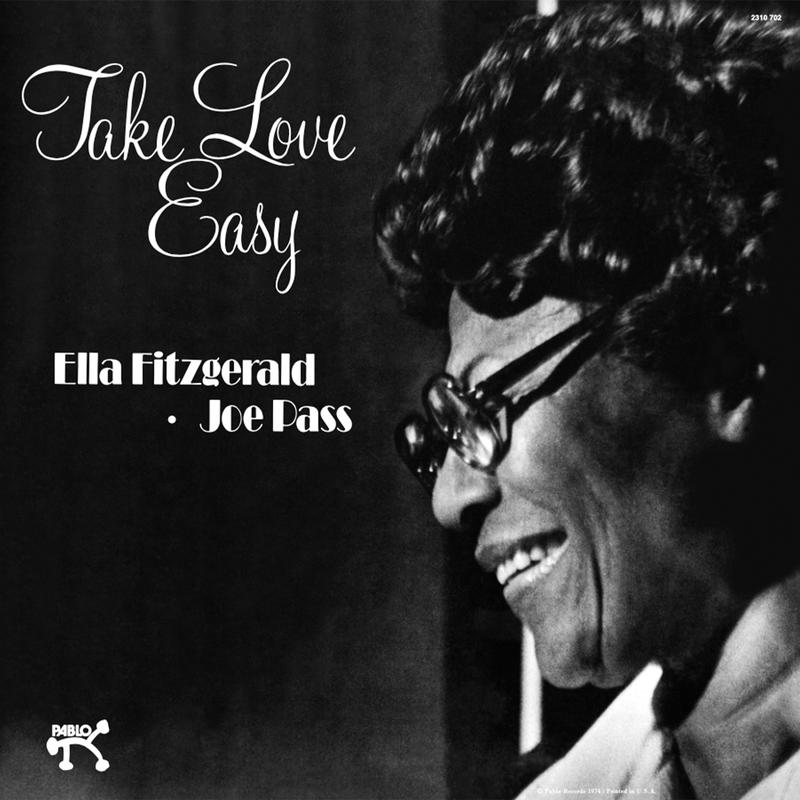
On Take Love Easy, Ella Fitzgerald and Joe Pass perform without an additional rhythm section. The ensemble is small, but its responsibilities are considerable. The guitar has to provide harmonic continuity, movement and responses to the singing, while Fitzgerald works without a permanently fixed backdrop of supporting instruments. That creates an inviting approach to nine familiar songs. Follow the moments when both musicians carry an idea together and those when one leaves room for the other. The reduced instrumentation does not diminish the repertoire. Instead, it reveals how many decisions can take place between just two independent musical voices.
The recordings were made in Los Angeles on August 28, 1973, with Norman Granz producing. A specific studio is not securely identified in the sources consulted. The date is nevertheless remarkable: the Pablo discography also lists Pass’s solo recordings for Virtuoso on the same day. Two important aspects of his work sit immediately alongside each other, the independent construction of a guitar performance and the exchange with a singer. Take Love Easy became the first of the pair’s four studio albums. This was the beginning of a collaboration that continued for more than a decade, rather than a chance combination confined to one release.

Familiar songs, responsibilities redistributed
Fitzgerald already had experience with very small ensembles, including her recordings with pianist Ellis Larkins. Nor was Pass a completely new partner: he had played in Tommy Flanagan’s quartet for her Carnegie Hall appearance in July 1973. For this studio album, the other instruments disappear. The relationship between song and accompaniment consequently changes. A guitar chord can signal the next harmonic movement while also commenting on a sung phrase. The duo exposes those possibilities without requiring every selection to adopt the same solution. Both players bring extensive knowledge of standards into the exchange, making recognition a starting point for further invention.
The title song comes from Beggar’s Holiday, Duke Ellington’s musical with lyrics by John La Touche. Billy Strayhorn contributed orchestrations to that production, and his own “Lush Life” also appears on the first side of the record. The programme thus connects two different paths through the Ellington circle. “Don’t Be That Way” adds another historical link: its composer Edgar Sampson played in Chick Webb’s orchestra before Fitzgerald began her career there. Such connections make the repertoire personal without turning the album into a retrospective exercise. Guitar accompaniment establishes a setting quite different from the large orchestras many listeners associate with Fitzgerald.

Broadway, Brazil and the jazz repertoire
“Once I Loved” leads to Antônio Carlos Jobim, Vinícius de Moraes and Ray Gilbert’s English lyric. Alongside this Brazilian song are “You’re Blase”, “You Go To My Head” and Billy Eckstine’s “I Want To Talk About You”. The selection cannot be reduced to a single composer or period. Its continuity comes from the two interpreters. Listen to the beginnings: how is a melody introduced, how much harmonic ground does Pass establish beneath it, and when does an accompanying figure begin to pursue a direction of its own? Each song allows those questions to be answered differently, keeping the relationship flexible across the programme.
Side two opens with “A Foggy Day”, which Fitzgerald had already recorded with Louis Armstrong and for her Gershwin Songbook. The same composition now occupies another instrumental environment. “Gee Baby, Ain’t I Good To You” and “You Go To My Head” extend the sequence before “I Want To Talk About You” brings it to a close. Nine selections are enough to demonstrate the duo’s range. Their purpose is not to replace earlier versions. The interest lies in how a recognisable song retains its outline while responding to a changed relationship between voice and guitar, with no additional players to mediate that exchange.
The Analogue Productions Pablo edition
Catalogue number AAPJ 159 belongs to the first Analogue Productions Pablo reissue programme. This is a single 180-gram LP running at 33⅓ RPM. Matthew Lutthans handled the mastering at The Mastering Lab, with the publisher identifying the original analogue master tape as the source. Documented runout inscriptions correspond to the new cut prepared for this release. It should therefore not be automatically grouped with earlier Pablo reissues or releases using existing metal parts. The duo was recorded in 1973; the mastering of this LP belongs to the subsequent history of that recording.
Quality Record Pressings is specified as the pressing plant, and Stoughton supplies a single-pocket tip-on sleeve. A gatefold is not promised for this edition. The first 250 numbered copies in the programme were reserved for subscribers, which does not make every offered copy numbered. The original technical credits also require care: the recording engineer is named as Rafael Valentin and should not be confused with Val Valentin. The LP retains the original nine-track sequence, keeping the focus on two musicians who translate a substantial shared knowledge of songs into an immediately comprehensible instrumental partnership. Michael 45 dispatches orders from Hilden, Germany, so you do not need to arrange your own US import. Please refer to the stated availability and delivery time for this item.
You order from Michael 45 in Germany. We arrange the US import and dispatch from Hilden.
More by Ella Fitzgerald: Clap Hands, Here Comes Charlie! · Ella Wishes You A Swinging Christmas
Customer question: Buying Analogue Productions records in Europe
Series: Pablo – all 30 records, musicians and the session book
Musicians
Documented participants in this recording. Track references correspond to the tracklist.
- Ella FitzgeraldvocalsParticipation: Album personnel
- Joe PassguitarParticipation: Album personnel


Duo without additional accompanists.

Reviews
There are no reviews yet.