




One cello carrying an entire musical world
Bach’s six suites for solo cello are works in which a small performing force permits extraordinary breadth. A single instrument must convey melody, motion and harmonic direction. Sometimes only one line is actually sounding while the memory of a bass note or an implied answering voice continues to work beneath it. That creates a particular intimacy. No orchestra stands between player and listener, and every fresh attack, pause or change of articulation can influence the direction of a phrase.
János Starker’s Mercury Living Presence cycle was recorded in several sessions during April 1963 and September and December 1965. The venue was Ballroom Studio A at Fine Recording in New York. The six suites form a complete sequence here, rather than a later compilation of familiar movements. Following the whole cycle allows the listener to hear Bach continually reconsider the possibilities of an unaccompanied string instrument. Keys, kinds of motion and technical demands change, while the larger relationship between the works remains recognisable throughout.
Born in Budapest in 1924, Starker moved to the United States in 1948. Positions in Dallas, at the Metropolitan Opera and with the Chicago Symphony Orchestra took him through important American musical centres. From 1958 he taught at Indiana University in Bloomington. The Mercury recording therefore belongs to a period when solo experience, orchestral work and sustained investigation of the instrument had already come together. Bach was not a one-off recording assignment for him. He returned to the suites repeatedly over the course of his life.
This Mercury cycle consequently deserves its own place alongside his other recordings of the music. A later interpretation does not simply replace an earlier one; it documents different decisions by the same artist. Listeners and collectors can recognise a familiar passage while reconsidering its course. How much space does an upbeat need? Where does a dance rhythm become perceptible? How clearly does an implied bass line separate from the melodic continuation? Such questions make listening more specific without prescribing a single correct answer before the performance has begun.

Six suites and six different perspectives
The sequence moves from G major, BWV 1007, through D minor, BWV 1008, C major, BWV 1009, and E-flat major, BWV 1010, to C minor, BWV 1011, and D major, BWV 1012. Each suite opens with a prelude and proceeds through stylised dances. Allemande, courante, sarabande and gigue provide a recurring framework, with additional paired dances supplying their own contrasts. The pattern gives orientation without making the works uniform. Their openings alone demonstrate different ways of setting a solo instrument in motion and establishing the character of what follows.
The familiar prelude of the First Suite is a welcoming starting point, but it cannot stand for the complete cycle. Its continuous figures focus attention on harmonic changes within an ongoing movement. Other suites bring different considerations forward: another weight of the home key, a differently sustained line, another relationship between passagework and stillness. Continuing beyond the familiar opening does not mean encountering five repetitions of the same musical idea. Each suite asks its own questions of the instrument and of the person playing it.
The Fifth Suite is associated with a special tuning of the highest string, known as scordatura: its original design lowers the A string to G. The surviving description of the Sixth Suite points to a five-string instrument, although its precise historical form remains a subject of discussion. Neither point is used here to assert a particular instrument configuration for Starker’s individual sessions. The first thing to follow is the changing design of the music itself. The cycle continues expanding its possibilities to the end, repeatedly demanding a balance between technical execution and the continuity of a musical thought.
The history of the written sources matters too. Bach’s autograph has not survived; Anna Magdalena Bach’s copy is one of the principal transmitted documents. The suites are generally associated with the Köthen period, without a securely established calendar date for every movement. Such gaps do not diminish the music. They remind us that interpretation involves working carefully with a transmitted text, reading its details and making musical decisions where the historical record does not provide an entirely mechanical answer.

Starker, Mercury and attentive listening
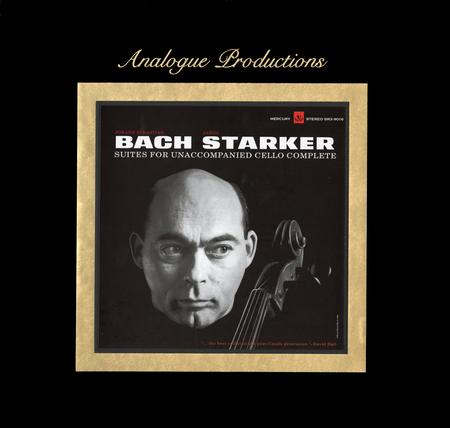
Harold Lawrence produced the sessions and Robert Eberenz served as recording engineer. Peter G. Davis wrote the original liner notes, while Mary Morris took the familiar Starker portrait used on the Mercury cover. Those names belong to the making of a recording centred on a single instrument. A solo cello asks something different of the listener from a large orchestra. A small change in bow contact, or the way one note leads into another, assumes greater importance when fewer simultaneous events compete for attention.
A useful approach is to follow one complete suite and then return to an individual movement. On the first hearing, the larger sequence can remain foremost; on the second, particular articulations and figures can receive closer attention. The contrast between a moving dance and a sarabande is especially revealing. Expression depends on more than tempo. The distribution of weight within a phrase and the relationship between sounding motion and deliberate stillness also change its meaning. None of this requires a ranking of several famous recordings before the music can be enjoyed.
The suites have a long performing and recorded history. Pablo Casals played a crucial role in establishing their concert reputation and recorded his celebrated cycle in the 1930s. Starker enters that history with his own musical voice. His repeated engagement with the works also makes the Mercury version a document of a particular stage in his life. It is rewarding to hear it as a complete artistic statement before searching for a hierarchy of interpretations or a supposedly final way of playing Bach.
For a collection, an entire cycle can reveal more than a single much-loved sarabande or the opening prelude. It presents the musician under changing conditions and lets individual decisions be understood in context. The six suites do not demand one uninterrupted listening session. A single suite may be enough for an evening, while the memory of an earlier one still changes the next encounter. The scale of this release therefore accommodates both concentrated listening to one work and a longer acquaintance with the complete sequence.
Six LPs and the route from three tracks to the cutting head
This Analogue Productions edition, AAPC 3-9016-45, spreads the complete cycle across six stereo LPs at 45 RPM. Ryan K. Smith cut the lacquers at Sterling Sound, supervised by Thomas Fine, with Stan Bishop credited for plating. The publisher describes the use of the original first-generation three-track tapes. Their three channels were mixed to two during cutting, without an additional intermediate tape being prepared as the cutting source. These are documented claims about the production of this specific reissue, rather than general assumptions about all editions bearing the album’s title.
The described chain included a modified Ampex ATR-100 and a Neumann VMS-80 cutting system. According to the publisher, the process used no digital programme or preview source and added no equalisation or dynamics processing for sonic sweetening. This is unusually detailed manufacturing documentation. It should be understood as information supplied by the publisher, not as an independent measurement of a particular copy. For a collector, the clear distinction between the original recording, its transfer and the manufacture of the records is valuable in itself.
Pressing runs must nevertheless be kept separate. The 2020 release is documented as a 200-gram QRP edition, while the later version is a 180-gram RTI pressing. Those specifications should not be combined into one imaginary configuration. The physical stock batch has not been identified. Stoughton packaging forms part of the presentation; the work list includes all six suites without assigning unverified movement breaks to the twelve record sides. The 45 RPM format provides more room for cutting and also requires more frequent side changes. Both considerations belong to the practical choice of this elaborate edition of Starker’s Mercury cycle.
You order from Michael 45 in Germany. We arrange the US import and dispatch from Hilden.
Customer question: Buying Analogue Productions records in Europe
Musicians
Participants and documented credit status. Track references correspond to the tracklist.
- János StarkercelloParticipation: album personnel

Recorded April 1963 and September and December 1965 at Ballroom Studio A, Fine Recording, New York. Producer: Harold Lawrence; engineer: Robert Eberenz. Original liner notes: Peter G. Davis; cover photograph: Mary Morris. Reissue: Ryan K. Smith, Sterling Sound, supervised by Thomas Fine; plating: Stan Bishop. Work listing does not assign unverified side breaks across the six LPs.

Reviews
There are no reviews yet.