A working quintet and one final Prestige autumn
Cookin’ With The Miles Davis Quintet takes us into the working relationship of a band whose names would become cornerstones of many jazz collections: Miles Davis, John Coltrane, Red Garland, Paul Chambers and Philly Joe Jones. Rudy Van Gelder records the quintet in Hackensack for Prestige, with Bob Weinstock supervising. Two substantial dates, 11 May and 26 October 1956, provide material for four albums: Cookin’, Relaxin’, Workin’ and Steamin’. They belong to the closing stage of Davis’ Prestige period and the circumstances surrounding his move to Columbia.
For this particular album, one distinction matters: all five selections on Cookin’ come from 26 October 1956. Telling the story of the two sessions together does not mean that every one of the four records draws on both dates. Cookin’ appeared in 1957 as the first release in that group. It preserves a connected portion of a repertoire the musicians had developed as a band. Rather than five unrelated studio projects placed beside one another, the programme presents a shared language extending across ballad, blues and more animated material.
Davis does not have to determine every moment of the music in this setting. Garland, Chambers and Jones form a rhythm section that offers the soloists both support and resistance. Coltrane’s tenor introduces another kind of articulation and density beside the trumpet. The different voices are part of what makes the group compelling: cohesion does not require everyone to choose the same accents. Follow the transitions between players rather than treating each track simply as a series of important solos. Often the accompaniment helps explain why a particular solo phrase has its effect at precisely that moment.

My Funny Valentine and the strength of a quartet
The album opens with Richard Rodgers and Lorenz Hart’s My Funny Valentine. Despite the quintet name on the sleeve, this performance is a quartet recording: John Coltrane does not take part. Miles Davis is accompanied by Red Garland, Paul Chambers and Philly Joe Jones. That straightforward personnel detail changes the perspective. The trumpet does not share its statement with a second horn, allowing a more direct relationship with the piano. The record begins with concentration rather than a demonstrative introduction of all five members of the band.
A ballad poses questions different from those of a fast number. Where does a phrase really end? How long does a note remain in the musical memory after it has stopped sounding? When does Garland move the argument forward, and when does the rhythm section leave the foreground open? Those are useful ways into this opening performance. They do not require a claimed verdict about a particular system or pressing. The arrangement of the music itself provides reason enough to slow down and notice how melody, chords and pulse are shared between the four players.
Blues By Five then opens the space to the full quintet. Coltrane returns, and the considerably longer blues leaves room for the contrasting voices. Its juxtaposition with the opening ballad explains an important aspect of the album: Davis presents the group in more than one posture. Red Garland remains an individual contributor throughout. His piano combines rhythmic precision with harmonic perspective, serving as both accompaniment and a solo voice. Chambers and Jones provide a mobile foundation rather than a rigid grid, allowing trumpet and tenor to react to the same setting in different ways.

Five selections and several ways of playing together
Sonny Rollins’ Airegin adds another character to the programme. Moving from the extended blues into this piece already asks for a different awareness of form and momentum. Tune Up and When Lights Are Low follow as two further stages, listed separately on this LP. The latter standard is by Benny Carter and Spencer Williams. The album is consequently not a programme made up exclusively of Davis compositions. Working through different material together reveals how strongly an ensemble can be recognised by its manner of playing, regardless of whose name appears in the composer’s credit.
For one complete pass, try staying with the rhythm section. Chambers does more than supply roots: his bass connects individual moments into a continuing line. Jones can encourage a soloist, underline a turn of phrase and prepare the next entrance. Garland provides harmonic reference points without making the performance feel confined to a static chord chart. On a subsequent hearing, return your attention to trumpet and tenor. The differences between them become more apparent once you have consciously noticed the shared musical activity to which both respond.
For collectors, Cookin’ therefore has two complementary identities. It is a self-contained, manageable album with a specifically identifiable quartet performance at the beginning. It also belongs to the larger Prestige body of work documenting this quintet across several releases. There is no need to own the entire four-album group before enjoying it. Adding the other records later supplies further perspectives on the same band and repertoire. That makes Cookin’ a valuable point of reference for a collection organised not only around celebrated titles but around the relationships between musicians.
The Prestige mono edition on one 33⅓ RPM LP
This vinyl release carries catalogue number APRJ 7094. Part of the Analogue Productions Prestige Mono Series, it comprises a single LP playing at 33⅓ RPM. Kevin Gray handled the mastering at Cohearent Audio from the original mono master tapes. Quality Record Pressings is the specified pressing plant, with Gary Salstrom credited for plating. The current manufacturer description lists 180-gram vinyl. The early AP pressing from 2013 is documented at 200 grams; its initial numbering does not establish that every subsequent copy offered today will also be numbered.
Separating the recording from the edition is especially useful for an album with so many reissues. Prestige released the original in 1957 as PRLP 7094. The Analogue Productions record described here belongs to a later publishing history while returning to the original mono recording. Mono places the musicians together within one image. It does not artificially redistribute them between left and right in order to suggest a stereo session. For listening, this can direct attention towards balance, phrasing and the movement within the ensemble rather than towards the separation of individual players across a soundstage.
This LP presents two selections on side A and three on side B. The intimate opening is followed by the extended blues; turning the record introduces a new chapter with Airegin. Tune Up and When Lights Are Low are listed separately in the documented tracklist for this edition. Some other releases combine the final two selections. A different track count therefore does not automatically identify additional music. What matters is the programme on the particular release and the way that programme has been divided.
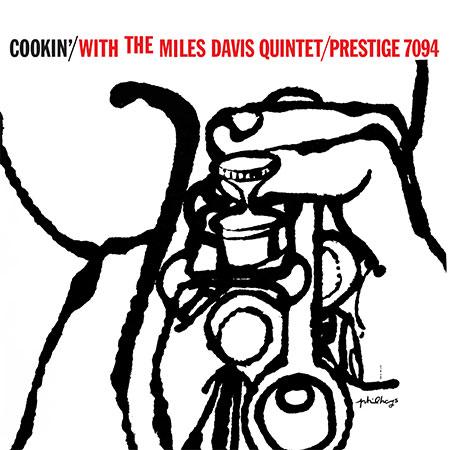
A single 33⅓ RPM record preserves that familiar album structure with just one side change. This is a practical advantage for a continuous listening session, without implying that one speed is universally superior to another. For five selections whose effect depends partly on their relationship to one another, the sequence is itself an attraction. The original cover, designed by Reid Miles with an illustration by Phil Hays, also belongs to this Prestige album’s history. It offers a visual language quite different from a later concert photograph of the trumpeter and helps locate the record within its original publishing context.
The shop also carries the separately described hybrid SACD CPRJ 7094 SA. APRJ 7094, however, is the vinyl LP: information about optical-disc layers or SACD-compatible players belongs to the other edition. Keeping these identities clear is useful as a collection grows. A listener can choose a preferred playback format while still distinguishing the recording, its personnel and the manufacturing details of the particular product.
You order from Michael 45 in Germany. We arrange the US import and dispatch from Hilden.
In the magazine: Miles Davis: A History in Records
Also on SACD: Cookin’ With The Miles Davis Quintet
More by Miles Davis: Steamin’ With The Miles Davis Quintet · Kind of Blue
Artist page: All titles by Miles Davis
Customer question: Buying Analogue Productions records in Europe
Series: Analogue Productions Prestige – all 50 records, musicians and session paths
Musicians
Participants and documented credit status. Track references correspond to the tracklist.
- Miles DavisPortrait: 1950strumpetParticipation: All tracks
- John ColtranePortrait: 1950stenor saxophoneParticipation: All except A1
- Red GarlandPortrait: 1950spianoParticipation: All tracks
- Paul ChambersPortrait: 1958double bassParticipation: All tracks
- Philly Joe JonesPortrait: 1962drumsParticipation: All tracks


All five tracks: October 26, 1956, Hackensack. John Coltrane does not play on A1, My Funny Valentine.

Reviews
There are no reviews yet.