Four musicians, one afternoon, an unmistakable voice
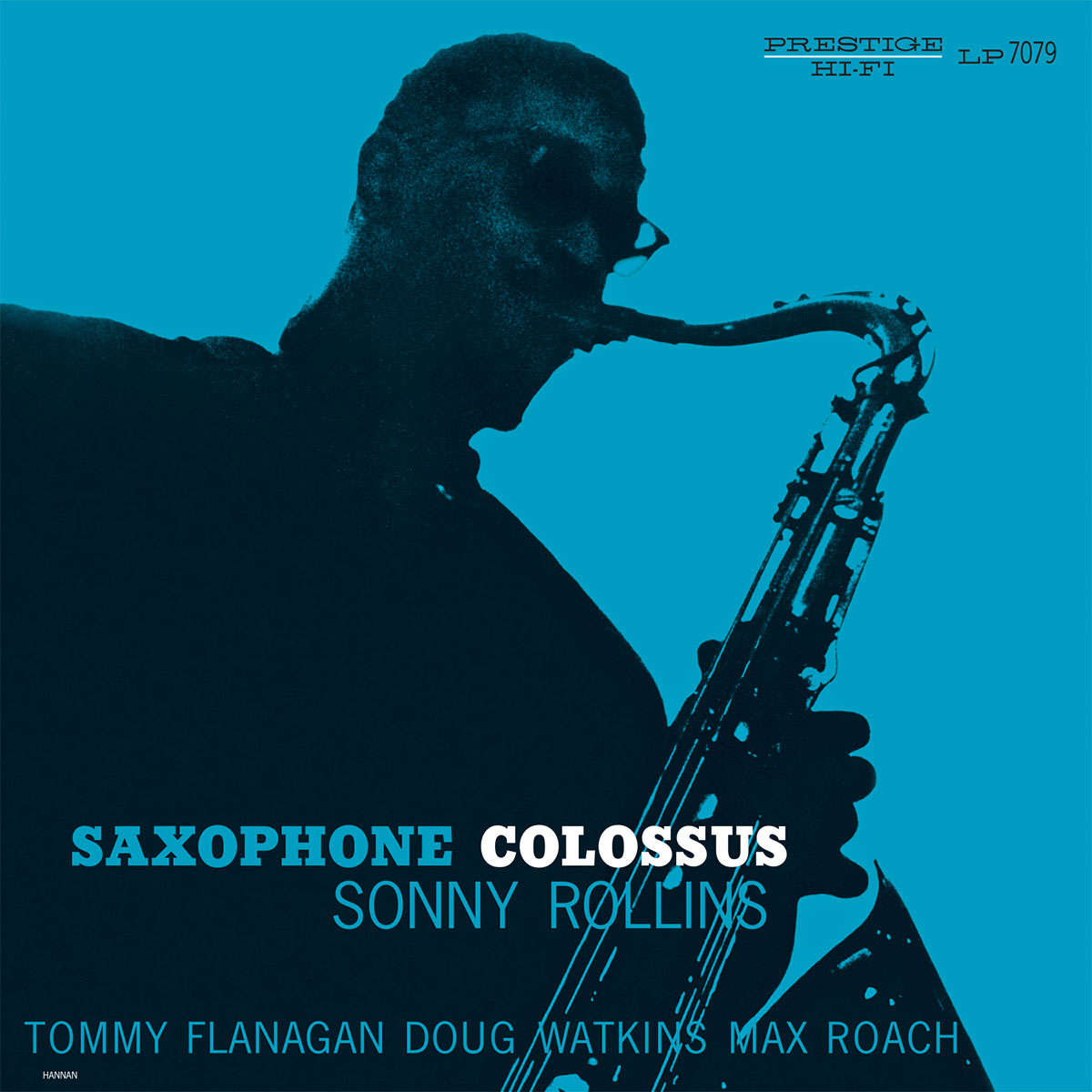
A title such as Saxophone Colossus might suggest an exercise in sheer power. Yet Sonny Rollins needs neither a large orchestra nor an sprawling programme when he enters Rudy Van Gelder’s Hackensack studio on 22 June 1956. Five selections and three exceptional partners are enough: Tommy Flanagan on piano, Doug Watkins on double bass and Max Roach on drums. Bob Weinstock supervises the date for Prestige. Rollins is twenty-five. The confidence with which he treats familiar melodies and his own material makes those straightforward details seem almost understated.
The album’s fascination lies in the meeting of spontaneous invention and audible structure. Rollins can take a small turn of phrase, move it across the beat, interrupt it and bring it back with a different emphasis. An improvisation becomes a story whose characters remain recognisable. You do not need a course in harmony to follow that process: choose a short phrase and listen for what happens to it in the following chorus. Silence belongs to the argument, too. A pause gives the rhythm section space and allows the next idea to arrive with purpose, rather than merely separating strings of notes.
His partners are essential to that balance. Flanagan keeps the harmonic setting responsive, Watkins gives the pulse both solidity and melodic shape, and Roach contributes accents that do much more than accompany. Each musician retains an individual voice. The personnel remain unchanged across all five tracks, so the shifts in atmosphere come from the pieces and the players’ decisions. For collectors, this is an attractively concentrated document: an entire programme traceable to a single recording date, with no later additions or changing line-ups needed to account for its variety.

From St. Thomas to the unfolding design of Blue 7
St. Thomas welcomes the listener with a melody whose Caribbean character gives it an immediately distinctive buoyancy. Rollins turns the calypso theme into an invitation to rhythmic play. Its appeal extends well beyond recognition of a famous tune. Follow the placement of the short motifs against the pulse and the way Max Roach helps shape their movement. This is music that makes its first impression readily while keeping its finer details available for another visit; an alert ensemble works beneath the apparent ease.
You Don’t Know What Love Is brings a different kind of concentration. Gene de Paul and Don Raye’s ballad asks for proportion: which note receives time, where a line is pared back, when the piano can answer. Flanagan matters greatly here. His role is not to fill every available space with chords, but to give the tenor a harmonic partner with its own sense of timing. Rollins’ Strode Rode then provides a more animated contrast. Within the opening three selections, the quartet has already demonstrated several quite different ways of allowing the same tenor saxophone to tell a story.
Moritat brings the Mack the Knife melody from Brecht and Weill’s Threepenny Opera into this setting. Because its outline is so familiar, it offers an especially clear opportunity to follow Rollins as he reshapes material without simply abandoning it. The closing Blue 7 is an extended blues that rewards attention to small motivic changes. The proportions of the programme matter: alongside the shorter performances stand two pieces lasting roughly ten and eleven minutes. Those longer spans let relationships emerge between ideas rather than forcing every selection into the same compact frame.

A classic whose story includes every member of the quartet
To hear Saxophone Colossus solely as a portrait of Rollins is to miss part of its achievement. Tommy Flanagan, also born in 1930, provides a precise but flexible setting for the horn. A year later he will record Overseas under his own name. Here he works within a quartet that calls for quick responses and a clear view of the whole. Doug Watkins supplies the foundation against which the freedom of the other players becomes meaningful. On one of the longer tracks, try following his bass line consistently instead of giving the leading saxophone your undivided attention.
Max Roach is equally far from being a timekeeper in the narrow sense. His part can answer a phrase, articulate a transition or redistribute the energy of a chorus. The result is an ensemble of four active musical personalities, even though one name leads the cover. That makes repeated listening productive. A different partner can become the centre of your attention on the next pass without requiring a hidden studio effect or a spectacular isolated moment to justify the exercise. The interest resides in how the musicians keep the performance moving together.
The album’s historical importance therefore reaches beyond its place on lists of essential jazz records. Within a manageable programme it brings together several central possibilities of modern jazz: blues and standards, Caribbean-inflected melody, ballad playing and the development of motifs. It can serve both as an introduction and as a reference point in a collection. Listeners who already know other Rollins recordings can compare the way his ideas unfold in different groups. Those arriving here for the first time encounter five distinct pieces and a quartet whose interaction gives attentive listening an immediate purpose.
The mono LP with Kevin Gray’s cut
This is Saxophone Colossus as a single mono LP in the Analogue Productions Prestige series, APRJ 7079, playing at 33⅓ RPM. Kevin Gray cut the lacquers at Cohearent Audio, with the publisher identifying the original analogue mono masters as the source. Quality Record Pressings is responsible for pressing, and Gary Salstrom is credited with plating. Those details distinguish this edition from the album’s SACDs and earlier 45 RPM releases. The album title remains the same, while the specific manufacturing history belongs to each individual edition.
The LP programme has an especially coherent division. Side A contains St. Thomas, You Don’t Know What Love Is and Strode Rode: calypso, ballad and more animated quartet jazz offer three concise perspectives on the same personnel. Side B provides room for the longer developments of Moritat and Blue 7. Those two extended performances can consequently be experienced as a continuous second half without another side change. For this particular album, the 33 RPM LP is also a satisfying way of preserving its musical progression. There is no need to turn that advantage into a blanket quality comparison with 45 RPM to appreciate the arrangement.
The glossy tip-on jacket recalls the physical presentation of the Prestige release. Documentation for the first pressing of this reissue, issued in 2013, also lists 200-gram vinyl, a flat disc edge, a deep-groove label and gold numbering. Later offerings under the same catalogue number are described as 180-gram pressings. Those features should therefore not be assumed for every copy available today. The reliable points of reference are the mono programme, catalogue number and documented Kevin Gray cut.
The attraction for a collection lies in its concentration: one record, five pieces, four musicians and a single recording day. The format retains the compact shape of St. Thomas alongside the expansive development of Blue 7, without adding bonus tracks or rearranging the programme. Anyone wishing to follow Rollins’ musical thinking gets the original album sequence in a clearly specified analogue edition. Alongside the celebrated tenor, it is always worth giving Flanagan, Watkins and Roach a turn at the centre of your attention. Their involvement is part of what makes this more than a document of one exceptional soloist, and part of why the same five performances invite repeated listening. You order from Michael 45 in Germany. We arrange the US import and dispatch from Hilden.
Also on SACD: Saxophone Colossus
More by Sonny Rollins: Tenor Madness · Sonny Rollins And The Contemporary Leaders
Artist page: All titles by Sonny Rollins
Customer question: Buying Analogue Productions records in Europe
Series: Analogue Productions Prestige – all 50 records, musicians and session paths
Musicians
Participants and documented credit status. Track references correspond to the tracklist.
- Sonny Rollinstenor saxophoneParticipation: All 5
- Tommy FlanaganpianoParticipation: All 5
- Doug Watkinsdouble bassParticipation: All 5
- Max RoachdrumsParticipation: All 5


The quartet plays on all five tracks. LP sides follow the edition documentation; SACD timings are not presented as timings of this LP.

Reviews
There are no reviews yet.