


A familiar song opens a different space
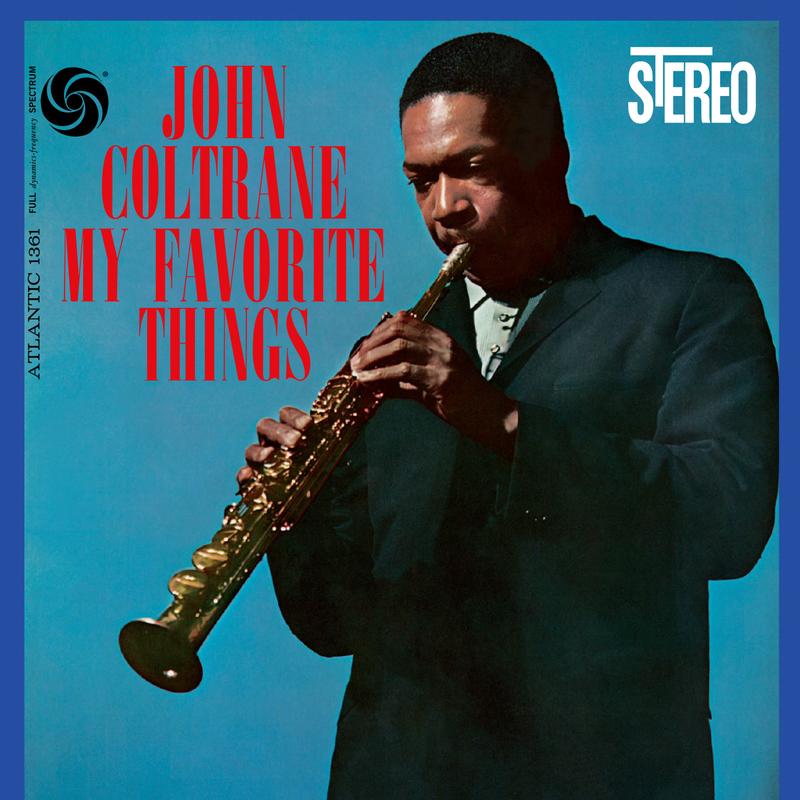
The melody is familiar, but its dimensions have changed. John Coltrane takes “My Favorite Things” from The Sound of Music and turns it into a performance lasting more than thirteen minutes, shaped by recurrence, small adjustments and gathering intensity. The tune remains recognisable. At the same time, it becomes the starting point for a journey that repeatedly returns to similar notes and discovers something different in them. The soprano saxophone carries this movement in a bright, slender voice, markedly distinct from Coltrane’s tenor sound and central to the performance’s identity.
Recorded on three October dates in New York during 1960, the album was released by Atlantic in March 1961. After the swift harmonic changes of Giant Steps, its title performance suggests another answer to a continuing question: how can an improvisation sustain motion over an extended period? Here, much of the fascination lies in expanding a limited area rather than constantly replacing the harmonic ground beneath it. Coltrane works on motifs, repeats them, moves their accents and finds renewed tension within material whose basic outline remains relatively easy to grasp.
The complete album consists of just four selections, all drawn from established American songs. Alongside Rodgers and Hammerstein are Cole Porter and the Gershwins. These familiar pieces receive more than respectful restatements. The quartet changes their proportions, rhythmic character and, in places, harmonic surroundings. Because the themes are recognisable, the listener can follow both the distance travelled from the starting point and the different routes by which the musicians return. Familiarity becomes part of the experiment, providing a reference against which the changes acquire meaning.
Reducing the record to the success of its title track would therefore miss an important part of the programme. Its two original LP sides also contrast instrumental colours. Coltrane plays soprano saxophone on “My Favorite Things” and “Everytime We Say Goodbye,” then tenor on “Summertime” and “But Not for Me.” The two voices belong to a continuous musical outlook, but they reveal its scope from different angles. Hearing all four pieces makes that relationship clearer than hearing the most famous performance on its own.

A quartet capable of sustaining long forms
McCoy Tyner on piano, Steve Davis on double bass and Elvin Jones on drums accompany all four selections. The sessions took place at Atlantic Studios on October 21, 24 and 26, 1960. Nesuhi Ertegun produced, with Tom Dowd and Phil Iehle named for engineering. The personnel distinction matters: the bassist here is Steve Davis, rather than Jimmy Garrison, whose name is associated with Coltrane’s later classic quartet. Davis should also not be confused with the drummer of the same name. This is a specific group at a particular moment in its development.
Tyner provides an architecture for the extended improvisations. Repeated figures and strongly placed chords offer points of reference without dictating every move made by the saxophone. On the title track especially, the piano can stabilise the music while supplying fresh energy. Turning attention from Coltrane to Tyner for a while reveals how much of the music’s ability to expand comes from the accompaniment. The soloist moves within a space that the other players continue to shape, rather than over a fixed backing that simply waits for the improvisation to end.
Jones treats the pulse as a living thing. A regular underlying motion remains perceptible while accents and rhythmic figures establish new relationships around it. The drums do more than indicate the progress of time; they change the tension within it. Davis connects the harmonic reference points with the physical movement of the performance. His role becomes particularly clear when a recurring pattern retains its power to orient the listener beneath an increasingly active surface. The bass can be followed as a line in its own right and as the link holding the ensemble together.
This interaction makes the longer forms sustainable. Four musicians can fill a considerable stretch of musical time when none confines his contribution to a rigid function. Piano supplies more than chords, drums more than beats and bass more than a foundation. Coltrane’s lines can circle for extended passages without the music becoming static. In this sense, the album documents the development of a shared language as much as a newly prominent instrumental colour for its leader. That language would continue to grow, but its capacity for sustained collective movement is already a defining feature here.

Four standards, four kinds of transformation
The triple metre remains a crucial reference in “My Favorite Things.” Repeated accompaniment figures and the movement between minor and major areas establish a frame in which Coltrane can greatly extend the melodic material. Duration matters as much as alteration. Instead of waiting only for the next chord, the listener follows the way a figure changes character when it receives a different accent, grows longer or moves into another register. A familiar song becomes a form that asks for more time and supplies enough developing detail to make that time meaningful.
Cole Porter’s “Everytime We Say Goodbye” then reveals another aspect of the soprano saxophone. After the extended title performance, the ballad feels concentrated and readily surveyed. Individual melodic arcs carry more weight, along with the way Coltrane holds a note or completes a phrase. The instrument’s higher colour need not generate constant urgency; it can support a sensitive, almost suspended line. The contrast between the first two selections establishes the soprano as a versatile expressive voice, rather than simply an unusual sound introduced for the sake of novelty.
For “Summertime,” Coltrane switches to tenor. A song often treated as a quiet lullaby becomes an energetic and expansive performance. Its familiar melody is a point of reference rather than a boundary. Comparing saxophone and drums is especially rewarding: both can propel the music while placing their accents differently. Their exchange creates tension that belongs to the ensemble, not only to the lead instrument. The song comes from the world of Porgy and Bess, but the quartet treats it decisively as material for its own musical purposes, allowing the original outline to support a very different scale of activity.
“But Not for Me” closes the album with a mobile tenor interpretation in which Coltrane’s interest in additional harmonic connections remains audible. The move towards longer modal passages does not mean that the questions behind Giant Steps have been abandoned. Different approaches coexist. A useful listening route therefore runs from comparing the two saxophones to comparing the forms: what changes when the group keeps a ballad relatively compact, lets a tune circle for a long stretch or gives a standard new harmonic pathways? The four performances provide distinct answers while retaining the identity of the same quartet.
Four record sides for four substantial performances
This edition carries catalogue number AAPA 011-45 and belongs to the Analogue Productions Atlantic 75 series. The album is presented on two 180-gram stereo records playing at 45 RPM. Each performance receives its own side: “My Favorite Things” on A, “Everytime We Say Goodbye” on B, “Summertime” on C and “But Not for Me” on D. The pieces remain complete, while the original single-LP sequence is punctuated by additional side changes. Each interpretation can consequently be approached as a substantial section in its own right.
Ryan K. Smith handled mastering at Sterling Sound. The label identifies the original analogue master tapes as the source and lists Quality Record Pressings for manufacture. Packaging is a laminated Stoughton tip-on gatefold jacket with two pockets. Documented pressing variants nevertheless require a distinction between the numbered initial run and later unnumbered copies: both QRP and RTI are listed for unnumbered versions. Without physically inspecting the specific stock batch, this does not establish the pressing plant of every individual copy currently available from the shop.
Similarly, the documented numbering of the first 2,000 copies is not automatically a description of current stock. Such information belongs to the release history, while the supplied variant must be checked on the actual item. The edition’s principal specifications are clear; they do not anticipate an individual listening assessment or justify a blanket promise of particular sonic effects.
This 45 RPM edition allows each of the four interpretations an uninterrupted record side. That presentation suits music whose effect depends on attention to extended development. My Favorite Things combines immediately recognisable melodies with a quartet that shifts their familiar boundaries. The longer the listener stays with the recurring figures, the more clearly the differences created by Coltrane, Tyner, Davis and Jones begin to emerge.
You order from Michael 45 in Germany. We arrange the US import and dispatch from Hilden.
Artist page: All titles by John Coltrane
Customer questions: Atlantic 75: which titles are worth buying? · Buying Analogue Productions records in Europe
Series: Atlantic 75 Series – all 75 albums, time journey and the people behind Atlantic
Musicians
Participants and documented credit status. Track references correspond to the tracklist.
- John ColtraneExisting portrait reference 1960soprano saxophone, tenor saxophoneParticipation: Soprano: A/B · tenor: C/D
- McCoy TynerOriginal illustration · portrait reference 1962pianoParticipation: All four original tracks
- Steve Davisdouble bassParticipation: All four original tracks
- Elvin JonesExisting portrait reference 1964drumsParticipation: All four original tracks


Atlantic Studios, New York, October 21, 24 and 26, 1960; original album March 1961. Nesuhi Ertegun: producer; Tom Dowd and Phil Iehle: engineering. Coltrane plays soprano on A/B and tenor on C/D. McCoy Tyner, bassist Steve Davis and Elvin Jones accompany all four tracks. Lee Friedlander: cover photo; Loring Eutemey: design. Ryan K. Smith: mastering. Distinguish the numbered QRP initial run from unnumbered QRP/RTI variants.
Also on SACD: My Favorite Things
How Michael hears this edition
Listening impression · paraphrased from the video
Michael hears a strong sonic resemblance to the original US stereo pressing. On the Atlantic 75 edition he finds the piano slightly fuller and more prominent, and his new copy plays more quietly. He describes these as small targeted improvements rather than a completely different presentation.
🎧 Review video: The 10 Best Audiophile Reissues Of 2022!
This video is hosted by YouTube (Google). It only loads once you switch on “Functional” in the cookie settings.

Ralf Doerner –
Wer John Coltrane mag sollte diese Platte im Bestand haben 😍