
Coltrane and the art of giving a melody room
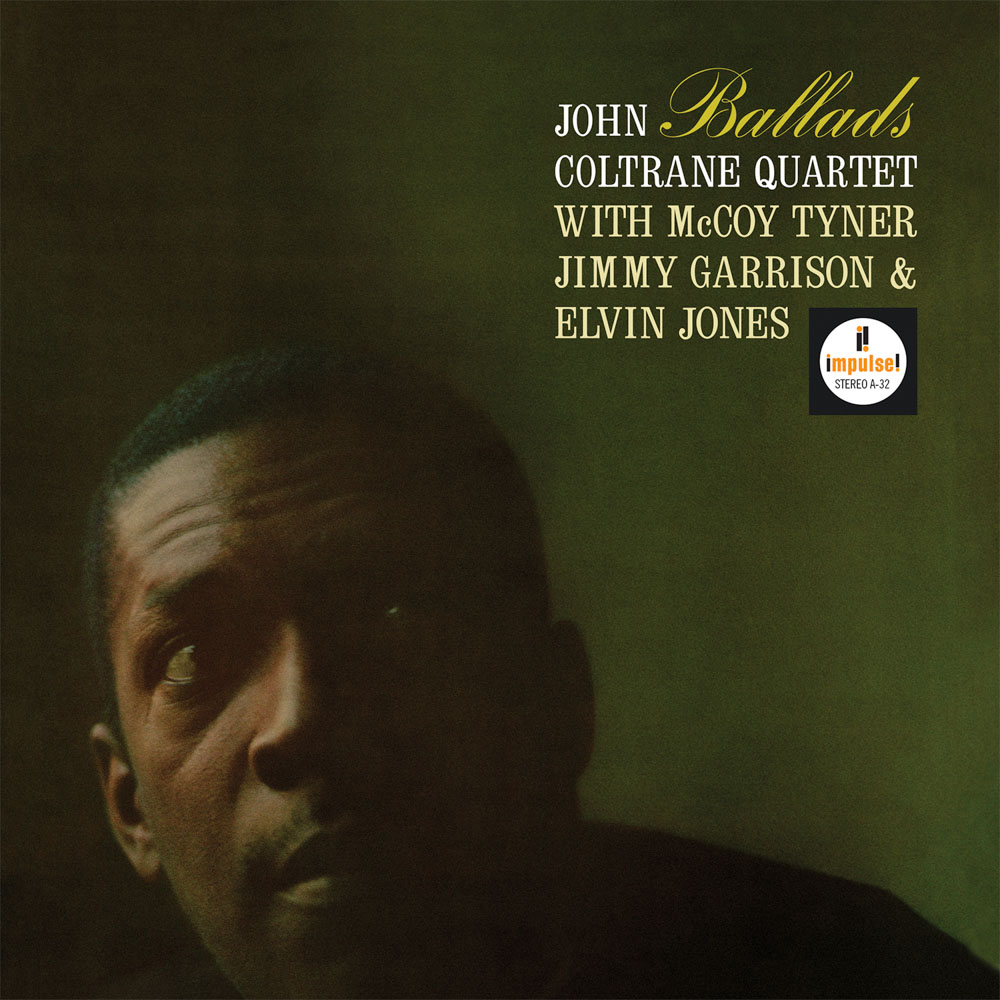
Ballads offers a particularly direct way into John Coltrane’s music. Eight songs from the American popular-song repertoire form its centre, played by a small ensemble attentive to the shape of each melody. Listeners who primarily associate Coltrane with extended improvisation and the expansion of musical forms encounter another kind of concentration here. The pieces are concise and their melodic outlines clear. That focus makes the expression contained in a phrase, its resonance and its relationship with the accompaniment especially rewarding to consider.
The album was not recorded in a single afternoon. Its history includes three sessions at Rudy Van Gelder’s studio in Englewood Cliffs: December 21, 1961, September 18, 1962 and November 13, 1962. Bob Thiele produced, with Van Gelder responsible for recording. Ballads appeared on Impulse! in January 1963, with A-32 and AS-32 identifying the original mono and stereo editions. Gene Lees supplied the liner notes. Behind the programme’s coherent identity are performances made at different points within an active period of Coltrane’s career.
Part of the record’s appeal is that it need not be understood as a rejection of his other music. A musician can explore expansive structures while also finding value in the concentrated interpretation of a song. Here the compositions retain enough room to reveal their individual shapes. The tenor saxophone carries them in a personal voice without obscuring their melodic identities. For an established collection, that is an essential part of the Coltrane picture; for a newcomer, it can provide an especially welcoming starting point.

The quartet, with an important change of bassist
McCoy Tyner on piano and Elvin Jones on drums accompany Coltrane throughout all eight selections. They belong to the core of the celebrated quartet, but Ballads calls for attention to different details from music built around long solo sequences. The spaces within a melody, the placement of a harmonic change and the way an accompanying phrase answers the saxophone all become important. Tyner’s piano and Jones’s drums remain individual voices. A quieter overall setting does not diminish the significance of their musical choices.
The bass credits require a little more precision. Jimmy Garrison plays on seven tracks; Reggie Workman appears on “It’s Easy to Remember,” the seventh selection, positioned at B3 on this LP. This division follows supplementary session discography. General album credits naming Garrison alone do not fully reflect the change. Workman’s contribution belongs to the early session in December 1961, so the completed record also preserves a small part of the ensemble’s personnel history.
That information need not turn listening into an exercise in detection. It offers a practical reason to follow the bass and consider its role. How does a line support the harmonic movement? How much activity does a slow song need to remain alive? How do piano and drums respond to the spaces in the saxophone part? In familiar standards, important differences often reside in details that initially seem modest. The ensemble establishes the setting in which Coltrane’s phrasing acquires its particular significance.
Coltrane plays tenor saxophone throughout. The instrument remains the central voice, giving the different songs a shared point of reference. Variety therefore comes from the paths taken through the melodies rather than a succession of featured instruments. The different bassists connect two moments in the ensemble’s history, while saxophone, piano and drums give the programme continuity. The album consequently has both a coherent musical identity and a specific recording history extending beyond the shorthand of its famous quartet.

Eight songs with individual histories
“Say It (Over and Over Again),” by Frank Loesser and Jimmy McHugh, opens the first side. It introduces a programme in which melodic memory and repetition can become sources of expression. Don Raye and Gene DePaul’s “You Don’t Know What Love Is” follows. Its familiarity within the jazz repertoire can be an advantage: knowing the outline of a melody allows the listener to attend more closely to the weighting of individual notes and the direction of a phrase. Recognition becomes the beginning of an encounter rather than its conclusion.
“Too Young to Go Steady,” by Harold Adamson and Jimmy McHugh, introduces another song before Arthur Altman and Jack Lawrence’s “All or Nothing at All” closes the side. These are not interchangeable examples of a slow tempo. Each melody has its own movement, turning points and connection with words. Even without a singer, the origin in song remains relevant. The saxophone occupies a position in which musical breath and the imagined shape of a vocal line can remain closely connected.
The second side begins with Harry Warren and Mack Gordon’s “I Wish I Knew,” followed by Bob Haggart and Johnny Burke’s “What’s New.” Richard Rodgers and Lorenz Hart’s “It’s Easy to Remember” provides the programme’s shortest performance and the change to Workman on bass. “Nancy (With the Laughing Face),” written by Jimmy Van Heusen and Phil Silvers, closes the album. The record ends within the same world of carefully constructed songs from which it began, while each composition has supplied a different route through that world.
This manageable selection rewards repeated listening. An individual performance can hold the attention, but a whole side also allows contrasting melodic characters to follow one another naturally. The concise forms encourage attention to choices within a song: the beginning of a phrase, a slight delay, the duration of a note or a response from the piano. Such details can create a strong sense of musical intimacy. The album remains approachable without extensive explanation while offering enough substance to sustain a lasting place in a collection.
The Acoustic Sounds Series on a single 33⅓ RPM LP
The edition offered here, AIMP 7801, belongs to the Verve and UMe Acoustic Sounds Series. Ryan K. Smith at Sterling Sound worked from the original tapes for the cut. The stereo LP is pressed at Quality Record Pressings, specified at 180 grams, and presented in a Stoughton tip-on gatefold jacket. These details identify this particular 33⅓ RPM release. Other reissues of the same album have their own format and production histories, which should be considered separately when choosing an edition.
The eight selections are divided evenly between the two sides. That offers a straightforward way to discover or revisit Ballads. A single 33⅓ RPM LP preserves the relationship between the original album halves and allows several songs to unfold before a side change. The concise performances can be experienced as an intentional sequence rather than isolated favourites. Choosing this format therefore also means choosing a particular rhythm of listening, with each side holding a small group of related but distinct songs.
Within a Coltrane collection, Ballads occupies a quiet yet substantial position. It brings the personality of a major improviser into contact with songs whose melodic qualities outlast any one interpretation. Tyner, Jones and the two bassists contribute to an ensemble approach in which small decisions carry considerable weight. The Acoustic Sounds Series presents that specific album programme on one LP: an invitation to spend time with eight songs and the individual voices shaping their familiar forms. It is a record that can welcome a first encounter and still justify returning attention years later.
You order from Michael 45 in Germany. We arrange the US import and dispatch from Hilden.
Also on UHQR: Ballads
More by John Coltrane: Crescent · ‘Live’ At The Village Vanguard
Artist page: All titles by John Coltrane
Series: Impulse! – all 19 records: the house that Trane built
Musicians
Participants and documented credit status. Track references correspond to the tracklist.
- John ColtranePortrait: 1950stenor saxophoneParticipation: All tracks
- McCoy TynerPortrait: 1965pianoParticipation: All tracks
- Elvin JonesPortrait: 1964drumsParticipation: All tracks
- Jimmy GarrisonPortrait: existing portraitdouble bassParticipation: Tracks 1–6 and 8
- Reggie WorkmanPortrait: existing portraitdouble bassParticipation: Track 7 / B3


Reggie Workman plays on B3, “It’s Easy to Remember”; Jimmy Garrison plays on the other seven tracks. Track assignment follows supplementary discography.
How Michael hears this edition
Listening impression · paraphrased from the video
Michael describes the 33⅓ RPM Acoustic Sounds edition as clear, lively and coherent, with beautiful dynamics and a convincing soundstage. It meets his high expectations. He explicitly has not compared it with the 45 RPM ORG edition, so his enthusiasm is not evidence that it beats that other edition.

Reviews
There are no reviews yet.