
A quintet that needs no elaborate frame
Relaxin’ with the Miles Davis Quintet belongs to those records on which a small ensemble opens an entire musical world. Miles Davis on trumpet, John Coltrane on tenor saxophone, Red Garland on piano, Paul Chambers on double bass and Philly Joe Jones on drums need neither a larger horn section nor additional studio decoration. Five personalities are enough when the relationships between them remain flexible. The title does not describe music without tension. It draws attention instead to the apparent ease with which an established ensemble can bring different melodic and rhythmic ideas into a shared performance.
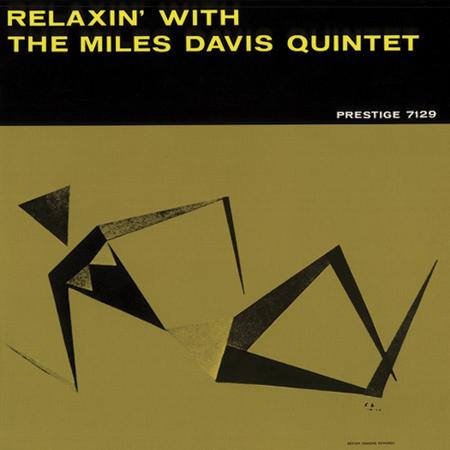
The recordings were made on two dates in 1956: May 11 and October 26, both at Rudy Van Gelder’s studio in Hackensack, with Bob Weinstock producing. Material from those sessions supplied the four Prestige albums Cookin’, Relaxin’, Workin’ and Steamin’. They are closely connected, but they are not interchangeable names for the same selection. Relaxin’ has its own programme of six pieces. Released in 1958, it originally carried the Prestige number PRLP 7129, a useful point of reference for collectors tracing the relationship between the album and its subsequent editions.
The allocation of tracks to the two recording dates can also be identified. “It Could Happen to You” and “Woody’n You” come from the May session. “If I Were a Bell”, “You’re My Everything”, “I Could Write a Book” and “Oleo” were recorded in October. That order is not the sequence heard on the record. It underlines how an album acquires its shape through selection and assembly as well as performance. Two working days become a musical arc arranged across two sides, with three pieces on each side and a distinct identity as a listening programme.

Miles Davis and John Coltrane in a shared space
Davis and Coltrane do not simply duplicate the melodic role. Their instruments and musical personalities offer different routes through the same material. It can be rewarding to notice how a theme changes its emphasis under different leadership. A trumpet phrase and a tenor saxophone line need not exert the same kind of pressure to belong to the same piece. Coherence emerges through the repertoire and through a rhythm section able to respond to both. The quintet depends on its members remaining recognisable within the common framework, rather than dissolving their individual identities into a uniform group manner.
Red Garland is central to that process. His piano can supply harmonic orientation, accompany a soloist and move forward into a leading role of its own. Chambers and Jones do not provide an immovable base beneath these changes. Bass and drums participate in the music’s conversational structure. Following only the two horns already offers much to consider; attending to the accompaniment reveals another layer of responses and transitions. The album consequently works both as an encounter with a celebrated group and as an invitation to return to the particular responsibilities inside a small jazz ensemble.
The retained studio conversation contributes to the release’s character. Something of the working context remains instead of every trace between performances being removed. There is no need to transform that fact into an invented scene or to supply imagined quotations. The documented circumstance is interesting in itself. The record presents more than abstract works isolated from one another; it also preserves moments from musicians working together in a studio. That is especially appropriate to this album’s title. A sense of human proximity can arise from actual people and their working interaction, without a retrospective story about supposedly private feelings.

Six pieces and six approaches to familiar repertoire
“If I Were a Bell” opens the album, giving the quintet room to turn a song into a jazz performance with its own time and scale. The melody is a starting point and a line of reference rather than the complete substance of the performance. That is one of the central pleasures of this music. A listener can retain contact with a recognisable theme while following the musicians as they form individual statements within its possibilities. The movement from melody into improvisation need not register as a break; it can feel like a familiar question receiving several distinct responses.
“You’re My Everything” and “I Could Write a Book” complete side one. Their titles point towards the song tradition from which jazz musicians repeatedly draw material for their own present. What matters is not only the selected tune but who plays it and in what relationship to the others. Davis, Coltrane and Garland are not interchangeable readers of a fixed script. Each entrance changes the perspective. Chambers and Jones ensure that these shifts remain part of a common movement. A familiar song becomes a form through which the band can accommodate differences without losing its connection to the underlying material.
Side two begins with Sonny Rollins’ “Oleo”. Listeners familiar with Davis’ earlier performance associated with Bags’ Groove have a particularly useful point of comparison: the same composition in a different ensemble configuration. “It Could Happen to You” and Dizzy Gillespie’s “Woody’n You” conclude the LP. The programme therefore reaches from American popular song and theatrical repertoire to compositions originating within jazz itself. It is concentrated without being uniform. Six pieces provide enough variety for the quintet to bring distinct melodic starting points into a common language, while allowing the identity of each piece to remain audible.
Prestige Mono: the specific original programme on vinyl
Analogue Productions’ APRJ 7129 belongs to the Prestige Mono series. Kevin Gray cut the record at Cohearent Audio from the analogue mono master tapes. Quality Record Pressings handled manufacture, with Gary Salstrom responsible for plating. The current LP is offered on 180-gram vinyl, runs at 33⅓ rpm and is presented in a tip-on jacket. Source, cutting engineer, pressing plant and format are therefore explicitly identified. For choosing an audiophile edition, those details are more useful than a general promise that every playback system will deliver an identical impression of intimacy, scale or presence.
Mono is the identity of this edition rather than an absent extra feature. All five musicians belong to a shared sound image; the distinction between their musical voices does not depend on a left-right distribution. That concentration can be an appealing way to approach their interaction. A product description nevertheless needs to remain grounded in facts. A carefully made mono cut cannot guarantee any particular personal response. It provides a documented production and a clearly identified version, allowing comparisons between editions to begin with verifiable information rather than with unsupported claims of universal superiority.
Earlier 200-gram pressings and references to numbered initial copies belong to this reissue’s history. They do not establish either the weight or numbering of the current 180-gram edition. Nor do other Prestige titles on SACD automatically represent format variants of this album. Relaxin’ remains this six-piece programme drawn from two sessions in 1956. Its enduring value lies in the quintet itself: five distinguishable voices forming a common musical language. This LP gives that encounter a concise, carefully documented frame—two sides, six pieces and ample reason to follow the relationships between the musicians as closely as the themes they play.
You order from Michael 45 in Germany. We arrange the US import and ship from Hilden.
In the magazine: Miles Davis: A History in Records
More by Miles Davis Quintet: Great Prestige Recordings
Artist page: All titles by Miles Davis
Customer question: Buying Analogue Productions records in Europe
Series: Analogue Productions Prestige – all 50 records, musicians and session paths
Musicians
Participants and documented credit status. Track references correspond to the tracklist.
- Miles DavisPortrait: 1950strumpetParticipation: Album personnel
- John ColtranePortrait: 1950stenor saxophoneParticipation: Album personnel
- Red GarlandPortrait: 1950spianoParticipation: Album personnel
- Paul ChambersPortrait: 1958double bassParticipation: Album personnel
- Philly Joe JonesPortrait: 1962drumsParticipation: Album personnel


Quintet according to session listings. B2 and B3: May 11, 1956; A1–A3 and B1: October 26, 1956. Timings follow the documented AP edition; differences in other editions remain recorded in the source dossier.
How Michael hears this edition
Listening impression · paraphrased from the video
Compared with the Craft Small Batch edition, Michael hears a softer, warmer character on the AP edition. He finds Craft more analytical and more forceful on Miles’s trumpet. He gives both nine out of ten: different presentations with no clear winner.
🎧 Review video: Miles Davis Quintet – Relaxin' Small Batch vs. Analogue Production
This video is hosted by YouTube (Google). It only loads once you switch on “Functional” in the cookie settings.

Reviews
There are no reviews yet.