
A voice among musicians
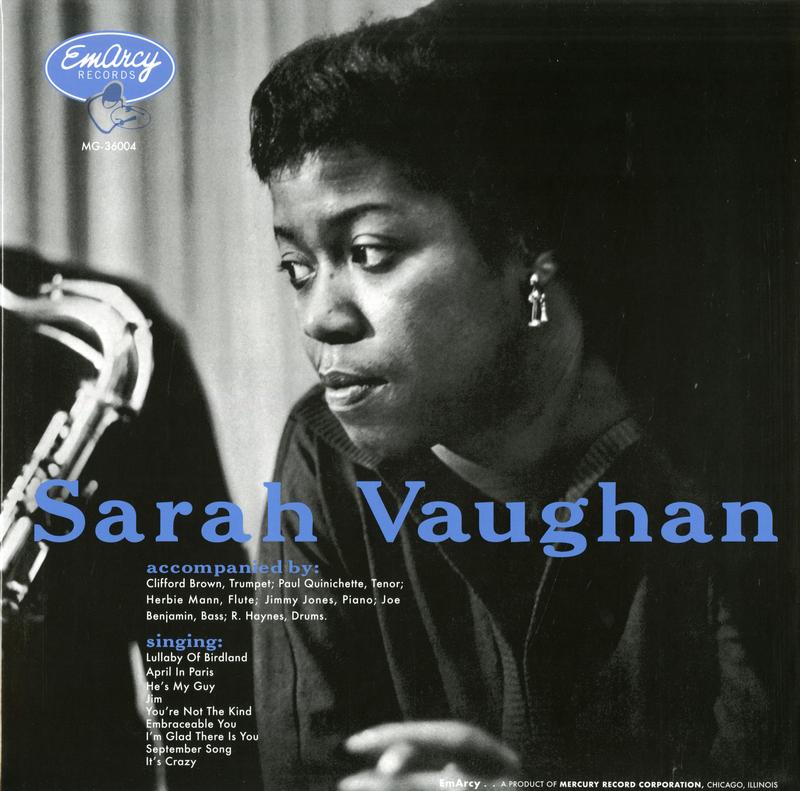
New York, December 1954: Sarah Vaughan records an album at Fine Sound that EmArcy releases under her own name in 1955. It is frequently identified with the addition With Clifford Brown. Understandably so, because Brown’s trumpet is one of its defining voices. At its centre, however, is a singer who can approach a melody with an instrumentalist’s flexibility. Vaughan joins the direct communication of a song to a rich harmonic imagination, allowing a familiar standard to feel both intimate and newly discovered.
The small ensemble is an essential part of that setting. Voice and horns interact directly, without a large orchestral backdrop determining the space. Producer Bob Shad brings Vaughan together with musicians whose contrasting colours enrich the programme. The album’s simple title is worth taking seriously: this is a portrait of Sarah Vaughan, shaped by her choices, phrasing and musical companions. The accompaniment belongs to that portrait just as much as the singing. Each partner helps reveal another aspect of the central voice.

Clifford Brown and the ensemble’s colours
Alongside Clifford Brown are Paul Quinichette on tenor saxophone and Herbie Mann on flute. Pianist Jimmy Jones, bassist Joe Benjamin and drummer Roy Haynes form the rhythm section. Three contrasting wind instruments offer several ways to answer a vocal phrase. Trumpet can carry a line forward, tenor can introduce another inflection, and flute can change the ensemble’s colour. This lineup makes vocal jazz understandable as a shared musical activity, with the singer fully inside the conversation.
Jimmy Jones is more than a name in the background. His accompaniment contributes to the harmonic foundation on which Vaughan can reshape a melody. With Benjamin and Haynes, he provides support that also keeps the performance moving. Taking attention away from the lead voice for a moment reveals another layer: small rhythmic choices and instrumental transitions. Their relationship with the singer makes this an ensemble record worth exploring beyond the fame of its best-known participants. The pleasure is in how those individual contributions meet.

Nine standards, many perspectives
“Lullaby Of Birdland” opens the programme, followed by selections including “April In Paris,” “He’s My Guy” and “Jim.” Side two moves from “You’re Not The Kind” through “Embraceable You” to “I’m Glad There Is You,” “September Song” and “It’s Crazy.” The repertoire brings different temperaments into contact. One song calls for rhythmic agility, another for patience and a sustained melodic line. Vaughan can move between these demands without losing the personality behind the voice.
“Embraceable You” is an especially inviting place to follow the relationship between singing and accompaniment. “September Song” encourages attention to the balance between melodic breadth and the weight of the words, while the closing “It’s Crazy” changes the emphasis again. The programme of this LP is clearly defined: nine tracks. An additional unedited version of “Lullaby Of Birdland,” familiar from some CD releases, is not included. The original album sequence retains a concentrated shape of its own, without supplementary takes altering the experience.
EmArcy in mono
AEMA 41301 is part of the Acoustic Sounds Series and presents the album in mono on one 180-gram LP at 33⅓ RPM. Ryan K. Smith handled mastering and lacquer cutting at Sterling Sound. The publisher identifies the original analogue tapes as the source, and pressing is by Quality Record Pressings. Mono is part of this edition’s identity: voice and instruments meet within a single coherent image. Left-to-right separation is not the principle by which this recording asks to be appreciated.
A Stoughton Printing tip-on gatefold jacket includes photographs by Herman Leonard inside. That considered presentation suits music built around attention to nuance. You may first play the record for Sarah Vaughan, then return because of Clifford Brown. Eventually, both paths lead to the same pleasure: musicians listening to one another, shaping familiar songs and giving them an individual voice. That is why the album remains more than a celebrated title in the history of jazz singing. Its reputation leads us to the music; the interaction keeps us there.
You order from Michael 45 in Germany. We arrange the US import and dispatch from Hilden.
More by Sarah Vaughan: Sassy · Crazy and Mixed Up
Musicians
Participants and documented credit status. Track references correspond to the tracklist.
- Sarah Vaughanvocals, bandleaderParticipation: Album personnel
- Clifford BrowntrumpetParticipation: A1, A2, A3, A4, B1, B3, B4, B5
- Paul Quinichettetenor saxophoneParticipation: A1, A2, A3, A4, B1, B3, B4, B5
- Herbie MannfluteParticipation: A1, A2, A3, A4, B1, B3, B4, B5
- Jimmy JonespianoParticipation: Album personnel
- Joe BenjaminbassParticipation: Album personnel
- Roy HaynesdrumsParticipation: Album personnel


Sarah Vaughan (vocals); Clifford Brown (trumpet), Paul Quinichette (tenor saxophone), Herbie Mann (flute) – according to AllMusic not on B2 “Embraceable You”; Jimmy Jones (piano); Joe Benjamin (bass); Roy Haynes (drums). Arrangements: Ernie Wilkins (per later CD credits; not credited on this LP). Recorded 16 and 18 December 1954 at Fine Sound, New York; recording engineer not documented. Producer: Bob Shad. Original release: EmArcy MG-36004 (1955, mono). This edition: mastered and lacquer-cut by Ryan K. Smith (Sterling Sound); pressed at Quality Record Pressings; Stoughton Printing gatefold with photographs by Herman Leonard; reissue supervision Chad Kassem. Nine tracks; the CD bonus version of “Lullaby Of Birdland” is not included.
How Michael hears this edition
Listening impression · paraphrased from the video
Michael describes Sarah Vaughan’s voice as so present that she seems to stand in the room. The quality of this presentation gives him goosebumps.

Reviews
There are no reviews yet.