
An album built from two encounters
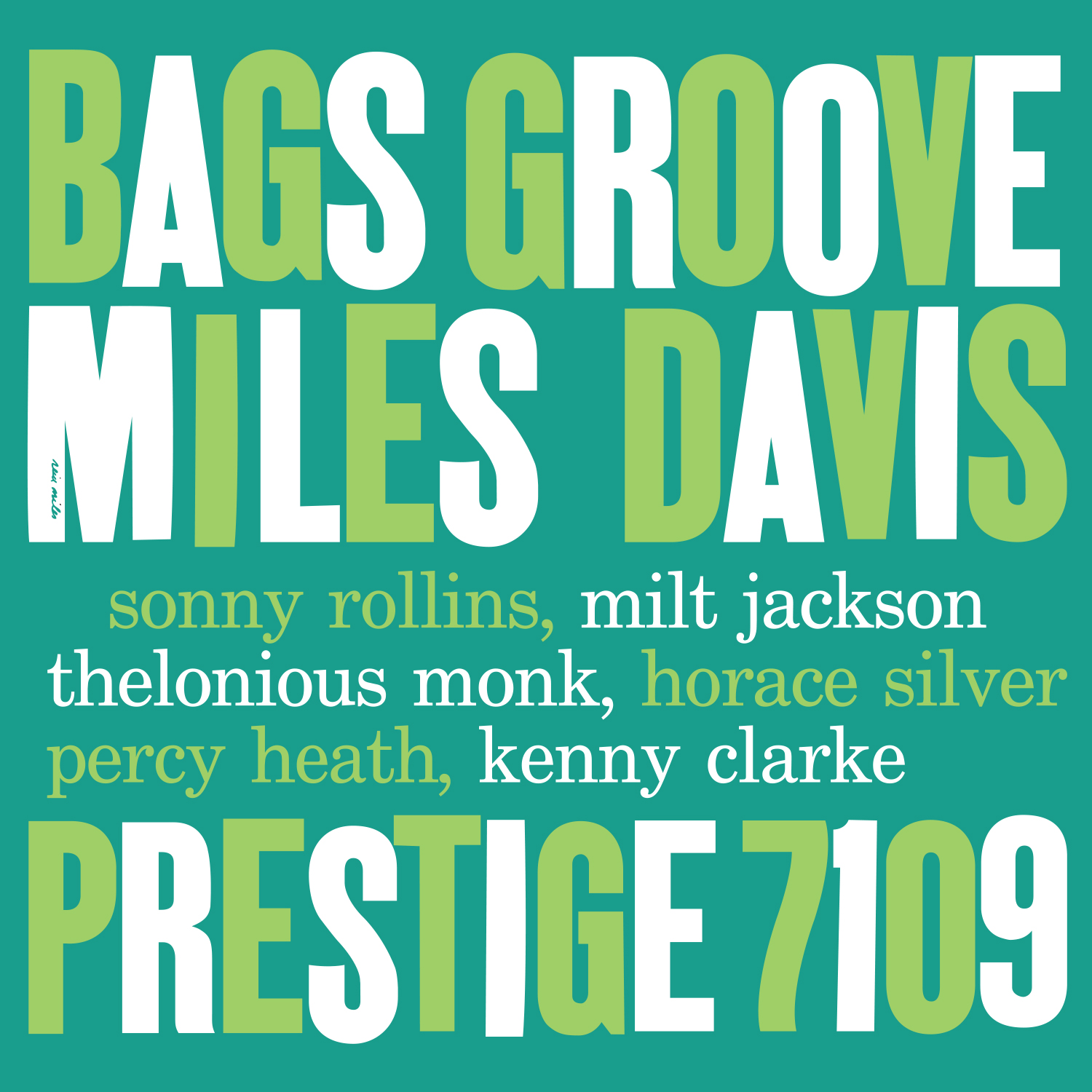
Bags’ Groove is one of those Miles Davis albums whose personnel becomes more intriguing the closer one looks. Sonny Rollins and Horace Silver appear in the credits alongside Milt Jackson and Thelonious Monk. They do not, however, constitute a single supergroup. The LP brings together two quintets recorded on different days in 1954 at Rudy Van Gelder’s studio in Hackensack. Prestige did not release the material in this album form, as PRLP 7109, until late 1957. Keeping recording and release separate reveals an especially interesting perspective: Davis exchanging ideas with several independent voices before those encounters were assembled into a lasting LP sequence.
The first date was 29 June 1954. Davis played trumpet, Rollins tenor saxophone and Silver piano, with Percy Heath on double bass and Kenny Clarke on drums. On 24 December, Davis, Heath and Clarke returned. Jackson’s vibraphone now replaced the tenor saxophone, while Monk took the piano chair. The eventual LP reverses the chronology. It begins with the two Christmas performances of Bags’ Groove, then presents the material from June. The album therefore opens with the later session before turning towards another configuration from the same year, allowing listeners to move between two distinct instrumental and musical settings.
That construction is more than a discographical footnote. It offers a chance to consider Davis not only as an unmistakable soloist, but as a participant in changing musical relationships. A vibraphone creates different conditions from a second horn; Monk brings different possibilities from Silver. At the same time, Heath and Clarke connect the two ensembles. The familiar and the new sit directly beside one another. For collectors interested in the Prestige catalogue beyond its best-known titles, Bags’ Groove is a particularly rewarding example of individual recording dates becoming an album with an identity of its own.

Milt Jackson gives the record its name
“Bags” was Milt Jackson’s nickname, and Bags’ Groove is his composition. That alone earns the vibraphonist a central place beside Davis in the story of this record. The entire first side is devoted to two takes of the same piece: the first lasts a little over eleven minutes, the second more than nine. This is not incidental bonus material added after the event. Together, the performances form the substantial opening half of the original album. Instead of immediately moving to another melody, the LP stays with one foundation and allows different realisations to be compared. The recording process itself becomes part of the programme.
Jackson, Heath and Clarke were also connected through the history of the Modern Jazz Quartet. Their shared experience meets Davis and Monk in this session. That offers a different perspective from the idea of a group merely standing behind a famous trumpeter. Each participant brings a strongly individual musical language. When listening, it can be rewarding to notice not only where a solo begins, but how it is handed over. How does the piano’s role change when the vibraphone leads? What orientation do bass and drums provide when the melodic voice changes? Returning to the composition creates unusually generous room for exploring such relationships.
Many stories have accumulated around this Christmas session. The music does not need an embellished account of personal conflict to make it compelling. Its documented core is already substantial: five musicians with different temperaments, one shared blues composition and two surviving takes. Other pieces recorded that day, including Bemsha Swing, Swing Spring and The Man I Love, belong to other releases, particularly Miles Davis and the Modern Jazz Giants. They are not on this LP. The exclusive attention given to Bags’ Groove is precisely what distinguishes its opening side, and a combined session list would obscure that identity.

Rollins, Silver and three future standards
The instrumental colour changes on side two. Rollins’ tenor saxophone joins Davis’ trumpet, and Silver takes over at the piano. Three Rollins compositions appear: Airegin, Oleo and Doxy. All became established parts of the jazz repertoire. Here they can be encountered early in their recorded lives, with their composer participating directly. That gives the side a particular coherence. Rollins is not simply a visiting soloist; he shapes the material on which the whole ensemble works. Davis’ name on the cover and Rollins’ authorship within the programme become complementary elements, rather than competing claims on the listener’s attention.
George and Ira Gershwin’s But Not for Me appears in two versions, placed between the Rollins pieces and at the close. The order matters: Airegin and Oleo are followed by Take 2, then Doxy, and finally Take 1 of But Not for Me. Both sides therefore use alternate performances, but in different ways. The title composition appears twice in immediate succession; the Gershwin performances are separated by Doxy. Listening deliberately to the complete side can reveal relationships that selecting individual tracks would not suggest. The sequence, as well as the recordings themselves, belongs to the album’s story.
Percy Heath and Kenny Clarke remain the shared axis of both dates. Their names deserve the same attention as the more prominent melodic voices. Through them, one can follow what a rhythm section contributes to changing ensembles without surrendering its own character. Bob Weinstock supervised the sessions for Prestige, Rudy Van Gelder recorded them, and Ira Gitler supplied the album notes. The fact that this programme took its LP shape several years later does not diminish its interest. It makes the distinction between the historical moment of performance and the eventual object on the record shelf particularly valuable to understand.
Prestige mono on one 33⅓ RPM LP
The Analogue Productions edition carries catalogue number APRJ 7109 and belongs to the Prestige Mono series. It presents the album on one LP playing at 33⅓ RPM. That makes musical sense for Bags’ Groove: the two extended takes remain together as a single opening chapter, while the second side groups the June quintet. The original organisation by side stays clear. No additional record change interrupts that comparison. For an album whose attraction includes the relationship between line-ups and alternate performances, continuity is a persuasive part of the format, quite apart from any preference about playback speed.
Kevin Gray mastered the reissue at Cohearent Audio from the analogue masters. Quality Record Pressings manufactures the LP, with Gary Salstrom credited for plating. The presentation includes a tip-on jacket. The current publisher listing specifies 180-gram vinyl, while earlier AP editions are also documented at 200 grams. This does not promise a particular number, label detail or weight variant for an individual copy. The correct title Oleo is retained here as well, despite the printing error “Oreo” on a documented rear sleeve of the reissue. Musical identity and manufacturing details both deserve accurate treatment.
This mono LP is especially appealing in a collection tracing Davis through his musical partnerships. It connects Jackson and Monk with Rollins and Silver while keeping their actual session relationships intact. Two recording dates, two quintets, seven track positions and several perspectives on the same musical personality provide its substance. The record encourages familiar names to be encountered again as musicians working with one another. That is a more generous way to approach it than simply treating the credits as a list of celebrated individuals. You order from Michael 45 in Germany. We arrange the US import and dispatch from Hilden.
In the magazine: Miles Davis: A History in Records
More by Miles Davis: Cookin’ With The Miles Davis Quintet · Steamin’ With The Miles Davis Quintet
Artist page: All titles by Miles Davis
Customer question: Buying Analogue Productions records in Europe
Series: Analogue Productions Prestige – all 50 records, musicians and session paths
Musicians
Participants and documented credit status. Track references correspond to the tracklist.
- Miles DavisPortrait 1950strumpetParticipation: All tracks
- Milt JacksonPortrait 1959vibraphoneParticipation: A1–A2
- Thelonious MonkPortrait 1957pianoParticipation: A1–A2
- Sonny RollinsPortrait circa 1956tenor saxophoneParticipation: B1–B5
- Horace SilverPortrait circa 1965pianoParticipation: B1–B5
- Percy HeathPortrait 1962double bassParticipation: All tracks
- Kenny ClarkePortrait 1964drumsParticipation: All tracks


29 June 1954, Hackensack: B1–B5, Davis/Rollins/Silver/Heath/Clarke. 24 December 1954, Hackensack: A1–A2, Davis/Jackson/Monk/Heath/Clarke. Bob Weinstock: supervision; Rudy Van Gelder: engineer; Ira Gitler: liner notes. LP released in late 1957.

Reviews
There are no reviews yet.