Double Trouble opens its circle
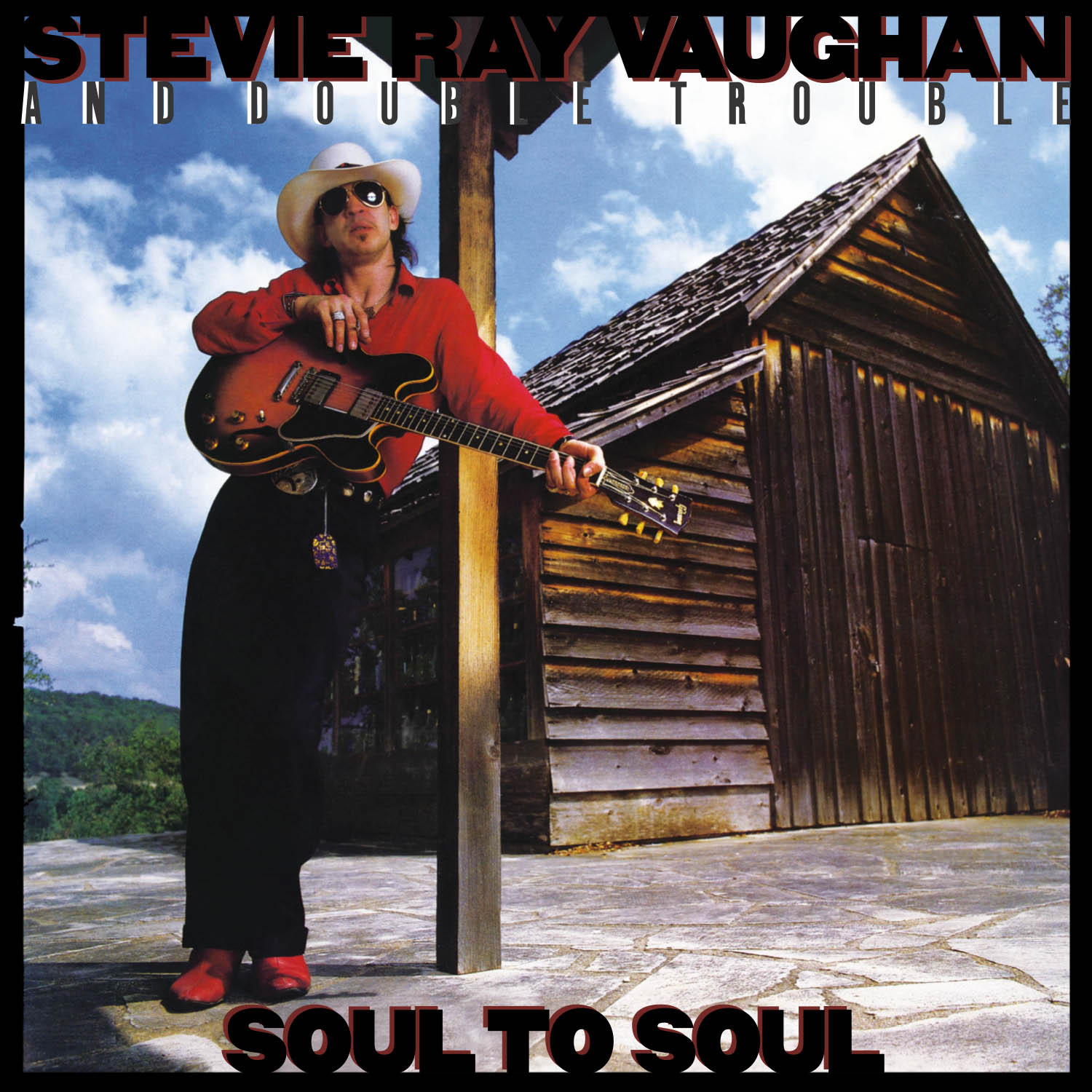
Soul to Soul changed the shape of Stevie Ray Vaughan and Double Trouble. On this third studio album, released in 1985, Reese Wynans on keyboards joins Vaughan, bassist Tommy Shannon and drummer Chris Layton. The familiar trio becomes a quartet. That is more than an extra instrumental colour: a keyboard player can sustain harmony, supply a response or organise the space between guitar phrases differently. Vaughan’s guitar remains a leading voice, but it now works within an expanded musical setting. The album’s title can also serve as an invitation to listen to the relationships within that new configuration.
Joe Sublett guests on saxophone, specifically on Lookin’ Out the Window and Look at Little Sister. His participation does not make him a fifth permanent member of Double Trouble. The distinction helps explain the album: Wynans changes the continuing band line-up, while Sublett adds a further voice to two songs. Both contributions matter, but their functions are different. In a catalogue often approached through its central guitarist, paying attention to the surrounding musicians is particularly rewarding. A larger musical frame is created not simply by adding instruments, but by deciding where and how their individual possibilities will be used.
Production is credited to Stevie Ray Vaughan and Double Trouble with Richard Mullen. Mullen also engineered the recording, with Ron Cote assisting and John H. Hammond serving as executive producer. Those names belong to the original album work. Credits from later CD reissues are not retrospectively assigned to the original sessions. For collectors, this separates three related stages: the 1985 recording, subsequent editions and the analogue reissue offered here. Each has its own participants and technical choices. Knowing which stage a name belongs to makes the information more useful when placing a particular copy within the larger recording history.

Ten selections joining originals and inherited songs
The opening Say What! is an instrumental written by Vaughan. Beginning this way places the band’s playing directly in the foreground before the following songs ask it to work around a vocal. Lookin’ Out the Window, by Doyle Bramhall, and Look at Little Sister, by Hank Ballard, come next. These are also the two tracks carrying Sublett’s saxophone contribution. The sequence therefore joins an instrumental introduction with two songs whose additional wind colour has a clearly documented place. On a return visit to the album, the first three selections can be followed as a compact introduction to its expanded resources.
Ain’t Gone ‘N’ Give Up on Love is another Vaughan composition, while Gone Home comes from Eddie Harris. That writing credit is worth keeping clear: an instrumental on a guitarist’s album is not necessarily his own composition. Change It brings a second Doyle Bramhall song into the programme, followed by You’ll Be Mine, associated with Willie Dixon. The result combines original and inherited material without treating the older songs as decorative references. Each needs to become a working arrangement for this particular band, bringing voice, rhythm and instrumental foreground into a relationship that suits the piece at hand.
Empty Arms, Come On (Part III) and Life Without You complete the original ten-track sequence. Vaughan wrote Empty Arms and Life Without You; Earl King wrote Come On. Four selections in total are Vaughan compositions. The album’s identity consequently does not depend on being an exclusively self-written statement. It develops through the meeting of several starting points within one performing group. This edition preserves that original programme. Additional performances and spoken material included on expanded CD releases are not part of the ten selections on the double LP described here, even when they appear on digital album pages.

Guitar, keyboards and the rhythm section’s shared work
Reese Wynans is central to the changed line-up. His keyboards can establish another harmonic layer beside the guitar without simply doubling its function. One useful way to listen is to follow the beginning and ending of a guitar phrase: what supports it, what answers it, and what continues when the guitar leaves some space? Those questions direct attention towards ensemble playing. The organ vignette accompanying this description responds to that additional world of sound. It is an original illustration of the expanded arrangement, not evidence identifying the exact make and model of an instrument used during a particular recording session.
Tommy Shannon and Chris Layton remain essential to the band’s cohesion. Bass and drums do more than establish a speed; they help determine the weight of an entrance and the way a phrase moves into its next bar. Listeners who primarily know Vaughan as a soloist can therefore approach the record from the foundation upwards: first following the bass, then the relationship between drums and guitar, and finally the keyboards working around them. This need not turn the music into isolated components. Changing the focus can reveal how those parts support one another, and how distinctive lead playing also depends on the musicians around it.
Sublett’s two appearances give the expanded palette another specific form. A saxophone can answer a song differently from guitar or organ without turning the entire album into a horn-led production. His contributions are accordingly assigned by title in the personnel section. Unusual supplementary vocal or drum credits retain their qualifications rather than being treated as proof that every listed instrument appears on every track. The portraits likewise keep their own historical context. Vaughan is shown through a verified later reference, and the later images used for Wynans and Sublett are identified as such. They depict the musicians, not a reconstructed photograph of the 1985 sessions.
The 45 RPM edition and its documented production chain
The release offered here is Analogue Productions AAPB 098-45, a stereo double LP running at 45 RPM. The publisher is unusually specific about its source: original half-inch analogue master tapes running at 30 ips. Ryan K. Smith at Sterling Sound cut the edition on a VMS 80 lathe. Gary Salstrom is credited with plating, and Quality Record Pressings with manufacturing. This information is more concrete than a general promise of audiophile sound. It identifies a documented chain of work without automatically establishing superiority over every other release or predicting what a particular listener will hear on an individual system.
The ten tracks are distributed across four sides: three on A, two on B, three on C and two on D. That gives the edition a different rhythm of listening from a single 33⅓ LP. The additional side changes belong to the format decision just as much as the mastering details. The current publisher listing specifies 180 grams, whereas an earlier documented pressing is described as a 200-gram edition. The catalogue number identifies the 45 RPM version; the weight of a particular stock batch may require separate confirmation. The SACD and the 33⅓ Texas Hurricane box are different formats, although they contain these album recordings.
Within a Vaughan collection, Soul to Soul occupies the point at which the group expands its regular personnel. Original writing meets blues and rhythm-and-blues repertoire, and attention can move among more than one prominent voice. Wynans joining the band, the continuing rhythm partnership of Shannon and Layton, and Sublett’s focused guest appearances provide the ten songs with their particular setting. This 45 RPM edition presents that original album with clear information about source tapes, cutting and manufacture, giving collectors a specific release to assess and enjoy. You order from Michael 45 in Germany. We arrange the US import and dispatch from Hilden.
Customer question: Buying Analogue Productions records in Europe
Musicians
Participants and documented credit status. Track references correspond to the tracklist.
- Stevie Ray VaughanPortrait reference 1983guitar, vocals; drums C3 reported by supplementary source onlyParticipation: Drums on Empty Arms in Q4 only; not independently confirmed from original sleeve
- Tommy ShannonPortrait reference circa 1983bass; additional vocal credit A1 in Q4 onlyParticipation: Say What! is an instrumental; no lead-vocal claim
- Chris LaytonPortrait reference circa 1983drums; additional vocal credit A1 in Q4 onlyParticipation: Album credit; nature of vocal contribution A1 unspecified
- Reese WynansLater portrait reference 2015keyboards; additional vocal credit A1 in Q4 onlyParticipation: Permanent fourth band member; supplementary A1 credit not independently confirmed
- Joe Sublettsaxophone (guest)Participation: A2 Lookin’ Out the Window; A3 Look at Little Sister


Original 1985 programme, ten tracks. Producers: Stevie Ray Vaughan and Double Trouble / Richard Mullen; executive producer: John H. Hammond; engineer: Richard Mullen, assistant: Ron Cote. Joe Sublett guests on A2/A3; he is not a permanent fifth member. Gone Home: Eddie Harris. Unusual extra drum C3 and vocal A1 credits are supplementary Q4 information, not confirmed against the original sleeve. No 1999 CD bonus or production credits included.

Reviews
There are no reviews yet.