
Encounters that became an album
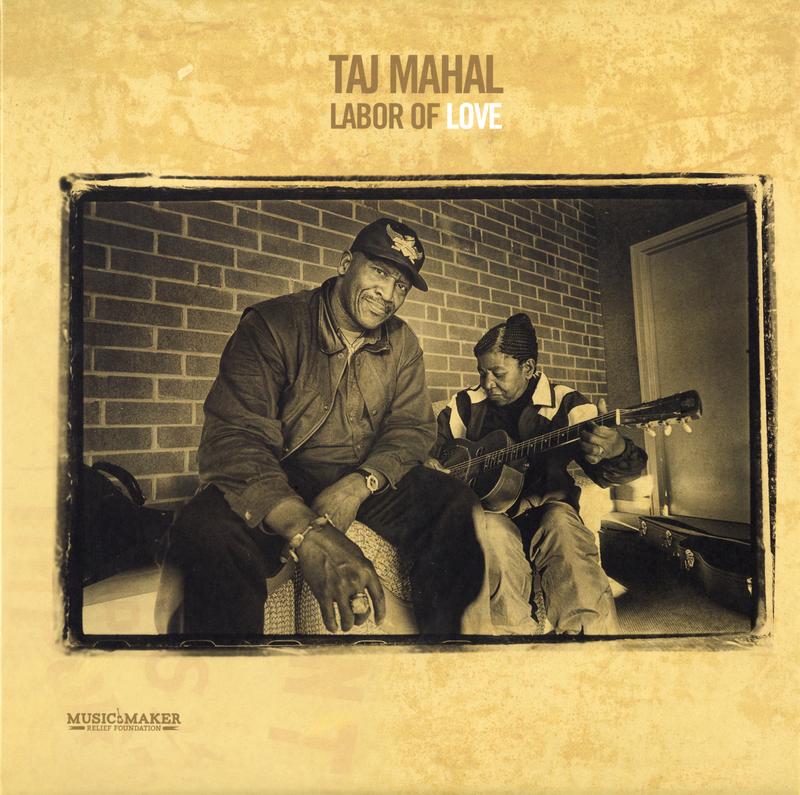
Labor of Love brings together recordings involving Taj Mahal from the late 1990s, issued as an album in 2016. Behind the project lies his relationship with Timothy Duffy and the Music Maker Relief Foundation. Thirteen selections combine solo performances with encounters involving other musicians. The title describes an approach best understood through the people taking part: well-known and less widely recognised artists share repertoire, exchange responsibilities and make room for one another. Taj Mahal is central, but his is not the only voice in this story.
The recordings did not originate as a conventional studio session with a fixed band. Duffy preserved musical encounters that were not initially issued as a regular album production. They were brought together for release later. The interval between performance and publication is consequently part of the record’s identity. 2016 is the release year, not the recording year. The music belongs to the context of Taj Mahal’s collaboration with Music Maker during the late 1990s.
The programme offers a perspective on transmission, memory and individual interpretation. An inherited song is not treated as an exhibit behind glass. It is played by people with different biographies and musical habits. Their meeting can reveal something that a list of titles cannot convey: tradition also involves responding to another musician and reshaping familiar material in a particular situation. Songs remain recognisable, while the relationships between the participants give each performance a context of its own.
That perspective makes the record especially interesting within a collection. Labor of Love extends the image of Taj Mahal as a singer and guitarist by demonstrating his willingness to take other roles. A celebrated name may attract attention to a project; this album then invites that attention to be shared. Its guests are additional musical personalities rather than anonymous support. Their names, instruments and respective tracks therefore belong explicitly in the account of the album and in its complete musician section.

Taj Mahal, Etta Baker and the other guests
Taj Mahal moves among singing, guitar and several other instruments. On “Shortnin’ Bread,” he plays banjo with Neal Pattman, who sings and plays harmonica. “I Ain’t the One You Love” places Algia Mae Hinton’s voice and twelve-string guitar at the centre, with Taj taking double bass. These assignments change the picture of the collaboration. Instrumentation follows each encounter; there is no permanently unchanged backing band simply continuing behind a succession of singers.
John Dee Holeman appears in two settings: singing and playing guitar on “Mistreated Blues,” with Taj at the piano, and participating in “Hambone.” Hambone is a form of rhythmic body percussion, not another stringed instrument. Cootie Stark sings and plays guitar on “So Sweet,” joined by Taj on harmonica. “Song for Brenda” brings in Cool John Ferguson on electric guitar and Ardie Dean on drums, with Taj playing double bass. The individual assignments turn a general list of guests into a meaningful account of how the music was made.
One particularly significant connection is with Etta Baker. On “John Henry,” her guitar meets Taj Mahal’s slide guitar. Baker is an important figure in the Piedmont guitar tradition, and her work had interested Taj long before this collaboration. Music Maker’s documentation records his appreciation of her playing. Here that relationship becomes a specific encounter on a particular track. Baker consequently receives her own large illustration in the description and a small portrait beside her name, alongside the new images of Taj himself.
Taj’s visual reference dates from 1998, while Baker’s appeared in a fall 2000 issue of Music Maker’s publication. Both new drawings use securely identified references without tracing the photographs. The musician section identifies eight participants and separates their contributions. Timothy Duffy belongs to the production and recording account; that credit is not turned into an invented instrumental role. Where another guest does not yet have a verified illustration, the name and musical participation remain fully documented.

Thirteen selections and changing perspectives
The first side opens with “Stagger Lee,” followed by “Shortnin’ Bread” with Neal Pattman and “My Creole Belle.” The sequence immediately connects a solo perspective with a collaboration. Following that change can be a rewarding listening approach: how does a musician’s responsibility alter when another singer becomes the focus? The answer involves more than the number of instruments. It concerns the distribution of initiative, support and shared movement within a performance.
Side B contains “I Ain’t the One You Love” with Algia Mae Hinton, “Fishin’ Blues,” “Mistreated Blues” with John Dee Holeman, and “Zanzibar.” Several combinations appear within this part of the programme. As an instrumental selection, “Zanzibar” provides a separate point of reference in the sequence. The changing roles encourage listeners not to assume that Taj Mahal must be the principal singer or guitarist on every track. Following the actual instruments makes the collaboration more tangible.
The third side consists of “So Sweet” with Cootie Stark, “Spike Drivers Blues,” and “Hambone” with John Dee Holeman. The move to body percussion broadens the idea of what musical accompaniment can involve. Rhythm need not depend on a drum kit, and a reduced instrumental inventory does not imply fewer musical relationships. That openness is important to this album: its continuity lies in repertoire and encounter, rather than an identical instrumental line-up maintained throughout.
“Walkin’ Blues,” “John Henry” with Etta Baker, and “Song for Brenda” with Cool John Ferguson conclude the record. The official release contains thirteen tracks. Shorter lists attached to other editions or databases should not be transferred unquestioningly to this double LP. The guests also belong at their actual positions: Baker plays on “John Henry,” not indiscriminately across the whole programme. Such accuracy preserves the feature that makes the project distinctive, namely the movement between different personal and musical connections.
Digital original recordings, Kevin Gray and two 33⅓ RPM LPs
Analogue Productions AAPB 113 presents the programme on two stereo LPs at 33⅓ RPM. Kevin Gray at Cohearent Audio is responsible for mastering, with pressing by Quality Record Pressings. The publisher identifies 44.1 kHz, 16-bit digital session recordings as the source. This is therefore not an all-analogue AAA production. Stating the actual source does not diminish the musical encounters; it describes how the performances were preserved and subsequently used for this edition.
The recording history includes mobile equipment that Duffy was able to use with support from Mark Levinson. Its purpose was to preserve music where the encounters took place. That background does not require an invented story about an original analogue master. The documented sequence is more useful to collectors: performances recorded in the late 1990s, their later assembly into an album, and a new mastering for vinyl. The edition has a gatefold jacket. Current publisher information specifies 180 grams, while documented earlier copies are listed as 200-gram pressings.
The arrangement of three, four, three and three tracks creates manageable sides while allowing several encounters to unfold consecutively. 33⅓ RPM provides a practical presentation of the complete programme. The edition’s appeal brings together music, documented provenance and clearly identified manufacturing. You order from Michael 45 in Germany. We handle the US import and ship from Hilden. Labor of Love invites listeners to follow a famous musician and, in doing so, become acquainted with other people whose contributions are essential to the album’s full identity.
Customer question: Buying Analogue Productions records in Europe
Musicians
Participants and documented credit status. Track references correspond to the tracklist.
- Taj Mahalportrait reference 1998vocals, guitar A1/A3/B2/C2/D1; guitar B4; banjo A2; double bass B1/D3; piano B3; harmonica C1; hambone C3; slide guitar D2Participation: Changing roles; no fixed backing band
- Neal Pattmanvocals, harmonicaParticipation: A2
- Algia Mae Hintonvocals, twelve-string guitarParticipation: B1
- John Dee Holemanvocals, guitar B3; vocals, hambone C3Participation: B3, C3
- Cootie Starkvocals, guitarParticipation: C1
- Etta Bakerreference published 2000guitarParticipation: D2
- Cool John Fergusonelectric guitarParticipation: D3
- Ardie DeandrumsParticipation: D3


Thirteen tracks; guests assigned by the official Music Maker/Bandcamp edition. Instrument roles supplemented from documented sleeve credits; Ardie Dean only D3. Produced/recorded by Timothy Duffy, liner notes by Will Boone. Late 1990s; digital original recordings, not AAA.

Reviews
There are no reviews yet.