
Three musicians and an unexpected open door
Texas Flood appeared in June 1983 and introduced Stevie Ray Vaughan and Double Trouble to an international audience. The central recordings had already been made in November 1982 at Jackson Browne’s Down Town Studio in Los Angeles. The route there passed through the band’s appearance at the Montreux Jazz Festival earlier that year. Browne met the musicians, played with them and offered studio time. An opportunity that had not begun as a fully planned major album production became the material for a debut that fundamentally changed the course of Vaughan’s career.
The documented visit ran from 22 to 24 November. Once equipment had been set up, the actual recording time was short. Tommy Shannon later described a large room with a concrete floor and a few rugs, where the musicians arranged themselves to play together much as they would as a live band. That account explains something about the working method without prescribing a particular listening impression. The trio brought an established musical relationship into a room where it could be captured with relatively little distance between the decisions being made and their performance on tape.
Vaughan sang and played guitar, Shannon played electric bass and Chris Layton played drums. There are no keyboards or horns expanding the trio here. That makes Texas Flood significantly different from the later In Step. The three musicians carry the programme’s changing requirements themselves: song accompaniment, instrumental pieces, extended developments and shorter rhythmic forms. Thinking of it as a guitarist’s debut is therefore only a starting point. Equally important is how bass and drums receive the playing, and how much shared movement can emerge from such a compact line-up.
John H. Hammond heard the material, brought it to Epic and became involved as executive producer. Richard Mullen appears in the production and engineering credits, and Lincoln Clapp in the mixing credits. The journey from session tapes to released album consequently involved further work; the familiar account of a rapid recording should not obscure everything that followed. In particular, Clapp is documented recording the vocal for “I’m Cryin’” separately. The directness of the central trio sessions can be acknowledged without making the absolute claim that every element of the finished release was completed without any further addition during the same two days.

A rhythm section as a musical partner
Shannon and Layton appear on all ten tracks. Their names also stand alongside Vaughan and Mullen in the production credits, fitting a record whose starting point was an established band. One rewarding approach on a return visit is to follow the bass. Where does Shannon keep a figure deliberately simple, where does he connect different sections, and how does Layton respond? This does not make the guitar less important. Its possibilities can become more apparent when heard in relation to the two other voices rather than separated from the musical framework they help create.
Instrumental material changes that relationship again. A sung verse provides a different framework from a piece whose development the musicians must carry without words. Texas Flood contains both. The transitions between vocal songs and instrumentals show that the group has more than one accompanying pattern at its disposal. Listen for the preparation of a phrase and for whether the drums reinforce the movement or leave additional space. These are invitations to individual listening, rather than claims based on a playback demonstration or a listening session supposedly conducted for this description.
Vaughan’s guitar playing stood within a history also made visible by his choice of other writers’ compositions. Larry Davis, Buddy Guy, Chester Burnett and the Isley Brothers are not merely names in an appendix. Their songs sit between Vaughan’s own work and alter the programme. For a debut, that relationship is especially revealing: a new personality introduces himself by bringing original and inherited material into one setting. Musical background becomes apparent through actual repertoire choices, rather than only through a retrospective list of artists who might have influenced his style.
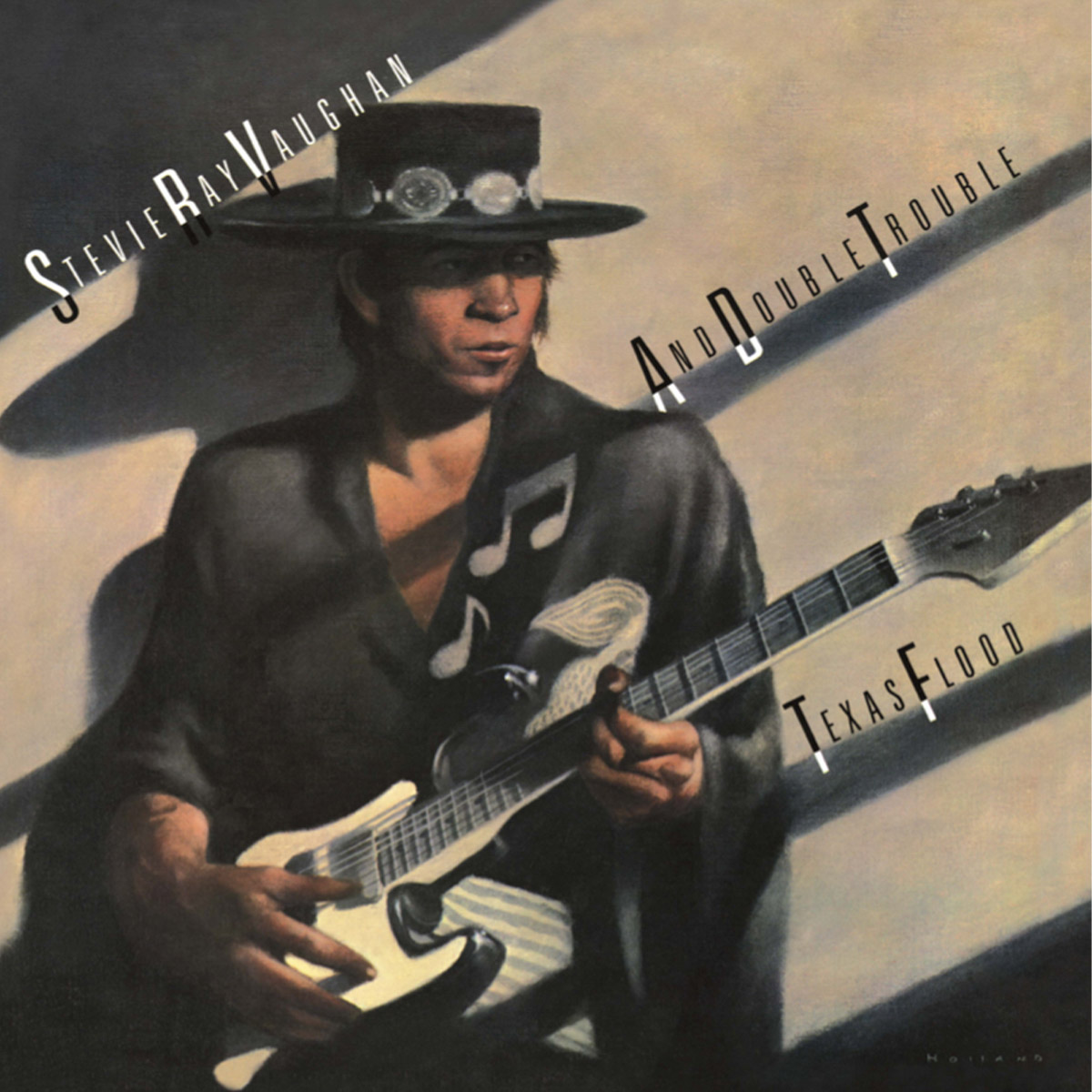
The documented equipment circumstances include Fender Vibroverb amplifiers and a Dumbleland Special belonging to Jackson Browne. Those details should not be turned into track-by-track equipment assignments unsupported by the sources. Similarly, knowing that Vaughan’s familiar principal instrument was a Stratocaster is different from proving its use on every individual take. The illustration draws on his appearance in this period without claiming to reconstruct one studio moment photographically. The work of the trio remains more important to an understanding of the album than a supposedly exhaustive list of equipment that cannot actually be verified.

Original songs within a living tradition
“Love Struck Baby” and “Pride and Joy” open the album before the title track changes its proportions. “Texas Flood” was written by Larry Davis and Joseph Wade Scott and had been recorded by Davis in 1958. Vaughan made it an important part of his repertoire without becoming its original author. That distinction belongs to an attentive appreciation of blues history: a performer’s personal adoption of a song and the memory of its earlier life can coexist. They explain different parts of what makes a subsequent version significant, rather than competing for the same credit.
The second side of the AP double LP contains “Tell Me” by Chester Burnett, known as Howlin’ Wolf, and “Testify” from the Isley Brothers’ repertoire. One edition listing confuses the latter with a different song of the same name by the Parliaments. Ronald, O’Kelly and Rudolph Isley are therefore identified here as the writers. Matching titles alone cannot establish correct authorship. Such apparently small distinctions matter in a repertoire-based record, because the composers’ names preserve a route back to earlier performances and to the separate histories from which the programme was assembled.
The third side combines Vaughan’s instrumental “Rude Mood” with Buddy Guy’s “Mary Had a Little Lamb” and “Dirty Pool”, written by Vaughan and Doyle Bramhall. Together they place different approaches to the blues tradition alongside one another: original instrumental work, interpretation of an established repertoire piece and collaborative songwriting. Bramhall’s writing credit should not be mistaken for an additional performing credit. The documented ensemble remains the trio. Keeping that distinction clear allows both the composition and the particular recording to retain their own histories and the people responsible for each.
“I’m Cryin’” and “Lenny” occupy the fourth side. The closing instrumental is dedicated to Vaughan’s then wife, Lenora “Lenny” Bailey. After the preceding vocal songs, it gives the guitar a different task: carrying the melodic narrative without another line of lyrics, while Shannon and Layton help shape its surroundings. The dedication provides a specific personal background but does not determine what every listener must feel. Part of the openness of such an ending lies precisely there: a biographical occasion becomes music capable of continuing beyond the circumstances that first prompted it.
The Analogue Productions edition across four sides
The edition offered here is Analogue Productions AAPB 096-45, two LPs running at 45 RPM. Ryan K. Smith cut the reissue at Sterling Sound. The publisher identifies the source as the original analogue half-inch master tapes running at 30 inches per second, with a Neumann VMS 80 used for cutting. Gary Salstrom is documented for plating and Quality Record Pressings for manufacture. This version belongs to the Texas Hurricane box-set programme and later appeared as a separate double LP. Those details describe the reissue, rather than every release carrying the album’s title.
The four sides divide the ten tracks into groups of three, two, three and two. That introduces additional interruptions compared with a single LP, while also creating clearly defined sections for deliberate listening. The final side, pairing “I’m Cryin’” with “Lenny”, retains a distinct concluding character. Whether this arrangement suits individual listening habits is a worthwhile consideration when choosing an edition. Rotational speed alone cannot establish how a particular cut will perform on a particular system; it is one relevant characteristic among several, alongside the source, mastering and manufacture.
The first documented standalone release from 2016 specifies 200 grams, while the 2022 repress is listed at 180 grams. Current publisher information describes 180 grams, although the stock batch has not been physically weighed here. A gatefold jacket forms part of the presentation. The edition combines traceable production details with the complete original ten-track programme. At its centre remain three musicians who used an unexpectedly available studio and recorded the language they had already developed together. Everything that followed adds interest to that beginning; the record does not need its documented history enlarged by additional legend in order to matter.
You order from Michael 45 in Germany. We arrange the US import and ship from Hilden.
More by Stevie Ray Vaughan: Couldn’t Stand The Weather · Soul To Soul
Customer question: Buying Analogue Productions records in Europe
Musicians
Participants and documented credit status. Track references correspond to the tracklist.
- Stevie Ray Vaughanguitar, vocalsParticipation: Album personnel
- Tommy Shannonelectric bassParticipation: Album personnel
- Chris LaytondrumsParticipation: Album personnel


Main sessions: 22–24 November 1982, Down Town Studio, Los Angeles. Producers: Stevie Ray Vaughan, Richard Mullen, Tommy Shannon and Chris Layton; executive producer: John H. Hammond. Engineer: Richard Mullen; mixing: Lincoln Clapp; separate I’m Cryin’ vocal recorded by Clapp. Original mastering: Ken Robertson; cover: Brad Holland. Testify: Isley Brothers, not the unrelated Parliaments song. AP: Ryan K. Smith, Sterling Sound; Gary Salstrom, plating; Quality Record Pressings.

Reviews
There are no reviews yet.