The fourth player brings another voice
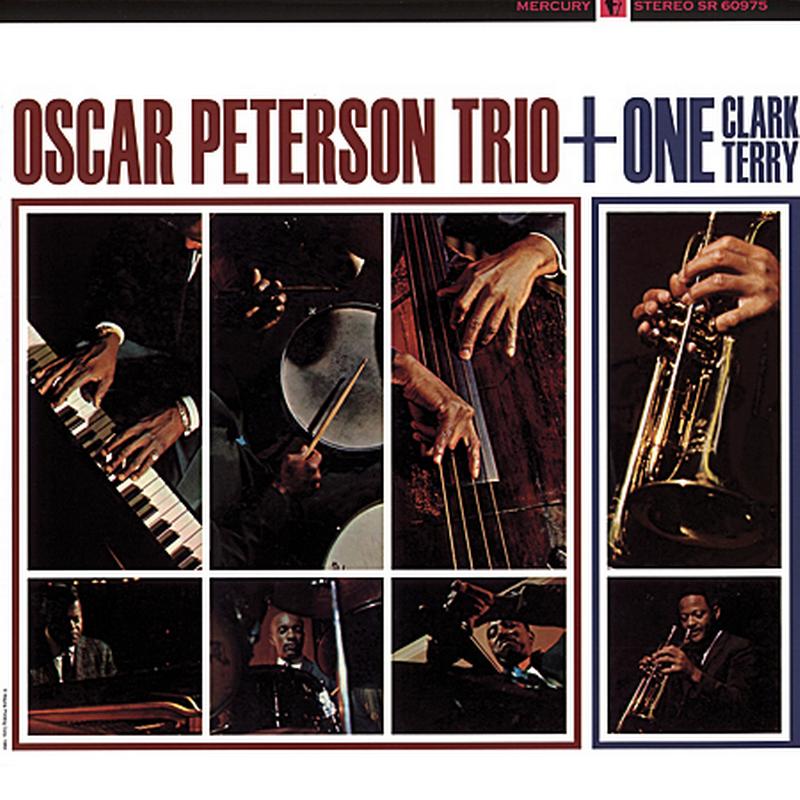
The “+ One” in the title sounds like a modest addition. Yet Clark Terry brings more than an extra instrument to Oscar Peterson’s trio. Trumpet, flugelhorn and his unmistakable way of singing change the possibilities of the conversation. Peterson, Ray Brown and Ed Thigpen meet a musician whose personality can be apparent within a brief phrase. Recorded in New York in August 1964, the album pairs an established trio with a guest who immediately emerges as a distinct voice.
Terry had worked with Count Basie and Duke Ellington. Here he joins a rhythm section that needs little introduction to one another: Brown on double bass, Thigpen on drums and Peterson at the piano. For the listener, it is a particularly clear arrangement. Three instruments establish the harmonic and rhythmic setting, while the horn introduces another melodic line. Leadership can shift within a tune.

When the horn player starts to sing
“Mumbles” and “Incoherent Blues” place Terry in a different role. His deliberately indistinct scat singing plays with syllables, articulation and the suggestion of spoken language. The humour resides in the performance itself. Even without an intelligible sentence, a phrase can begin, hesitate, answer or accelerate. The voice becomes an instrument with a pronunciation of its own.
Terry wrote both pieces, which were also issued together as a Mercury single. They are more than incidental studio diversions on an instrumental album. In the original sequence, each closes a side, giving the two halves their own punchline. Between them, try comparing Terry’s vocal articulation with his horn phrasing. Different ways of producing sound can express a related sense of timing and humour.

Broadway, blues and music from within
The rest of the programme combines standards with compositions by members of the group. “Brotherhood of Man” is by Frank Loesser; “They Didn’t Believe Me” by Jerome Kern and Herbert Reynolds. “Mack the Knife” reaches back to Brecht and Weill’s The Threepenny Opera, with the English adaptation forming part of its subsequent history. In an instrumental performance, a familiar melody provides shared ground without prescribing the players’ responses.
Peterson contributes “Blues for Smedley”, “Roundalay” and “Squeaky’s Blues”, among other pieces. He also wrote the album’s liner notes. The pianist appears here as player, composer and someone introducing the project to its audience. The record originally came out on Mercury, a useful distinction because the present reissue belongs to the Verve and UMe Acoustic Sounds Series. That programme draws on several historical catalogues; it does not change where this recording began.
This edition
AMER 89540 is a 180-gram Acoustic Sounds Series LP playing at 33⅓ RPM. Acoustic Sounds identifies the original analogue master tape as its source, Quality Record Pressings as its pressing plant and a Stoughton Printing tip-on gatefold as its jacket. The ten-track programme includes both of Clark Terry’s vocal performances.
Series: Verve – all 34 records: voices, organ and bossa nova
Musicians
Documented selection of participating musicians. Personnel may vary by track; this list does not claim to be complete.
| Name | Instrument / role |
|---|---|
| Clark Terry | Flugelhorn, Trumpet, Vocals |
| Oscar Peterson | Piano |
| Ray Brown | Double bass |
| Ed Thigpen | Drums |

Reviews
There are no reviews yet.