Ellington at close range: four musicians and room to explore
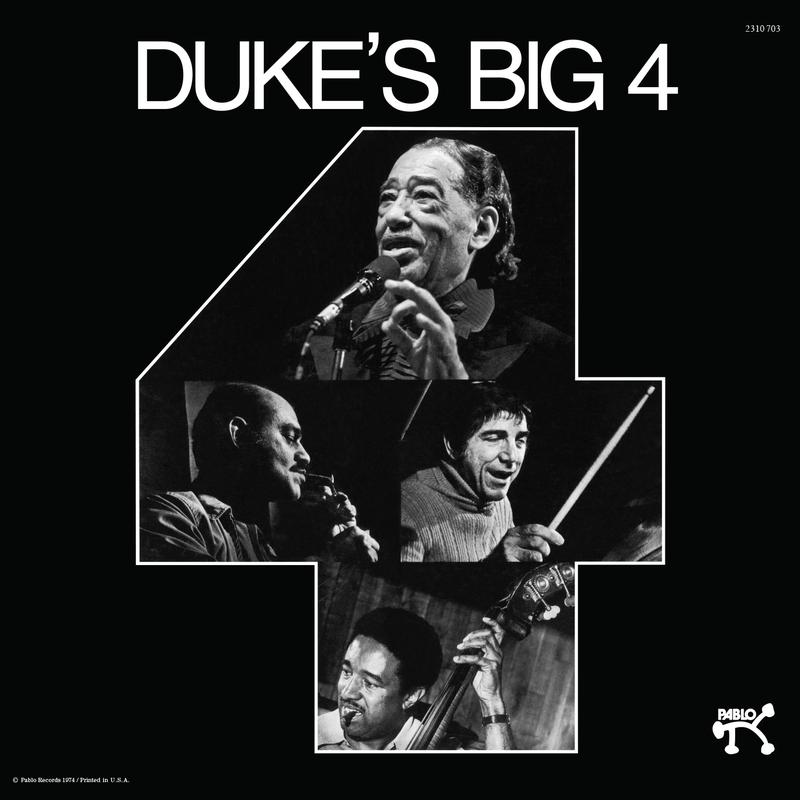
The name Duke Ellington readily evokes an orchestra: carefully related horn colours and compositions whose identities are bound to particular soloists. Duke’s Big 4 changes the distance. Ellington sits at the piano with Joe Pass on guitar, Ray Brown on double bass and Louie Bellson on drums. Four musicians open another perspective on his musical language. His understanding of orchestral writing has not disappeared; it operates under different conditions. An individual piano figure, a chord or a partner’s response can acquire particular weight within a group small enough for each relationship to remain easy to follow.
The session took place in Los Angeles on January 8, 1973, with Norman Granz producing. The album followed on Pablo in 1974. It belongs to Ellington’s later work, although its appeal need not be reduced to the historical significance of a late recording. The personnel themselves provide ample reason for close attention. Pass, Brown and Bellson play instruments capable of both support and independent expression. Ellington participates as the pianist in a compact exchange, bringing a different emphasis from his role directing a large ensemble. That change in position helps define a useful approach to the whole album.
If you know Ellington’s themes primarily through orchestral performances, the smaller setting offers a chance to consider what else those compositions can do. Recognising the tune is only the beginning. How much of its character rests in its rhythmic approach? Which harmonic turn remains significant when no horn section supplies its colour? What can the guitar contribute, and what relationship does that create with the piano? These questions require no score. They arise naturally from the instrumentation, making the album particularly interesting for listeners wanting to become more familiar with Ellington at the keyboard. A celebrated name leads to a strikingly intimate musical scale.

Seven selections offering different views of the quartet
Cottontail opens the first side, placing a familiar Ellington theme at the entrance to a programme that explores established material in another environment. The Blues follows, its uncomplicated title offering a different reference point: a shared form within which personalities can develop. A distinctive composition and a common musical framework already provide contrasting possibilities. Listen to how the group approaches each starting point. A motif can establish continuity, a rhythmic gesture can begin movement, and a short reply may matter as much as an extended line. The quartet supplies the common setting through which those different possibilities can be heard.
The Hawk Talks was written by Louie Bellson, giving the drummer a compositional presence on an album headed by Ellington’s name. Prelude to a Kiss, credited to Ellington, Irving Gordon and Irving Mills, closes the first side. The sequence places different kinds of musical concentration beside one another. The quartet can work with a recognisable theme, shape a blues and follow the detail of an established song melody. The personnel remain constant while the repertoire changes the task. That is part of the appeal of a small ensemble whose experienced players have sufficient independence to respond in individual ways.
Side B begins with Love You Madly, continues through Just Squeeze Me (But Don’t Tease Me) and finishes with Everything But You. Lee Gaines shares the writing credit on Just Squeeze Me; Don George and Harry James are co-writers of Everything But You. Ellington is involved as writer or co-writer on six of the seven pieces, with Bellson’s contribution the exception. The programme is therefore strongly rooted in Ellington’s musical world while explicitly making room for a partner. Four tracks on the first side and three on the second create a clear album shape in which each performance belongs to the same larger encounter.

Joe Pass, Ray Brown and Louie Bellson as individual voices
Joe Pass changes the quartet’s possibilities through the presence of his guitar. Beside the piano is another instrument capable of carrying harmony while also forming mobile single-note lines. That overlap creates a particular relationship: the two musicians can share an area of musical responsibility without making identical contributions. A rewarding listening approach follows how that work is distributed. When does one instrument leave space for the other? How might an accompanying figure become an answer in its own right? With fewer simultaneous voices, the ensemble makes those exchanges more accessible, allowing a shift of attention to reveal another part of the performance.
Ray Brown’s double bass combines the lowest register with rhythmic direction. Following it consciously can alter your perception of the whole recording. Instead of concentrating only on the solos, you begin to notice transitions and the continuity maintained beneath them. Louie Bellson adds the drums to this relationship. His role as composer of The Hawk Talks further reminds us that the rhythm section consists of creative musicians. Bass and drums are specific voices with their own possibilities, and their contribution cannot be adequately described as interchangeable support. The interest lies partly in how these responsibilities relate to one another throughout the programme.
Ellington’s piano belongs within that network. The change in perspective allows the composer to be followed as a player, giving his music weight and direction in the moment of ensemble performance. Familiar melodies remain available, while a chord or a pause can guide attention towards less obvious details. For a jazz collection, Duke’s Big 4 consequently offers a valuable companion to the orchestral records. It provides a distinct encounter with a familiar musical imagination, shaped by the particular people in the room. The four names in the personnel list help explain how a modest ensemble can offer such a substantial subject for repeated listening.
Kevin Gray’s mastering for the Analogue Productions Pablo series
The edition offered here, AAPJ 153, is a 180-gram stereo LP at 33⅓ RPM in the Analogue Productions Pablo series. According to the publisher, Kevin Gray mastered it from the original analogue master tape; the edition documentation associates the cut with Cohearent Audio. Quality Record Pressings handles pressing, and Stoughton Printing supplies a single-pocket tip-on jacket. This is a single sleeve rather than a gatefold. Specific distinctions of that kind are more useful to collectors than a general packaging description repeated across a series without checking the individual release’s actual presentation.
The single LP retains the programme’s two-part arrangement: four tracks on A and three on B. Prelude to a Kiss leads to the side change, followed by Love You Madly at the start of the second section. Playback at 33⅓ RPM allows these extended sequences with one interruption. A preference between editions also depends on how you wish to experience an album. Another speed does not, by itself, guarantee a result or replace a clear mastering credit. Here the attraction includes an identified mastering engineer and a side layout corresponding to the familiar proportions of the album.
Duke’s Big 4 suits listeners interested in Ellington’s music as a flexible, personal activity: seven selections, four players and a single recording date. Pass, Brown and Bellson give it a distinct place even within a substantial Ellington collection. Recognisable themes become occasions to follow the relationships between instruments and to pay closer attention to the pianist behind the celebrated orchestra leader. The record provides a manageable entry into that perspective while leaving plenty for another visit, particularly when you shift your attention from one member of the quartet to another. You order from Michael 45 in Germany. We arrange the US import and dispatch from Hilden.
Customer question: Buying Analogue Productions records in Europe
Series: Pablo – all 30 records, musicians and the session book
Musicians
Participants and documented credit status. Track references correspond to the tracklist.
- Duke EllingtonPortrait reference 1972pianoParticipation: Original album quartet; seven tracks
- Joe PassExisting portrait; not a session depictionguitarParticipation: Original album quartet; seven tracks
- Ray BrownExisting portrait reference 1976double bassParticipation: Original album quartet; seven tracks
- Louie BellsonExisting portrait reference 1978drumsParticipation: Original album quartet; seven tracks


Los Angeles, January 8, 1973; first released in 1974. Norman Granz: producer; Benny Green: liner notes – the British writer, not the pianist on All for You. Duke Ellington: piano; Joe Pass: guitar; Ray Brown: double bass; Louie Bellson: drums and composer of The Hawk Talks. Ellington wrote or co-wrote six of the seven pieces. Just Squeeze Me: 6:03 in the exact pressing tracklist. Kevin Gray: reissue cut at Cohearent Audio.

Reviews
There are no reviews yet.