
Two musicians remember Jimmy Blanton
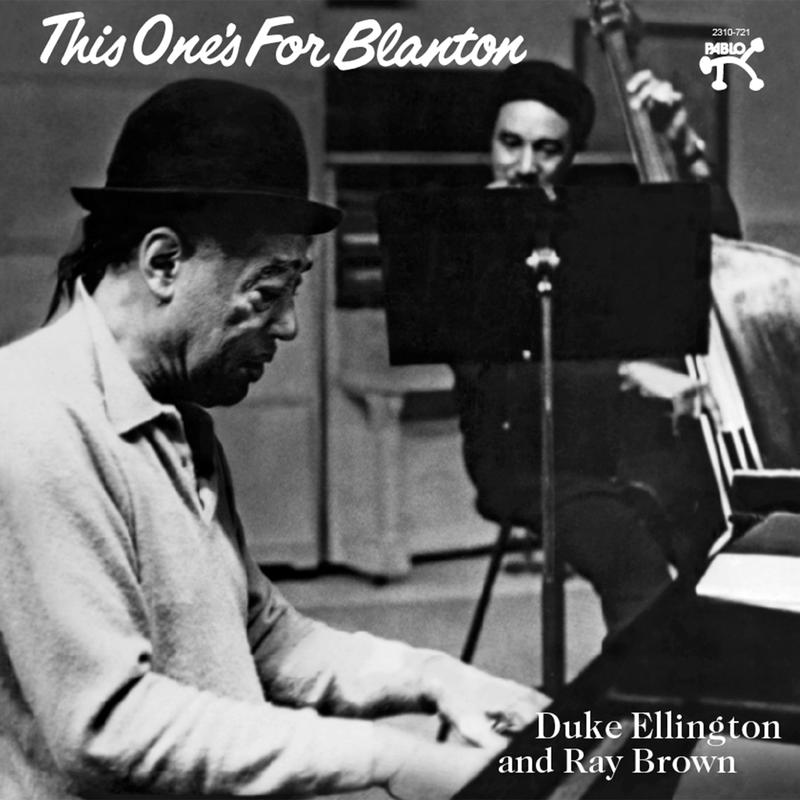
On December 5, 1972, Duke Ellington and Ray Brown entered a Las Vegas studio. Piano and double bass were enough for This One’s For Blanton: two musicians paying tribute to a bassist whose influence extended far beyond his short life. Jimmy Blanton had played in Ellington’s orchestra from 1939 to 1941, opening new solo possibilities for the double bass. Brown was among the musicians who carried that development forward.
Norman Granz produced the session at United Recording. The dedication connects Ellington’s earlier partnership with Blanton to this later encounter with Brown. The history is not a prerequisite for enjoying the music, but it adds a point of reference. Two instruments meet on a record that combines remembrance with a new shared occasion.

Ray Brown and the conversation for two
Without drums or a horn section, each accompanying decision becomes especially interesting. When does the bass carry the movement, when does the piano respond, and where do they meet? Those questions provide a useful entrance to a duo recording. They direct attention to the relationship between the players rather than simply waiting for a featured solo.
The programme includes Do Nothin’ Till You Hear From Me, Pitter Panther Patter and Sophisticated Lady. Pitter Panther Patter connects directly to the Blanton period. Brown and Ellington revisit that link in another setting and at another moment. This is what can make a tribute feel alive: a memory becomes an opportunity to make music together.

Four movements for piano and bass
Side two is devoted to the Fragmented Suite For Piano And Bass. Ellington and Brown composed it together, and its four movements form a connected part of the programme. After the five selections on the first side, the focus shifts from individual pieces to a larger form.
Hearing the suite without interruption allows attention to its transitions. What joins the sections, which ideas return, and how do the players redistribute their roles? The small ensemble makes those relationships accessible. A record like this encourages repeated listening because attention can shift each time: first towards Ellington, then towards Brown, and finally towards what develops between them.
The Pablo reissue and Doug Sax’s cut
The current Analogue Productions edition AAPJ 154 is a stereo 180-gram LP running at 33⅓ RPM. It uses Doug Sax’s 1994 cut at The Mastering Lab; it is not a new 2024 cut. The label identifies the original analog master tape as the source for that mastering. QRP pressing and RTI plating are documented for the current edition, together with a Stoughton tip-on gatefold.
Distinguishing the original recording, an existing cut and a later pressing is part of describing this edition accurately. It also leaves space for its central attraction: two musicians, two instruments and a dedication. Taking time with it means following a musical exchange whose starting points are unusually clear.
You order from Michael 45 in Germany. We arrange the US import and dispatch from Hilden.
More from the series: Analogue Productions (Pablo)
Customer question: Buying Analogue Productions records in Europe
Series: Pablo – all 30 records, musicians and the session book
Musicians
Participants and documented credit status. Track references correspond to the tracklist.
- Duke Ellingtonpiano, compositionParticipation: Album personnel
- Ray Browndouble bass, composition (suite)Participation: Album personnel


Duo throughout. Ellington and Brown jointly composed the Fragmented Suite. Produced by Norman Granz. The current pressing uses Doug Sax’s 1994 cut.

Reviews
There are no reviews yet.