A new chapter for Booker Ervin
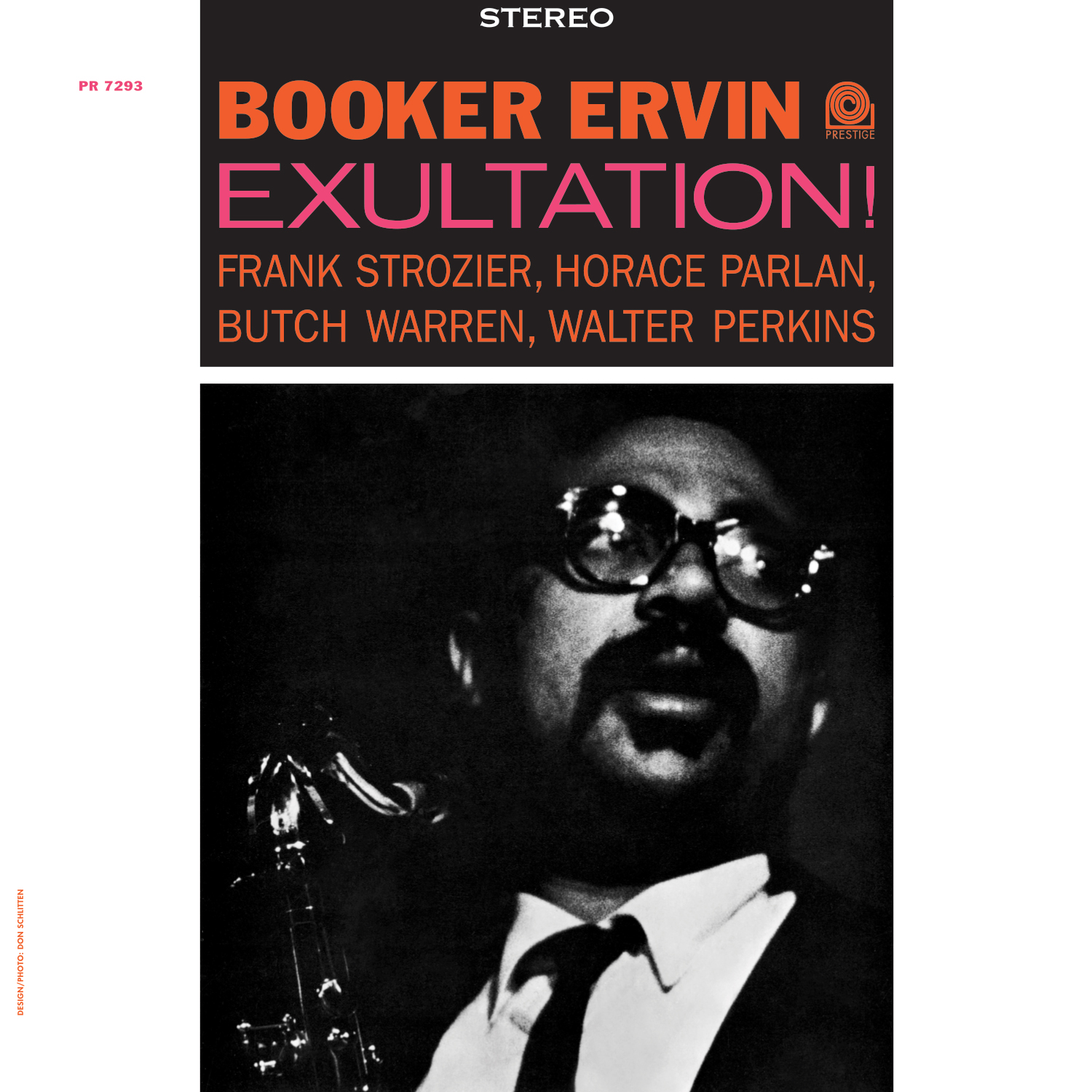
Exultation! begins Booker Ervin’s story as a leader at Prestige. Recorded on 19 June 1963, it presents a tenor saxophonist whose personality was already firmly established but who was gaining a new setting for his own music. Ervin had played with Charles Mingus and had made albums under his own name for other labels. His Prestige debut is therefore no tentative first attempt. It brings an experienced, distinctive musician together with a group whose relationships extend beyond a single appointment in the recording studio.
The front line is especially attractive: Frank Strozier’s alto saxophone stands beside Ervin’s tenor. Two saxophones can blend closely while opening clearly different registers and expressive spaces. Unlike a trumpet-and-tenor quintet, the second melodic instrument here belongs to the same family, yet has another range and response. This encourages attention both to the shared presentation of themes and to the separation of individual voices. A horn passage can consequently feel unified and layered at the same time. The instrumentation is an essential part of this record’s identity, not merely a detail in its credits.
Producer Don Schlitten brought the quintet to Rudy Van Gelder’s studio in Englewood Cliffs. Schlitten also handled design and photography, while David Himmelstein supplied the original liner notes. The album appeared in 1963 as Prestige PRST 7293. For collectors familiar with Ervin’s subsequent Prestige recordings, this starting point has particular interest. Important relationships are already present, but the record need not be treated simply as preparation for a later achievement. Exultation! has its own programme and its own ensemble, both deserving attention on their individual merits.

Horace Parlan and two shared histories
Pianist Horace Parlan was a familiar partner for Ervin. Both belonged to Charles Mingus’s musical world and can be heard on recordings such as Mingus Ah Um. That experience amounts to more than a matching entry in two biographies. Mingus’s music demanded attention to form, collective movement and the distinct characters of other players. On this quintet album, Ervin and Parlan meet under different conditions, but their shared past gives the relationship a specific background. The pianist brings an independent history and expressive identity to the session rather than simply filling an instrumental position.
Parlan’s playing developed under particular physical conditions: childhood polio had restricted his right hand. His distribution of musical tasks between the hands consequently became part of his individual pianistic language. That biographical fact should not reduce the musician to a limitation. The interest remains in how he weights a phrase, how a chord answers a horn entrance and how rhythmic decisiveness can coexist with melodic flexibility. Exultation! offers an opportunity to hear Parlan as an equal participant in the quintet, rather than regarding the piano as harmonic scenery behind the saxophones.
Frank Strozier and Walter Perkins also brought a history of working together. Both had been involved with the Chicago group MJT+3. Strozier plays alto saxophone here and Perkins drums. The quintet thus does not simply unite five unrelated careers: two established partnerships are brought into a new combination. That makes the record interesting as a document of musical connections between groups, cities and individuals. Jazz history is shaped not only by the prominent name on the front of a sleeve but also by these recurring relationships, through which experience moves from one ensemble to another.
Butch Warren completes the group on double bass. His name belongs in this picture as fully as those of the two saxophonists. A quintet with two active horn voices needs a bass part that maintains harmonic orientation and rhythmic continuity. Warren and Perkins give the soloists a common reference point, while Parlan can add density, respond or leave space. On a return to the album, following the rhythm section deliberately offers another view of the same selections. The foreground voices retain their character, but the conditions that allow them to move freely become easier to recognise.

Standards and original material in conversation
The original programme contains Mooche Mooche, Black & Blue, Mour, Just in Time, No Land’s Man and Tune In. Even that sequence of titles indicates a range of starting points: music from within the band’s own circle sits beside songs with longer histories. Ervin’s Mooche Mooche and Tune In are important reminders of his role as a composer. The leader determines more than the colour of his solos; he also supplies material around which the whole ensemble can organise itself. Themes and improvised continuations belong to the same musical personality.
Black & Blue leads back to Fats Waller, Harry Brooks and Andy Razaf. The song carries a history extending beyond its harmonic usefulness as a jazz standard. Its words connect personal pain with racial exclusion. An instrumental performance does not sing those lyrics, but neither does it erase their origin. It can therefore be rewarding to attend first to the melody’s shape and composure before following the improvisations that depart from it. A standard is not entirely neutral material. It arrives with memories and meanings that can remain relevant even when no vocalist is present.
Just in Time brings the Broadway world of Jule Styne, Betty Comden and Adolph Green into the programme. Written for the musical Bells Are Ringing, it sits here beside Black & Blue and the original compositions. That proximity shows how naturally jazz musicians could bring different repertoires together. A piece is characterised by more than its place of origin. It is also shaped by the particular ensemble performing it: the voices carrying its theme, the development of the solos and the rhythm section’s handling of the movement. Those questions can be followed throughout the record.
Mour and No Land’s Man invite the same open attention to musical form without requiring a choice between conflicting composer attributions. Both belong to the documented original programme and to this specific encounter between five musicians. For the album as a whole, the significant point is that the group does more than interpret familiar songs. Established melodies appear beside material with fewer prior associations, creating different listening situations. Recognition and discovery can coexist. The differing track configurations documented for later pressings are explained separately in the tracklist section, where the edition question can be kept distinct from the musical account.
A Prestige stereo session at 33⅓ rpm
The Analogue Productions edition carries catalogue number APRJ 7293. Kevin Gray is credited with mastering at Cohearent Audio, and manufacture is by Quality Record Pressings. The current label description specifies 180-gram vinyl and a tip-on jacket; earlier editions of the title were also issued on 200-gram vinyl. Such differences matter when identifying a particular pressing, but they do not replace attention to the recording itself. This is a stereo quintet session from Van Gelder’s studio, preserving a specific point in Ervin’s career through its distinctive personnel and repertoire.
A single LP at 33⅓ rpm is well suited to this music. Several pieces and their changing perspectives can be experienced as a sustained sequence. That is particularly useful when listening to the interplay: one theme remains in the memory as the next selection presents a different task. Attention can move from Ervin to Strozier, from Parlan to Warren and Perkins, without the album being repeatedly interrupted by additional side changes. In this setting, playback speed serves the continuity of the programme and the pleasure of following a group over a complete record side.
Exultation! is a rewarding choice for listeners who want to know Booker Ervin beyond his striking contributions to the Mingus world. It presents him as leader, composer and partner within a differently constituted ensemble. Frank Strozier’s alto voice, Horace Parlan’s piano and the Warren–Perkins rhythm partnership give the encounter its particular shape. The beginning of a label association becomes an independent musical story: five musicians, several shared paths and enough differences for familiarity to create new possibilities. It is a record whose place in a discography matters because of the people and music within it.
You order from Michael 45 in Germany. We arrange the US import and dispatch from Hilden.
More by Booker Ervin: The Freedom Book · The Song Book
Customer question: Buying Analogue Productions records in Europe
Series: Analogue Productions Prestige – all 50 records, musicians and session paths
Musicians
Participants and documented credit status. Track references correspond to the tracklist.
- Booker Ervintenor saxophoneParticipation: Album personnel
- Frank Strozieralto saxophoneParticipation: Album personnel
- Horace ParlanpianoParticipation: Album personnel
- Butch Warrendouble bassParticipation: Album personnel
- Walter PerkinsdrumsParticipation: Album personnel


Recorded by Rudy Van Gelder, Englewood Cliffs, 19 June 1963. Production, design and photography: Don Schlitten. Liner notes: David Himmelstein. AP mastering: Kevin Gray; Momchil Zanev is also credited for the side-B cut on the documented 2023 pressing. The list shows the six titles of the original programme. Some AP pressing records list eight entries including short alternate versions. Whether the pressing on offer includes the additional alternate versions is not confirmed; sources also differ on the composers of Mour and No Land’s Man.

Reviews
There are no reviews yet.