One violinist, two musical languages
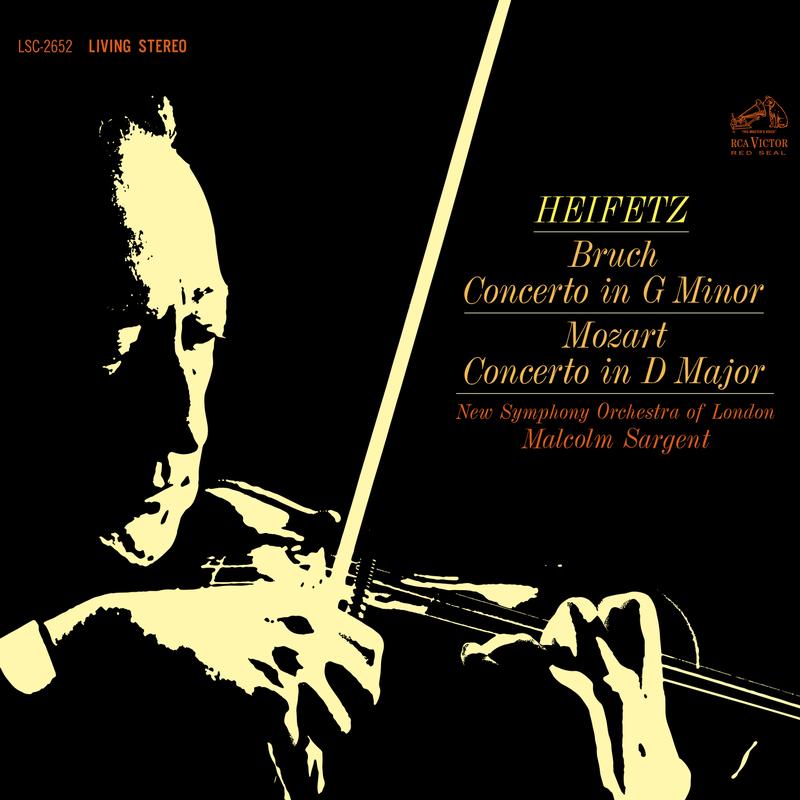
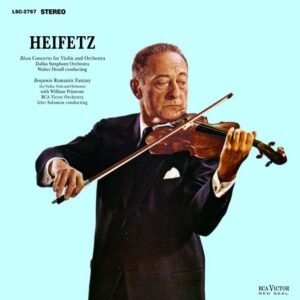
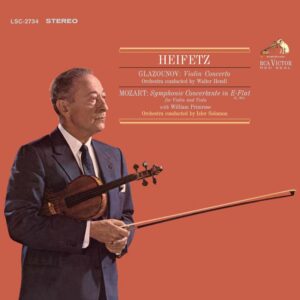
Bruch’s First Violin Concerto and Mozart’s Fourth can easily be grouped together as great violin music. The more interesting question is how they differ. Bruch asks for long lines and a close relationship between soloist and orchestra. Mozart poses different questions about articulation, movement and musical speech. With Jascha Heifetz, Sir Malcolm Sargent and the New Symphony Orchestra of London, that contrast becomes the point of the coupling.
Nearly nine decades separate the works. Mozart wrote his D-major Concerto K. 218 in 1775; Bruch revised his G-minor Concerto in the 1860s. The shared performers give us a stable reference from which to hear the differences: the same soloist, but two distinct ideas of how a violin can converse with an orchestra.

Why Bruch begins with a “Vorspiel”
Bruch calls the opening Vorspiel: Allegro moderato. The heading is not incidental. The movement leads directly into the Adagio, preparing a larger musical span. Hearing it merely as an introduction to the slow movement’s celebrated melodies overlooks how closely the two parts are connected.
The work’s history reflects that search for a convincing shape. Following an initial performance in 1866, Bruch revised the concerto extensively. Joseph Joachim was an important adviser and performed the revised version in Bremen in 1868. The familiar concerto was not simply complete at the first attempt. Its apparent inevitability emerged through work, feedback and reconsideration.

Mozart leaves space for the interpreter
Heifetz is credited as the cadenza author for the Mozart concerto on this recording. It is a small detail with considerable significance. A cadenza is more than an opportunity to display technical command. It gives the soloist space to respond to what has already been heard and bring the movement’s character into focus from an individual perspective.
The finale also rewards closer attention. Its heading combines Andante grazioso with Allegro ma non troppo: contrasting kinds of movement are explicitly part of the design. The pleasure is not confined to the return of a tune, but includes the change in musical attitude between its sections. Articulation and phrasing can make those shifts compelling within a seemingly clear structure.
Compare without choosing a winner
There is no need to decide which concerto wins. The coupling works because the compositions illuminate different qualities of the instrument. In Bruch, follow the extended line into the Adagio. In Mozart, listen to smaller changes of direction and the exchange between solo passages and the full ensemble.
The 45 RPM edition keeps Bruch’s Vorspiel and Adagio together on the first side. The finale follows on side B, with Mozart occupying the second LP. That practical arrangement preserves an important musical connection at the opening. It also suggests a way to listen: follow the broad shape on one pass, then return for the orchestra’s individual answers and the details that make the solo line feel alive.
More from the series: RCA Living Stereo Series
More by Jascha Heifetz: Bruch: Scottish Fantasy / Vieuxtemps: Concerto No. 5
Customer question: Buying Analogue Productions records in Europe
Series: RCA Living Stereo – all 25 titles, conductors and soloists
Musicians
Named soloists, conductors and ensembles. The album credits do not individually name every orchestra member.
- Jascha HeifetzViolin
- Malcolm SargentConductor
- New Symphony Orchestra of LondonOrchestra



Reviews
There are no reviews yet.