

Two ways of hearing a solo voice
This pairing takes a less familiar route into the Heifetz catalogue than the standard violin-concerto landmarks. Miklós Rózsa’s concerto and Arthur Benjamin’s Romantic Fantasy invite attention to the relationship between virtuosity and song, between a prominent voice and the colours surrounding it. Even their scoring points in different directions: Benjamin’s work is for violin, viola and orchestra.
That difference changes the way we listen. A concerto lets us follow one solo voice asserting its place. In the fantasy, the conversation between two related but distinct instruments offers another kind of invitation. The viola is more than a lower extension of the violin. Its register and weight give the exchange another perspective, another way of feeling a musical movement.

Rózsa and a particular performer
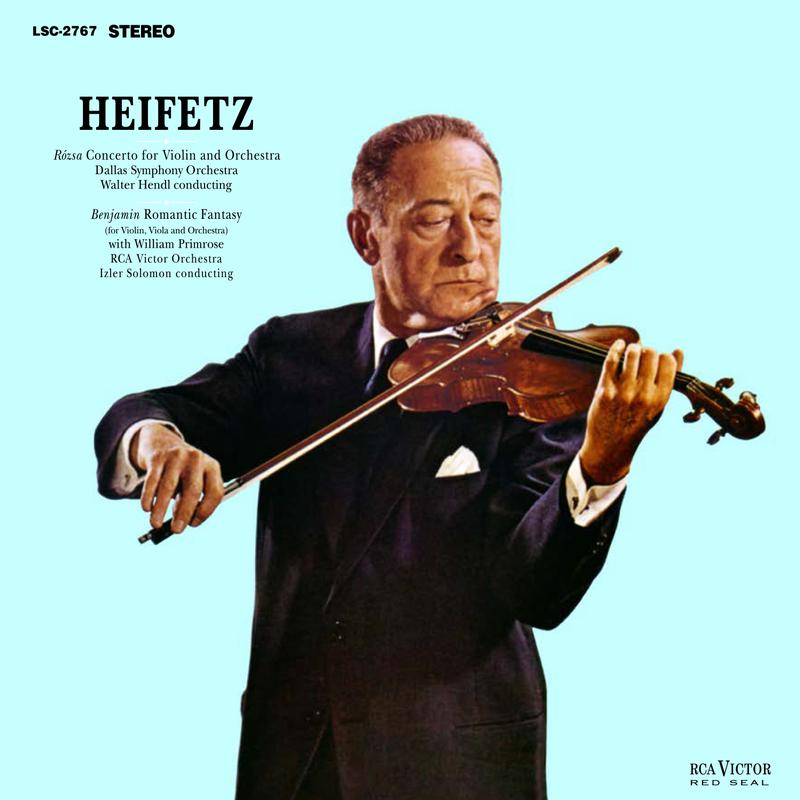
Rózsa’s Violin Concerto, Op. 24, dates from 1953 and has a close connection with Jascha Heifetz. The violinist gave its premiere on 15 January 1956 with the Dallas Symphony Orchestra under Walter Hendl. This is not simply a famous performer encountering an interesting score: the soloist belongs to the work’s early history.
If you know Rózsa chiefly through Ben-Hur or Spellbound, the record offers a way into his concert music without reducing it to a film score missing its images. Here, a long musical line must establish its own direction. Tension comes from the relationship between ideas, not a change of shot on screen. It is an opportunity to hear the composer outside an otherwise familiar frame.

A recommendation that reaches into the score
Emmanuel Bay, Heifetz’s piano partner, played an important intermediary role in Rózsa’s concerto. He brought the work to Heifetz, whose interest encouraged its completion. The connection between composer and soloist therefore predates the recording. The performer’s name represents a relationship with the work’s creation, not simply a later interpretation.
The opening also complicates the idea of a virtuoso vehicle. A clarinet ostinato begins the first movement, and the violin’s entry relates to its material. Early responses from violas and clarinet take up ideas associated with the solo line. Thematic work and virtuosity are intertwined: the orchestra participates in development instead of merely waiting to accompany another display.
Arthur Benjamin’s Romantic Fantasy, dating from 1935, places violin and viola together before the orchestra. Its scoring includes piano but omits trombones and tuba. That selection gives a concrete indication of the different balance available between soloists and ensemble. The pairing is not simply two opportunities for the same kind of violin brilliance. It presents different musical tasks for strings in the concert hall.
About this pressing
Analogue Productions · RCA Living Stereo · AAPC 2767-45 · 2 LPs · 180 g vinyl per disc · 45 RPM. Remastered and cut by Bernie Grundman from the original master tape. Pressed at Quality Record Pressings (QRP). Includes a two-panel insert.
Also on SACD: Rozsa: Concerto For Violin And Orchestra / Benjamin: Romantic Fantasy
Customer question: Buying Analogue Productions records in Europe
Series: RCA Living Stereo – all 25 titles, conductors and soloists
Musicians
Documented selection of participating musicians. Personnel may vary by track; this list does not claim to be complete. Walter Hendl and the Dallas Symphony Orchestra are assigned to the Rózsa recording. Full personnel for the Benjamin coupling remain unconfirmed.
- Jascha HeifetzViolin
- Walter HendlConductor
- Dallas Symphony OrchestraOrchestra


Reviews
There are no reviews yet.