One violin becomes a conversation
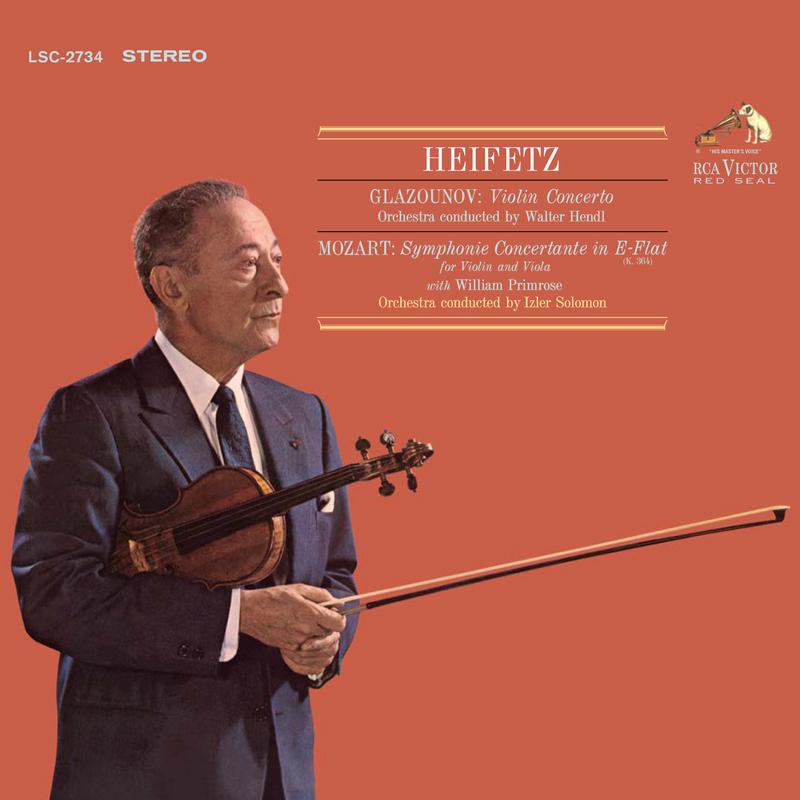
This coupling changes its scale as it unfolds. In Glazunov’s Violin Concerto, Jascha Heifetz is the central soloist. In Mozart’s Sinfonia concertante, William Primrose joins him on viola. Attention shifts from a single line to an exchange between two related but distinctly different instruments. That is more than a change in the personnel list. It alters the way we listen.
The conductor changes too: Walter Hendl directs Glazunov, while Izler Solomon leads Mozart. Four names on a sleeve can initially seem complicated. Once their roles are clear, the programme becomes easy to understand: two contrasting works connected by Heifetz and by the relationship between upper and lower solo strings.

Glazunov and Leopold Auer
Glazunov composed his A-minor Concerto, Op. 82, in 1904 and dedicated it to Leopold Auer. Heifetz studied with Auer in St Petersburg. There is therefore a specific teaching connection between composition and interpreter, rather than merely a broad association with Russian violin tradition: a concerto dedicated to the teacher, performed by one of his best-known pupils.
Its construction encourages us to hear a continuous argument. The slow section is embedded in the larger course of the work, without the usual pauses between concerto movements. The substantial cadenza is not an outside addition either; Glazunov wrote it himself. Technique and structure are linked. The task is not simply to overcome individual difficulties, but to maintain a comprehensible line through them.

The viola is not a darker echo
Mozart’s Sinfonia concertante, K. 364, composed in 1779, gives violin and viola independent roles. Primrose’s instrument is not there merely to reinforce the violin from below. The soloists answer, take over from one another and change their relationship to the orchestra. In the slow movement especially, follow the handover of a phrase. Does the idea remain the same when another voice continues it?
A fascinating detail appears in Mozart’s score: the solo viola is directed to tune a semitone higher. This is a fact about the composition, not a verified claim about the tuning Primrose used in this particular session. Even so, it reveals the importance Mozart attached to the viola’s presence and colour. The instrument is meant to stand beside the violin, not disappear behind it.
Primrose has his own path
William Primrose began as a violinist before making the viola his principal instrument. That background adds interest to his partnership with Heifetz without requiring a sweeping claim about their sound. Two soloists meet here with a shared world of string-playing craft, while representing different registers and musical roles.
On the 45 RPM edition, Glazunov occupies the first LP and Mozart the second. After the concerto’s continuous solo argument, the programme opens another kind of space. The question becomes less how one voice can hold everything together, and more what can develop between two voices. That shift makes the album something more engaging than a convenient pairing of repertoire.
More from the series: RCA Living Stereo Series
Customer question: Buying Analogue Productions records in Europe
Series: RCA Living Stereo – all 25 titles, conductors and soloists
Musicians
Named soloists, conductors and ensembles. The album credits do not individually name every orchestra member.
- Jascha HeifetzViolin
- Walter HendlConductor (Glazunov)
- Izler SolomonConductor (Mozart)
- William PrimroseViola (Mozart)
- RCA Victor Symphony OrchestraOrchestra



Reviews
There are no reviews yet.