The soloist enters a conversation
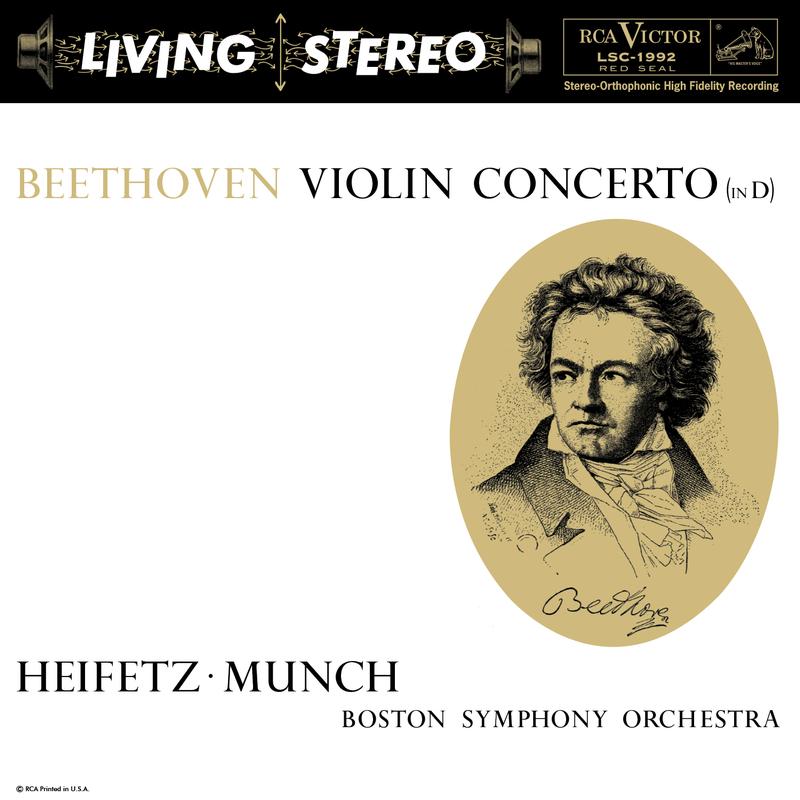
Beethoven’s Violin Concerto begins with quiet timpani strokes. Before the violin takes the lead, the orchestra develops its ideas at length. That opening establishes an essential relationship in the D-major concerto, Op. 61: the soloist joins a conversation already underway. Jascha Heifetz, Charles Munch and the Boston Symphony Orchestra recorded the work in Boston’s Symphony Hall on November 27 and 28, 1955. They had performed it together in the same hall immediately before the recording sessions.
The recording therefore follows shared work on the score in front of an audience. Munch had been the orchestra’s music director since 1949, and the RCA partnership documented a substantial part of his Boston years. Heifetz brought the background of a violinist whose training was closely connected with Leopold Auer. On this record that relationship is more than a biographical detail: he plays the Auer-Heifetz cadenza in the first movement. His connection to his teacher enters the performance at a central musical moment.

A cadenza with a personal history
A cadenza gives the soloist greater freedom within a concerto. With the orchestra silent, the violin can take up motifs, intensify them and make new connections. Heifetz uses Auer’s cadenza in his own version. If you know performances featuring the frequently played Kreisler cadenza, this passage offers a specific point of comparison. It directs attention toward interpretive decisions: which ideas the violinist emphasizes, and how an extended passage shaped largely alone finds its way back to the shared movement of the concerto.
Beethoven wrote his only completed violin concerto in 1806 for Franz Clement, who gave the first performance in Vienna that December. The young Joseph Joachim later helped advance its reputation with an 1844 London performance conducted by Felix Mendelssohn. The work’s familiar place in concert programs today can obscure that longer history. Hearing it again as a sequence of decisions, rather than anticipating every familiar turn, restores attention to the changing relationships within the score and the distinctive role of each participant.

From an extended argument to a dance
The opening movement occupies a substantial part of the concerto. Follow the themes as they pass between orchestra and solo violin, and notice how the violin maintains its line inside a larger structure. The Larghetto changes the focus. Its calmer motion brings ornaments and the relationship between sustained orchestral sounds and the solo voice forward. The transition into the finale then opens another world. The rondo draws energy from the return of its dance-like principal idea, each recurrence renewing the sense of direction.
Those three movements ask for different kinds of concentration. Include Munch and the orchestra deliberately in your listening: they introduce themes, alter the background and receive the soloist’s contributions. Heifetz’s cadenza is a striking personal element, but it does not exhaust the recording’s interest. The subject remains a concerto in which one violin shares long stretches with an entire orchestra. The changing responsibility for the musical argument provides a rewarding guide through the work, even when the score itself is already familiar.
This edition
The Analogue Productions RCA Living Stereo release, AAPC 1992-45, spreads the concerto across two 180-gram LPs running at 45 RPM. Bernie Grundman is credited for mastering and cutting, with the original master tape identified as the source by the publisher. Quality Record Pressings handles the pressing, and a two-panel insert is included. The edition presents the historic Boston stereo recording.
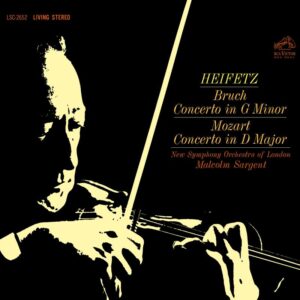
More by Jascha Heifetz: Mendelssohn: Concerto In E Minor / Prokofieff: Concerto In G Minor
Customer question: Buying Analogue Productions records in Europe
Series: RCA Living Stereo – all 25 titles, conductors and soloists
Musicians
Documented selection of participating musicians. Personnel may vary by track; this list does not claim to be complete.
| Name | Instrument / role |
|---|---|
| Jascha Heifetz | Violin |
| Charles Munch | Conductor |
| Boston Symphony Orchestra | Orchestra |
How Michael hears this edition
Listening impression · paraphrased from the video
Michael highlights the dynamic contrast: quiet violin passages give way to forceful orchestral entries. This contrast makes the 45 RPM edition particularly engaging for him.
🎧 Review video: 5 Extraordinary Audiophile Reissues For Your Collection
This video is hosted by YouTube (Google). It only loads once you switch on “Functional” in the cookie settings.

Reviews
There are no reviews yet.