A soloist within a symphonic argument
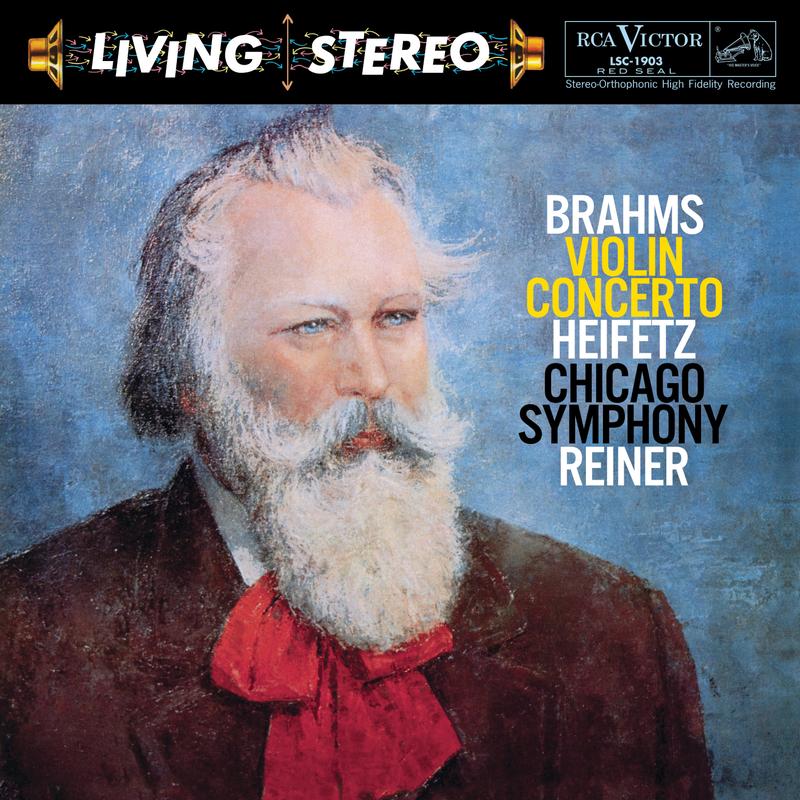
Brahms does not bring the violin in immediately. The orchestra first establishes the world the soloist will enter: themes, motion and tension already exist before the violin makes its first substantial statement. This is why the concerto offers more than a virtuoso leading role with accompaniment. Jascha Heifetz meets Fritz Reiner and the Chicago Symphony Orchestra in a performance that rewards attention to the musical responsibility on both sides.
The recording sessions took place in Chicago’s Orchestra Hall on February 21 and 22, 1955. Heifetz had performed in the same hall the previous day; his estate’s chronology records the concert and the subsequent RCA sessions separately. Reiner had become the orchestra’s music director in 1953. The recording therefore belongs to the early years of a partnership that would become an important part of the RCA catalogue.

Joseph Joachim behind the score
Brahms composed his only violin concerto in 1878 and dedicated it to Joseph Joachim, who advised him on the solo writing. Joachim played at the premiere in Leipzig’s Gewandhaus on January 1, 1879, with Brahms conducting. That collaboration helps explain the work’s character: the ambition of a large symphonic structure meets the practical possibilities of the violin, explored in discussion with a major exponent of the instrument.
Heifetz’s own training touches this history indirectly. He studied with Leopold Auer, who had earlier worked alongside Joachim in Hanover. This does not establish an identical interpretative doctrine passed intact through generations. It does show a living violin tradition around the printed notes. Decisions about the direction of a line, its articulation and the connection between phrases still belong to the individual player making them.

The oboe has the first word in the Adagio
One of the slow movement’s central melodic statements belongs initially to the oboe. The violin can listen before taking up and extending the thought. It is a revealing alternative to the idea that a concerto must keep its named soloist occupied at every moment. Brahms creates expression through the change of voice itself. Following the relationship between woodwind and violin turns the Adagio into an exchange, rather than simply a rest between two larger statements.
Brahms had originally considered a four-movement design. The final three-movement structure gives the Adagio a particular position between the expansive opening movement and the energetic finale. The finale’s dancing motion is not detached from what precedes it: after long spans of tension, a different kind of forward movement enters. Changing weight, agility and melodic leadership shape the drama across the entire concerto.
Recorded in stereo before the stereo LP arrived
The performance first appeared on the mono LP LM-1903 in 1955. Its stereo counterpart, LSC-1903, followed in 1958. The gap is a reminder that recording practice and everyday playback formats did not advance in step. This edition presents the stereo version, for which Acoustic Sounds identifies the original analogue master tape as the source.
The side arrangement of this 45-RPM double LP is also worth knowing. The first movement spans both sides of the first record; the Adagio and finale each receive a side of the second. A break within the opening movement is therefore part of this particular format. Keeping the larger arc in mind across that pause can be rewarding: the orchestra’s preparation, the soloist’s replies and the return of familiar ideas. The scale of the interpretation lies in those connections, where a precisely shaped detail serves a much longer musical argument. The violin may command attention, but it never needs to be heard in isolation from the form around it.
More from the series: RCA Living Stereo Series
More by Fritz Reiner: Richard Strauss: Also Sprach Zarathustra · Bartok: Concerto For Orchestra
Artist page: All titles by Fritz Reiner
Customer question: Buying Analogue Productions records in Europe
Series: RCA Living Stereo – all 25 titles, conductors and soloists
Musicians
Documented selection of participating musicians. Personnel may vary by track; this list does not claim to be complete.
| Name | Instrument / role |
|---|---|
| Jascha Heifetz | Violin |
| Fritz Reiner | Conductor |
| Chicago Symphony Orchestra | Orchestra |

Reviews
There are no reviews yet.