A quartet gains a fifth voice
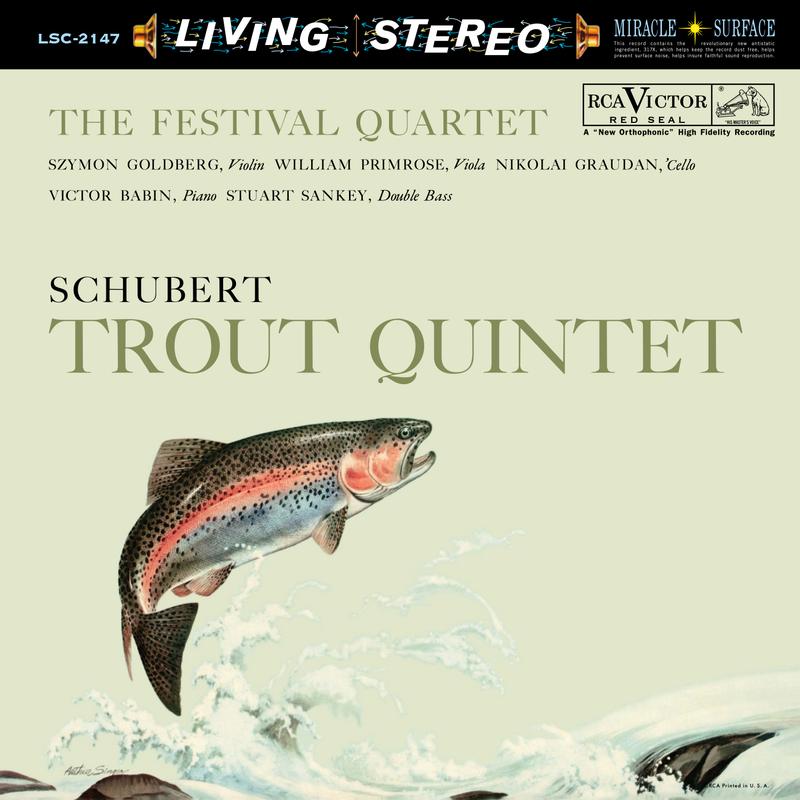
The cover names the Festival Quartet, but Schubert's Trout Quintet requires five musicians. Szymon Goldberg plays violin, William Primrose viola, Nikolai Graudan cello and Victor Babin piano. For this 1957 recording, Stuart Sankey joins them on double bass. The ensemble's name refers to a piano quartet; it is not a complete list of the forces required by the work they perform here.
The additional voice is central to the piece. Schubert writes for piano, violin, viola, cello and double bass. The second violin of a conventional string quartet is absent. Instead, the double bass extends the group downwards and changes the responsibilities of the other instruments. Listen for the moments when it provides the foundation and consider how the cello moves above it. This unusual combination offers a useful way into the work as a whole.

A summer journey and a requested song
In 1819, the 22-year-old Schubert travelled to Steyr. The amateur cellist Sylvester Paumgartner belonged to the musical circle he encountered there. Paumgartner prompted the composition of the quintet and requested variations on Schubert's song “Die Forelle”, or “The Trout”. The song's theme appears in the fourth of five movements: it is neither the beginning of the work nor its conclusion.
The quintet was not published until 1829, after Schubert's death. Its familiar nickname can encourage listeners to wait mainly for the variation movement. Yet the preceding movements have their own purposes. They introduce the ensemble in different kinds of motion and provide the setting in which the familiar melody eventually appears. On a first hearing, following the distribution of the parts can be more revealing than simply waiting for the tune that gives the quintet its name.

Four backgrounds around the same musical table
The Festival Quartet's members were associated with musical life in Aspen. Goldberg had served as concertmaster of the Berlin Philharmonic, and Graudan as its principal cellist. Primrose had been a member of the NBC Symphony Orchestra; Babin was also known for his piano duo with Vitya Vronsky. In Schubert, those different backgrounds meet within a chamber ensemble.
In the variation movement, attention passes between the instruments. Ask which player carries the theme and which changes its surroundings. Even when a melody remains recognisable, its register, accompaniment and allocation can alter its character. Sankey's double bass belongs to that musical conversation, rather than merely completing the head count. The finale then takes the work beyond the variations: the quintet does not end with its most famous movement. Hearing all five movements together makes those proportions clearer.
Five movements across four sides
This Analogue Productions stereo release consists of two 180-gram records playing at 45 RPM, pressed at Quality Record Pressings, with an insert included. The publisher credits Matthew Lutthans at The Mastering Lab with cutting from the original master tapes. Movement I occupies side A, movement II side B, the scherzo and variations share side C, and the finale fills side D. No movement is split across a side change. The catalogue number is AAPC 2147-45.
Michael 45 keeps the records in Germany and ships them from Hilden, so customers need not organise a personal US import or wait for customs clearance.
More from the series: RCA Living Stereo Series
Customer question: Buying Analogue Productions records in Europe
Series: RCA Living Stereo – all 25 titles, conductors and soloists
Musicians
Documented selection of participating musicians. Personnel may vary by track; this list does not claim to be complete.
| Name | Instrument / role |
|---|---|
| The Festival Quartet | Ensemble |
| Szymon Goldberg | Violin |
| William Primrose | Viola |
| Nikolai Graudan | Cello |
| Victor Babin | Piano |
| Stuart Sankey | Double bass |

Reviews
There are no reviews yet.