
One pianist, two orchestras
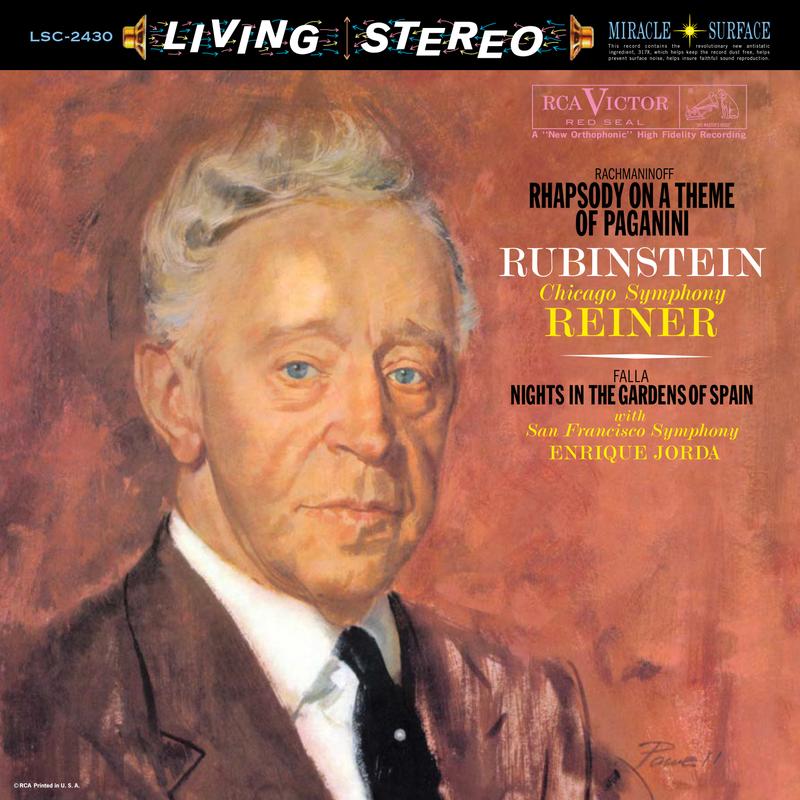
Artur Rubinstein connects these two works, but the ensemble around him changes completely. He recorded Rachmaninoff’s Rhapsody on a Theme of Paganini with Fritz Reiner and the Chicago Symphony Orchestra on January 16, 1956. For Falla’s Nights in the Gardens of Spain, Enrique Jordá conducted the San Francisco Symphony on May 25, 1957. The coupling moves from Chicago to California and from a sequence of variations to three musical landscapes.
The sessions took place at Orchestra Hall and the War Memorial Opera House respectively. These are separate recordings, rather than a joint production involving both conductors. Rubinstein’s piano provides the point of connection through which the different works and orchestral partnerships can be considered together.

Twenty-four responses to Paganini
Rachmaninoff wrote his rhapsody in Switzerland in 1934, taking the last of Paganini’s 24 Caprices for solo violin as his starting point. The result is a set of 24 variations for piano and orchestra. Material is rearranged and responsibilities pass between soloist and ensemble, giving the familiar theme a succession of different functions.
The eighteenth variation is particularly well known and often heard separately. Within the complete work, its context matters: listen to the stages leading up to it and to the movement that follows. The rhapsody consists of relatively short sections whose relationships depend on their transitions. That makes the side division of this edition worth knowing in advance. You turn the first record over after Variation XV, with XVI through XXIV continuing on the reverse side.

Jordá and the Spanish gardens
Manuel de Falla initially conceived Noches en los jardines de España as piano pieces. The project developed into a work for piano and orchestra, completed in 1915. Its three parts are “En el Generalife,” “Danza lejana” and “En los jardines de la Sierra de Córdoba.” The first points to the gardens beside the Alhambra; the other titles suggest further Spanish settings.
Enrique Jordá was music director in San Francisco from 1954 to 1963. His partner here had a connection with the work reaching back much further: Rubinstein had attended an early performance in San Sebastián. The 1957 recording continues that personal history with the repertoire. In contrast to Rachmaninoff’s sequence of explicitly numbered variations, Falla offers larger spans to follow. Notice when the piano emerges as an individual voice and when its figures become part of the orchestral texture. Despite the Spanish associations, the score does not call for a guitar.
A tape-copy source for this 45 RPM edition
AAPC 2430-45 presents the two works on two 180-gram stereo LPs at 45 RPM, pressed at Quality Record Pressings. Acoustic Sounds credits Matthew Lutthans at The Mastering Lab and explicitly identifies a tape copy as the source. An insert is included. The first LP contains Rachmaninoff; the second contains Falla, with its opening part on side A and the remaining two on side B. The record change within the rhapsody occurs after Variation XV.
Michael 45 keeps the records in Germany and sends them from Hilden, so customers do not have to arrange a personal import from the United States or wait for customs processing.
More from the series: RCA Living Stereo Series
Artist page: All titles by Fritz Reiner
Customer question: Buying Analogue Productions records in Europe
Series: RCA Living Stereo – all 25 titles, conductors and soloists
Musicians
Documented selection of participating musicians. Personnel may vary by track; this list does not claim to be complete.
| Name | Instrument / role |
|---|---|
| Artur Rubinstein | Piano |
| Fritz Reiner | Conductor |
| Chicago Symphony Orchestra | Orchestra |
| Enrique Jordá | Conductor |
| San Francisco Symphony | Orchestra |
Reiner and the Chicago Symphony Orchestra: Rachmaninoff. Jordá and the San Francisco Symphony: Falla. Rubinstein is the pianist on both recordings.

Reviews
There are no reviews yet.