
A soloist who knew the orchestral desk
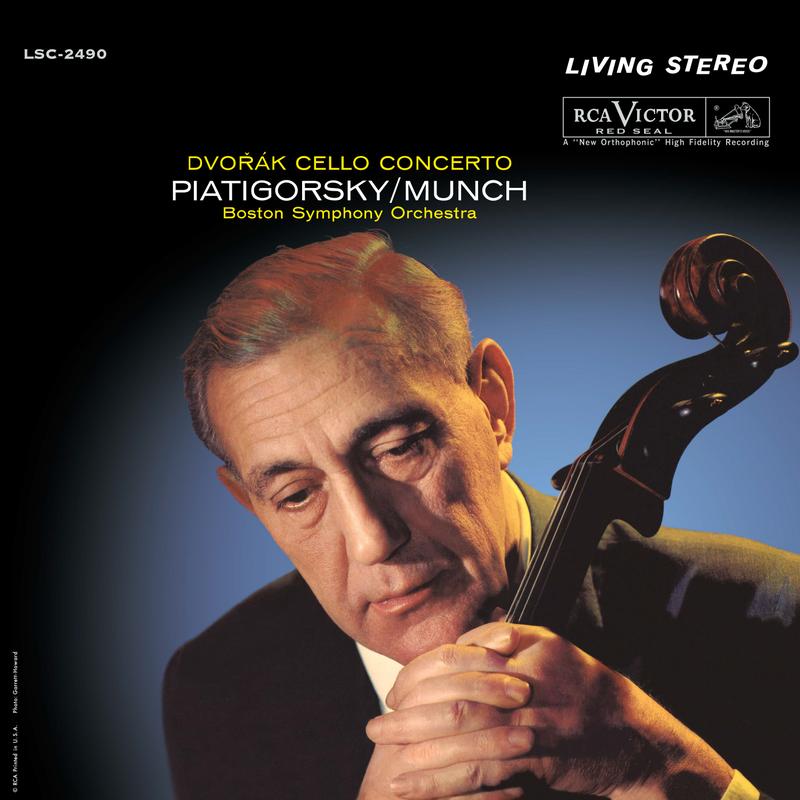
Gregor Piatigorsky had served as principal cellist of the Berlin Philharmonic before his international career as a soloist took centre stage. Dvořák’s B minor concerto brings those experiences into the same musical setting: a single cello has to establish its relationship with a large orchestra, while the score offers more than alternating stretches of solo playing and simple accompaniment.
Piatigorsky performs here with the Boston Symphony Orchestra conducted by Charles Munch. Max Wilcox produced the recording and John Crawford was the engineer. The historical RCA LP appeared in 1961. The complete concerto, Op. 104, is presented in its three movements: “Allegro,” “Adagio ma non troppo” and “Allegro moderato.”

A concerto after years of hesitation
Dvořák had long doubted the cello’s suitability as the solo instrument in a concerto. An important stimulus came in New York in 1894, when he heard Victor Herbert’s Second Cello Concerto. He began his own work that November and initially completed it in February 1895. The music thus belongs to the period of his American residence, even though its later performance history led back across the Atlantic.
The cellist Hanuš Wihan was the dedicatee, but he did not give the premiere. Leo Stern played it in London in 1896, with Dvořák conducting. The work’s history already involves several encounters and decisions rather than a straightforward commission followed by a performance. In listening, the balance between orchestra and solo instrument is particularly useful to follow. When does the cello stand apart, and when does it take over material already prepared by another voice?

A song returns
Material from Dvořák’s song “Leave Me Alone” appears within the concerto. The song was associated with his sister-in-law Josefina, who became seriously ill while he was composing the work. After her death in May 1895, he revised the ending. A personal memory therefore lies within the larger concerto, one that would not be apparent from the movement headings alone.
You can retain that background without trying to assign a biographical explanation to every passage. In the slow movement, notice how a melodic line is continued between cello and orchestral voices. In the finale, references to earlier ideas become important alongside the forward movement. Piatigorsky’s cello supplies a recognisable point of focus, while Munch directs the surrounding ensemble. If you know the concerto chiefly through isolated solo passages, the complete performance offers the opportunity to trace its larger connections.
Two sides for the first movement
AAPC 2490-45 presents the recording on two 180-gram stereo LPs playing at 45 RPM, pressed at Quality Record Pressings. Acoustic Sounds credits Bernie Grundman for the cut and identifies the original master tape as the source. An insert is included. The first movement occupies both sides of the first LP, so the record must be turned over before that movement is complete. The slow movement and finale each receive a side of their own on the second LP.
Michael 45 holds the records in Germany and dispatches them from Hilden, allowing customers to avoid a personal US import and the customs wait associated with it.
More from the series: RCA Living Stereo Series
Customer question: Buying Analogue Productions records in Europe
Series: RCA Living Stereo – all 25 titles, conductors and soloists
Musicians
Documented selection of participating musicians. Personnel may vary by track; this list does not claim to be complete.
| Name | Instrument / role |
|---|---|
| Gregor Piatigorsky | Cello |
| Charles Munch | Conductor |
| Boston Symphony Orchestra | Orchestra |

Reviews
There are no reviews yet.