

One melody across five movements
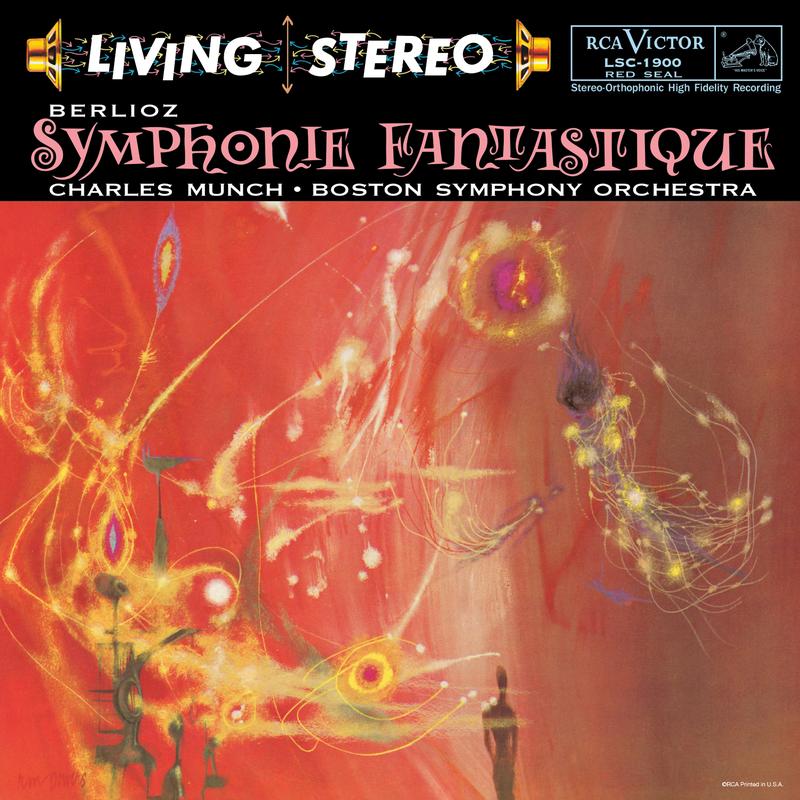
The Symphonie fantastique concerns an artist and an idea that will not leave him alone. Hector Berlioz called its recurring musical presence the “idée fixe.” It belongs to a five-movement symphony premiered in Paris in 1830, combining a large orchestra with a narrative that moves from reverie and dancing towards execution and a supernatural night gathering.
Charles Munch conducts the Boston Symphony Orchestra in this 1954 recording. He had been its music director since 1949. His route from Strasbourg through German and French musical life eventually led to Boston, and Berlioz remained part of the French repertoire closely associated with his name. Here the entire five-movement work is presented as a continuous programme across the set.

From a ballroom to the countryside
The first movement is “Rêveries – Passions,” followed by “Un bal” and “Scène aux champs.” “Marche au supplice” and “Songe d’une nuit du sabbat” complete the sequence. The titles alone establish very different situations. The returning melody connects them without requiring the movements to take on the same character or perform the same formal function.
Following that melody can make a first encounter with the long work more manageable. Where does it return, and what has changed around it? A ballroom provides a different context from a pastoral scene. You can use the narrative as a guide while attending to musical events: the movement between individual voices and larger groups, the recurrence of a figure and the preparation for a new section. The written story and the orchestral construction offer complementary ways of following the work.

Berlioz reconsidered the programme
The narrative has a personal background in Berlioz’s fascination with the actress Harriet Smithson, whom he later married. Yet the printed programme was not an unchanging set of instructions. He revised it, and in a later version allowed that it need not be distributed for a performance of the symphony on its own in concert.
That leaves two useful approaches to Munch’s recording. You can follow the five narrative pictures or hold the music together through its recurring ideas. On a return listen, moving between those perspectives can be particularly revealing. “Un bal” is a self-contained movement but also a stage in the symphony’s development; the finale places earlier material in another context again. With five movements, these relationships become an essential part of the work’s construction rather than details around a single famous episode.
Four sides, five complete movements
AAPC 1900-45 presents the stereo recording on two 180-gram LPs playing at 45 RPM. Acoustic Sounds credits Bernie Grundman for the cut and identifies the original two-track master tape as the source. The records are pressed at Quality Record Pressings, and an insert is included. The first LP carries movements one and two. On the second, movements three and four share side A, while the finale occupies side B. No movement is interrupted by a side change. The original 1955 release was mono; this edition presents the stereo version.
Michael 45 holds the records in Germany and ships them from Hilden, eliminating the need for a personal US import and the corresponding customs wait.
More from the series: RCA Living Stereo Series
More by Charles Munch: A Stereo Spectacular: Saint-Saens Symphony No.3
Customer question: Buying Analogue Productions records in Europe
Series: RCA Living Stereo – all 25 titles, conductors and soloists
Musicians
Documented selection of participating musicians. Personnel may vary by track; this list does not claim to be complete.
| Name | Instrument / role |
|---|---|
| Charles Munch | Conductor |
| Boston Symphony Orchestra | Orchestra |

Reviews
There are no reviews yet.