Bringing the bass to the centre
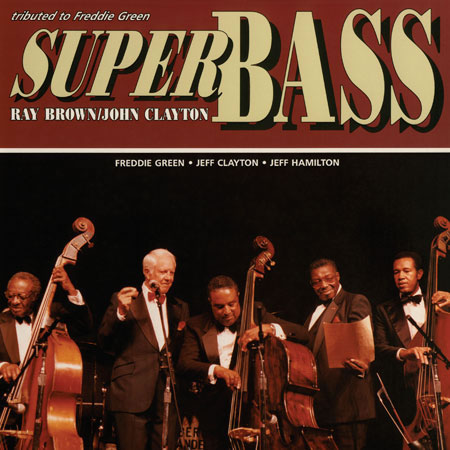
Ray Brown spent decades demonstrating what a bass could contribute to a band. With Dizzy Gillespie, the Oscar Peterson Trio and countless other groups, he was a defining rhythmic partner. On Super Bass, the instrument itself becomes the starting point for an entire studio project. Melody, accompaniment, ensemble texture and contrasting registers provide the raw material for its arrangements.
John Clayton joins him, a musician who attended Brown’s UCLA jazz course as a teenager. Their relationship had developed from teacher and student into a collaboration between two independent musical personalities. Clayton supplies almost all the arrangements and several compositions. This Capri album should be distinguished from the later Telarc live project SuperBass with Christian McBride: the present recording explores Brown and Clayton’s work in the studio.

Two players, more than two bass parts
The recordings were made at Coast Recorders in San Francisco and Group IV Recording in Hollywood, with Phil Edwards engineering. The studio is used creatively: overdubbing allows the bassists to build several parts on top of one another. Album documentation identifies ten bass voices on “Happy Days Are Here Again”. The number of audible lines is therefore not simply the number of bass players in the room.
That creates a different approach from a bass duet played entirely live. Listen for the part carrying the melody and the one supplying movement underneath it. How does register help distinguish their roles? The project can be heard as a collection of arrangements for an instrument normally occupying one position in a group. Here it can take several responsibilities within the same passage, shaping both foreground and background.

A programme with personal connections
Milt Jackson’s “Bags’ Groove” returns to a musician associated with Brown since the Gillespie years. Benny Golson’s “Killer Joe” brings another jazz standard into the programme. Clayton contributes “Swing Jig”, “Righteous Boogie Bass” and “Hues”, while Brown’s pieces include the opener and “Goodbye Freddie Green”. The dedication to Count Basie’s long-serving rhythm guitarist forms part of the album’s identity.
Jeff Clayton and Jeff Hamilton expand the ensemble. Hamilton was also working in Brown’s trio during this period, while the Clayton brothers had already established a jazz orchestra with him. These arrangements grow from established musical relationships as well as an unusual instrumental premise. Try “Bags’ Groove” before one of Clayton’s pieces: how do the melodic and rhythmic roles change? Familiar repertoire provides an accessible entrance, while the varied arrangements give reasons to follow the full album.
The Capri LP with Doug Sax mastering
ACPR 74018 is the Capri vinyl edition of this studio project. The publisher credits Doug Sax at The Mastering Lab, working from the original master tapes through custom tube electronics. Documented runouts carry the TML stamp, and Quality Record Pressings is named as the pressing plant. These details concern the vinyl reissue, rather than the production of the original CD.
The stated vinyl weight is inconsistent across the available documentation. The publisher lists 180 grams, while database entries also specify 200 grams. Those records do not establish the weight of an individual stock copy. The musical identity is clearer: this is the Capri programme built around Brown and Clayton’s bass arrangements, not an edition of the later Telarc concert. That distinction matters more than the near-identical title, since personnel, recording approach and musical design differ.
You order from Michael 45 in Germany. We arrange the US import and dispatch from Hilden. Editions not currently in stock are dispatched after the goods arrive.
Musicians
Documented selection of participating musicians. Personnel may vary by track; this list does not claim to be complete.
| Name | Instrument / role |
|---|---|
| Ray Brown | Double bass |
| John Clayton | Double bass |

Reviews
There are no reviews yet.