

First, exchange instruments
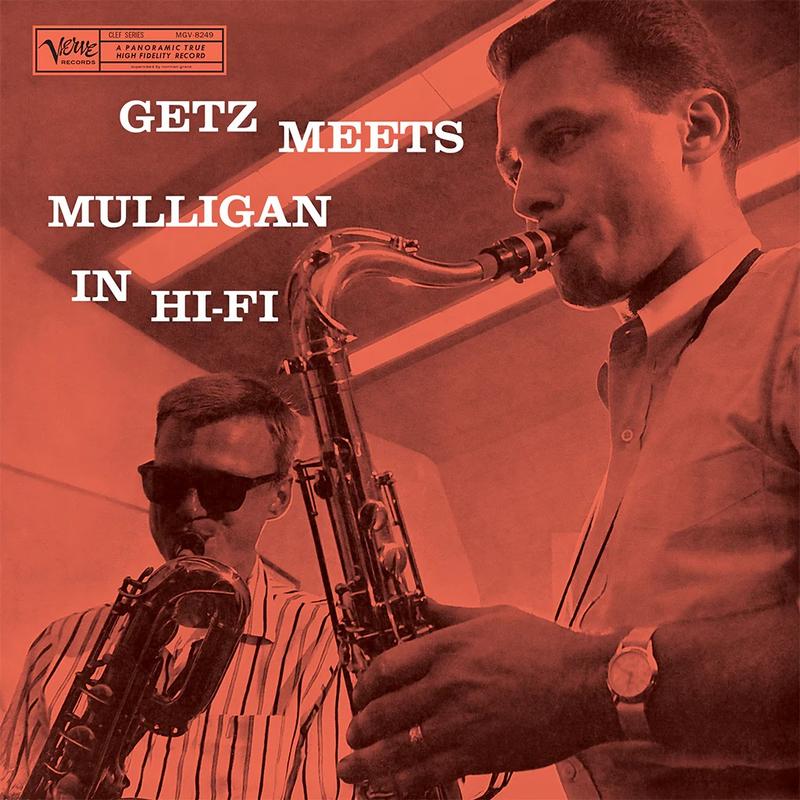
Stan Getz plays tenor and Gerry Mulligan plays baritone: that familiar association is part of how listeners identify the two musicians. Getz Meets Mulligan in Hi-Fi begins by reversing it. For the first three selections, Getz takes the baritone saxophone and Mulligan the tenor. Identifying a player simply by the register of his instrument will therefore lead you in the wrong direction.
The meeting took place in Los Angeles on October 12, 1957, with Norman Granz producing. Lou Levy on piano, Ray Brown on bass and Stan Levey on drums form the rhythm section. A session for five musicians and six tunes becomes a manageable experiment in the relationship between a personal musical language and the instrument on which it is normally expressed.

Three tunes with the roles reversed
“Let’s Fall in Love,” “Anything Goes” and “Too Close for Comfort” open the record. The exchanged instruments apply to all three. From “That Old Feeling” onwards, Getz and Mulligan return to their customary horns. “This Can’t Be Love” and Mulligan’s own composition “A Ballad” complete the programme.
The division between the sides gives the comparison a straightforward structure. Pay attention to phrasing rather than pitch alone: how does an idea begin, where is it interrupted, and how is a line brought to a close? You can ask the same questions again on the second side. The album supplies two configurations with the same rhythm section underneath them. There is no need to turn the exercise into a contest; its interest lies in following familiar musical personalities under slightly altered conditions.

Two routes through cool jazz
Getz and Mulligan were both born in 1927. Getz’s lyrical tenor language was influenced by Lester Young, while his nickname “The Sound” points to the importance listeners attached to his tone. Mulligan worked as an arranger as well as a baritone player, for artists and bands including Claude Thornhill, Miles Davis and Stan Kenton. His pianoless quartet with Chet Baker had already established a distinctive setting for his work in the early 1950s.
Here a pianist, Lou Levy, is explicitly part of the ensemble. That makes the accompaniment worth following instead of concentrating exclusively on the two horns. Piano, bass and drums give the exchange of instruments a common foundation. Try tracking Ray Brown’s line through a complete passage, then return to the saxophone entries above it. The album’s unusual premise becomes something you can investigate directly, without first needing a detailed knowledge of either musician’s catalogue.
This edition is mono
AVER 77187 is a single 180-gram mono LP at 33⅓ RPM. Matthew Lutthans mastered it at The Mastering Lab, with Acoustic Sounds specifying the original master tape as the source. Pressing is by Quality Record Pressings, and packaging is a Stoughton tip-on gatefold jacket. The mono designation applies to this edition; other versions of the album exist in stereo. “Hi-Fi” in the title does not, by itself, identify the number of channels on this record.
Michael 45 holds the record in Germany and dispatches it from Hilden, so customers can avoid arranging a personal import from the United States and waiting for customs clearance.
Musicians
Documented selection of participating musicians. Personnel may vary by track; this list does not claim to be complete.
| Name | Instrument / role |
|---|---|
| Stan Getz | Baritone saxophone, Tenor saxophone |
| Gerry Mulligan | Tenor saxophone, Baritone saxophone |
| Lou Levy | Piano |
| Ray Brown | Double bass |
| Stan Levey | Drums |
Getz and Mulligan exchange instruments on the first three tracks. Getz then returns to tenor and Mulligan to baritone. The rhythm section is credited at album level.
🎧 Review video: 15 Amazing New Reissues you might want in your Collection
This video is hosted by YouTube (Google). It only loads once you switch on “Functional” in the cookie settings.

Reviews
There are no reviews yet.