A song finds its band
A second recording can sometimes tell you more about a group than an interview. “Willin’” had already appeared on Little Feat’s debut. On Sailin’ Shoes, released in 1972, it returns in a newly recorded band arrangement, allowing its traveller’s story to unfold at an unhurried pace. Revisiting an existing song makes sense here. These four musicians are developing a shared language in which country, blues and rock move easily into one another.
Lowell George, Bill Payne, Roy Estrada and Richie Hayward still form the original quartet. George supplies voice and guitar, Payne the keyboards; Estrada’s bass and Hayward’s drums connect the changing patterns. The six-piece band and more pronounced New Orleans funk of Dixie Chicken come later. Sailin’ Shoes catches the preceding moment: a smaller formation with an already remarkably broad musical vocabulary.

Boogie and the open road
“Easy to Slip” makes an immediate opening statement. “Tripe Face Boogie”, written by Payne and Hayward, brings the band’s rhythmic workings to the foreground. “Trouble” and “Willin’” give their melodies more room. These shifts turn the eleven tracks into a sequence of different perspectives. The album does not need an extended running time to establish a world of its own.
“Willin’” particularly rewards attention to the instruments around the vocal. Sneaky Pete Kleinow’s pedal steel is one of the album’s additional colours; he also contributes to “Texas Rose Cafe”. Its sliding transitions and Payne’s keyboards offer a kind of movement quite different from a continuous guitar riff. Listen for the way a brief instrumental answer between vocal lines can carry the story onward.

Names on the label, pictures in the mind
The “Fred Martin” credited as co-writer of “Easy to Slip” is Martin Kibbee, an associate of George’s from The Factory. The George/Martin writing credit later appears on “Dixie Chicken” too. Here is a thread that continues across changes in the group’s membership. Payne also contributes compositions of his own, including “Got No Shadow” and “Cat Fever”. George gives the record a strong personality, while leaving room for musical ideas from elsewhere within the band.
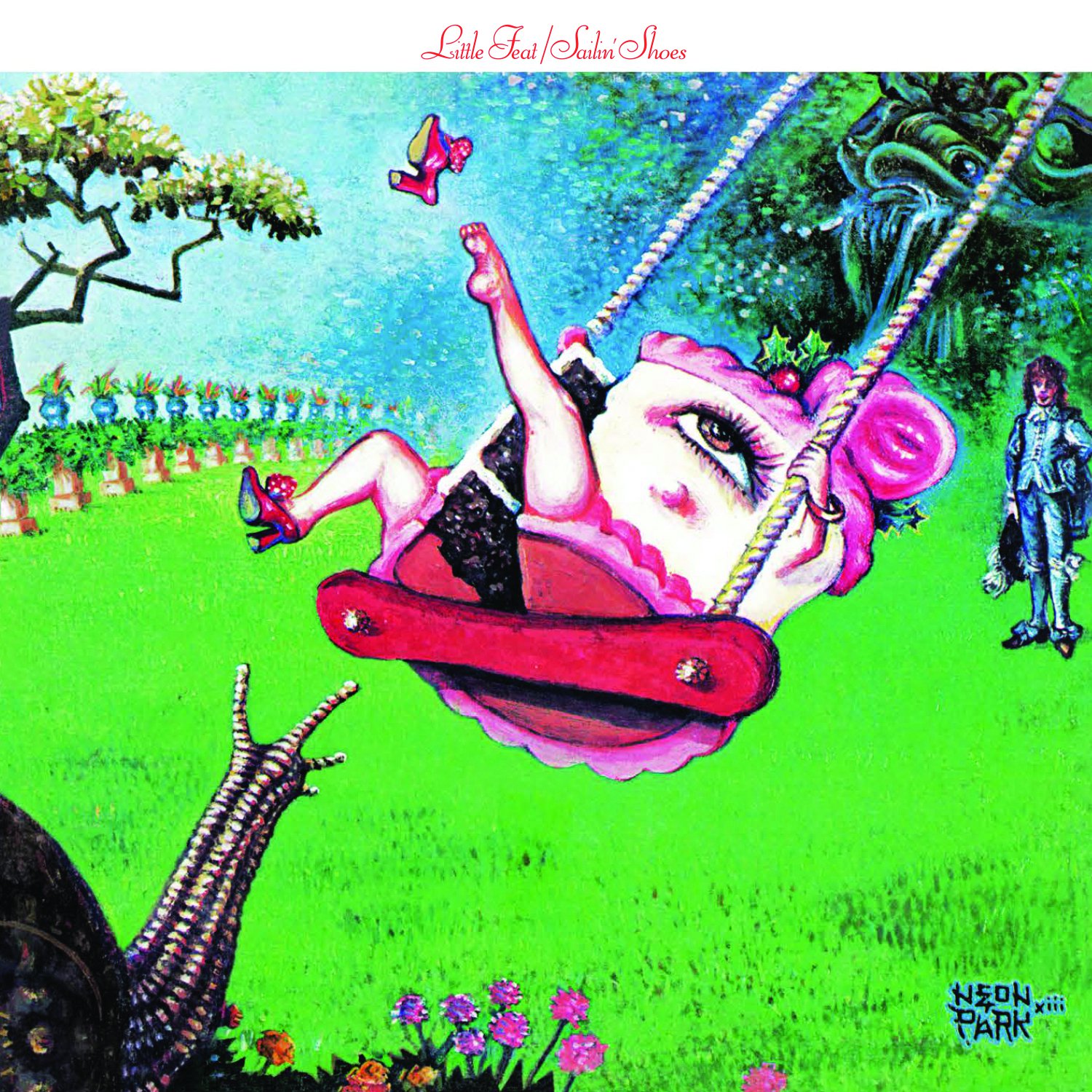
Something lasting begins with the artwork as well. Sailin’ Shoes introduces Neon Park as Little Feat’s cover artist. His absurd imagery belongs alongside songs that place ordinary experiences next to unusual characters. Ted Templeman produced the album; George subsequently took on that responsibility himself. The second Little Feat LP thus occupies two turning points: the group has found its visual language, while its next musical line-up is still ahead.
This edition
Analogue Productions’ AAPR 015-45 belongs to the Acoustic Sounds 40 Series. The eleven album tracks are spread across two 180-gram LPs at 45 RPM. Acoustic Sounds credits Matthew Lutthans at The Mastering Lab with cutting from the original master tape, names Quality Record Pressings as the pressing plant and specifies a Stoughton Printing tip-on gatefold jacket.
Also on SACD: Sailin’ Shoes
Customer question: Buying Analogue Productions records in Europe
Series: Acoustic Sounds 40th Anniversary – all 25 albums, recommendations and musicians
Musicians
Documented selection of participating musicians. Personnel may vary by track; this list does not claim to be complete.
| Name | Instrument / role |
|---|---|
| Lowell George | Baritone saxophone, Backing vocals, Lead vocals, Harmonica, Guitar |
| Bill Payne | Backing vocals, Electric piano, Lead vocals, Accordion, Piano, Organ |
| Roy Estrada | Backing vocals, Bass |
| Richie Hayward | Backing vocals, Percussion, Drums |

Reviews
There are no reviews yet.