A debut album with five years behind it
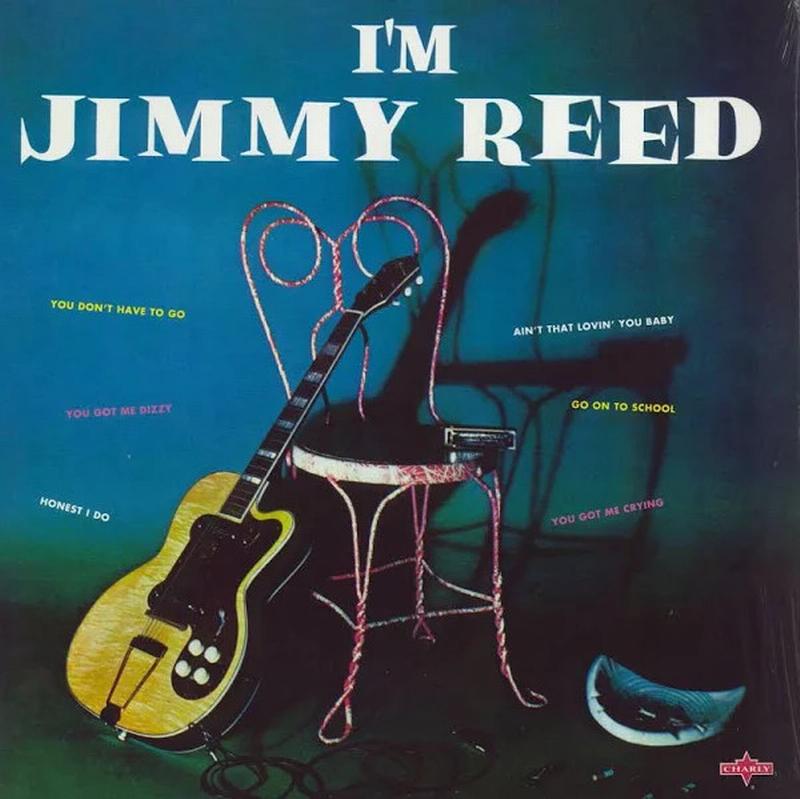
I'm Jimmy Reed arrived in 1958, but its recording history begins much earlier. The twelve selections bring together single sides made between 1953 and 1958. Reed's first LP therefore follows an artist across several stages of recording activity. It has its own sequence and identity, assembled from pieces originally intended for the shorter format. Each single side had needed to make an impression on its own. That background helps explain the album's concentrated shape: voice, guitar and harmonica establish the central character quickly, while the accompanying musicians give each performance its particular setting and momentum.
Vee-Jay released the album, and Reed's recordings reach back into the label's earliest history. “Roll & Rhumba” had been the reverse of his first Vee-Jay single in 1953. Five years later, the instrumental shared an LP with newer recordings such as “Go On To School” and “You Got Me Crying”. The record is consequently both a debut and a retrospective. It gathers an existing catalogue into a larger portrait. Instead of documenting one introductory studio date, it connects a series of shorter releases, allowing performances made years apart to become neighbours on the same two album sides.

Eddie Taylor and the changing band
Eddie Taylor is a crucial presence beside Reed. The guitarist had helped him learn the instrument in Mississippi and became his principal accompanist. Taylor appears on nearly every selection here, but the album does not feature one fixed band throughout. Earl Phillips plays drums on many of the later recordings. Vernell Fournier takes that role on “Ain't That Lovin' You Baby” and “Can't Stand To See You Go”. Fournier would become especially well known for his work with Ahmad Jamal's trio. The connections between blues and jazz are therefore present in the actual personnel, rather than only in a broad stylistic family tree.
Another unexpected name belongs to “Boogie In The Dark” and “You Don't Have To Go”: Albert King plays drums on those recordings. The musician later identified so strongly with the guitar also worked as a drummer around Reed during this period. Guitarists Remo Biondi and John Brim appear on specific selections as well. These changing combinations are worth keeping in mind while listening. The recognisable artist at the centre works with different colleagues over time. The personnel information accompanying this story consequently attaches documented players to their particular tracks, preserving the session differences that a single general band credit would conceal.

Short performances with a long afterlife
“Honest I Do”, “Little Rain” and “You Got Me Dizzy” provide inviting routes into the record. Their compact forms leave room to notice small decisions: a harmonica entrance, an answering guitar figure, or the placement of the next vocal phrase. The two instrumentals, “Boogie In The Dark” and “Roll & Rhumba”, offer a different point of attention. Without the singing to lead the way, the relationship between rhythm and instrumental statement becomes central. Across twelve tracks, the LP therefore gives several perspectives on Reed's musical vocabulary while retaining the scale and directness of its origins on singles.
The Rolling Stones' repertoire demonstrates how far some of these songs travelled. They recorded “Honest I Do” for their first album in 1964 and returned to “Little Rain” many decades later on Blue & Lonesome. The connection extends across a remarkable span of their career. Reed's own album allows those familiar songs to be heard among the other performances with which they originally shared an LP. Returning to that context changes the perspective: a song known through another band becomes part of Reed's developing catalogue again, alongside the instrumental pieces and the work of his various studio partners.
The Bluesville Acoustic Sounds Series release
This Craft Recordings reissue belongs to the Bluesville Acoustic Sounds Series. It presents the twelve-track album on one 180-gram LP playing at 33⅓ rpm. Matthew Lutthans handled mastering and lacquer cutting at The Mastering Lab, and Craft identifies original master tapes as the source. The subject of the reissue is the historical album assembled from recordings made over several years. Its programme remains intact, without later performances or additional singles being inserted. The sequence continues to provide the thread linking material with different recording dates and different accompanying musicians.
Quality Record Pressings manufactures the LP. Stoughton Printing supplies the tip-on jacket, and a blue obi carries an accompanying essay by Scott Billington. Those production details connect the release to the wider Bluesville series while giving Reed's debut its own place within it. For a collection, the album offers a sustained early portrait of the singer, guitarist and harmonica player. Its component recordings already had a history before they became an LP. Hearing them together makes it possible to follow that history across two sides, and to recognise the musicians whose changing contributions helped give each individual performance its form.
You order from Michael 45 in Germany. We arrange the US import and dispatch from Hilden.
Musicians
Participants and documented credit status. Track references correspond to the tracklist.
| Name | Instrument / role | Participation |
|---|---|---|
| Jimmy Reed | vocals, harmonica, guitar | Album personnel |
| Eddie Taylor | guitar | A1, A2, A3, A4, A5, A6, B1, B2, B3, B5, B6 |
| Earl Phillips | drums | A1, A2, A3, A5, B1, B2, B5 |
| Vernell Fournier | drums | A6, B3 |
| Albert King | drums | A4, B6 |
| Remo Biondi | guitar | A2, A5, B5 |
| John Brim | guitar | B4 |
The album draws on several sessions. A4 and B4 are instrumentals; Reed plays harmonica on B4. Uncertain additional participants are not listed as confirmed.
How Michael hears this edition
Listening impression · paraphrased from the video
In musical contrast with Harlem Street Singer, Michael finds this Bluesville edition gentler, more relaxed and more soulful. At the same time, its blues rhythm draws him straight into the music. He is describing the character of his listening experience, rather than comparing the sound of different pressings of the same album.
🎧 Review video: 14 Amazing New Reissues
This video is hosted by YouTube (Google). It only loads once you switch on “Functional” in the cookie settings.

Reviews
There are no reviews yet.