Twelve songs, two ensembles
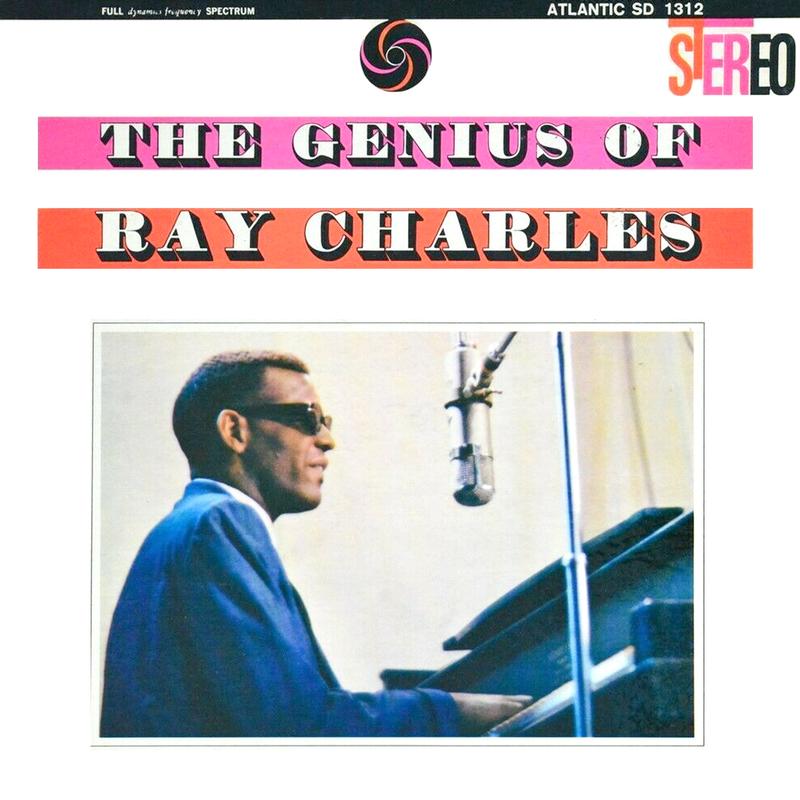
Two orchestral worlds meet on The Genius of Ray Charles, released in 1959. Six performances feature a big band; six others introduce strings. Charles holds both together through his voice and piano. The album presents a singer extending his repertoire beyond rhythm and blues while retaining its sense of musical speech.
The division is particularly tangible on this reissue: the first LP contains the six big-band tracks and the second the six string-backed ballads. Changing records offers a genuine pause between the two parts, making the change of ensemble something to notice consciously.

Quincy Jones writes for the horns
Quincy Jones provides the big-band arrangements. Musicians associated with Count Basie and Duke Ellington contribute their experience, including Clark Terry, Zoot Sims and Freddie Green. They are joined by voices from Charles’ own musical circle. David “Fathead” Newman takes several solos; Paul Gonsalves can be heard on “Two Years of Torture”.
“Let the Good Times Roll”, drawn from Louis Jordan’s repertoire, immediately makes the division of roles clear. Follow the way Charles phrases a line and the way the horns respond. The size of the ensemble becomes apparent through more than volume: it also emerges in the variety of answers available to a single singer.

Ralph Burns opens the second half
Ralph Burns supplies the string arrangements. The second half starts with “Just for a Thrill” and ends with “Come Rain or Come Shine”, with songs such as “Don’t Let the Sun Catch You Cryin’” and “Am I Blue?” in between. The strings provide a different setting for the same voice; Charles need not change his musical identity to inhabit it.
Pay particular attention here to the distance between a sung phrase and its orchestral continuation. The album does more than place two ensembles side by side. Its sequence moves from the direct address of the big band towards the longer lines of the ballads. Jerry Wexler and Nesuhi Ertegun oversee the production; Tom Dowd and Bill Schwartau belong to the recording team.
Two LPs in stereo
The Analogue Productions Atlantic 75 edition AAPA 066-45 comprises two 180-gram LPs at 45 RPM in stereo, pressed at QRP and housed in a Stoughton tip-on gatefold. The publisher’s product page does not specify a master-tape source.
Michael 45 keeps the goods in Germany and ships from Hilden, allowing German and EU customers to avoid organising a private US import and the corresponding customs wait.
Also on SACD: The Genius Of Ray Charles
More by Ray Charles: The Genius Sings The Blues · The Great Ray Charles
Customer questions: Atlantic 75: which titles are worth buying? · Buying Analogue Productions records in Europe
Series: Atlantic 75 Series – all 75 albums, time journey and the people behind Atlantic
Musicians
Documented selection of participating musicians. Personnel may vary by track; this list does not claim to be complete.
| Name | Instrument / role |
|---|---|
| Ray Charles | Vocals, Piano |
| Clark Terry | Trumpet |
| Ernie Royal | Trumpet |
| Joe Newman | Trumpet |
| Snooky Young | Trumpet |
| Marcus Belgrave | Trumpet |
| John Hunt | Trumpet |
| Melba Liston | Trombone |
| Quentin Jackson | Trombone |
| Thomas Mitchell | Trombone |
| Al Grey | Trombone |
| Frank Wess | Tenor saxophone, Alto saxophone, Flute |
| Paul Gonsalves | Tenor saxophone |
| Zoot Sims | Tenor saxophone |
| Billy Mitchell | Tenor saxophone |
| David "Fathead" Newman | Tenor saxophone |
| Quincy Jones | Conductor |
| Bob Brookmeyer | Valve trombone |
🎧 Review video: 5 Amazing new Reissues + 1 UHQR + 1 Grail of a Boxset
This video is hosted by YouTube (Google). It only loads once you switch on “Functional” in the cookie settings.

Reviews
There are no reviews yet.