A new lineup begins to define its world
Nursery Cryme was the first Genesis album to feature Phil Collins and Steve Hackett. By its release in 1971, Peter Gabriel, Tony Banks and Mike Rutherford had already experienced several changes in the group. Anthony Phillips left after Trespass; Collins joined in 1970 and Hackett early in 1971. The resulting quintet developed a repertoire in which extended narratives and miniature scenes could coexist. There is no single scale for a song on this record. A brief observation can follow a composition lasting more than ten minutes, with each piece allowed to establish its own proportions.
Part of the preparation took place at Luxford House in East Sussex, rented by Charisma head Tony Stratton-Smith. Recording began at London's Trident Studios in August 1971, with John Anthony producing, David Hentschel engineering and Mike Stone assisting with the tapes. The group had additional resources with which to develop its ideas: Hackett's guitar work, Collins' drumming and voice, and the Mellotron joined the existing acoustic and electric instruments. The album captures an early stage in the life of the five-man lineup that would become central to Genesis's identity during the following years, as its members learned what their combined abilities could achieve.

A musical box, giant plants and a brief new voice
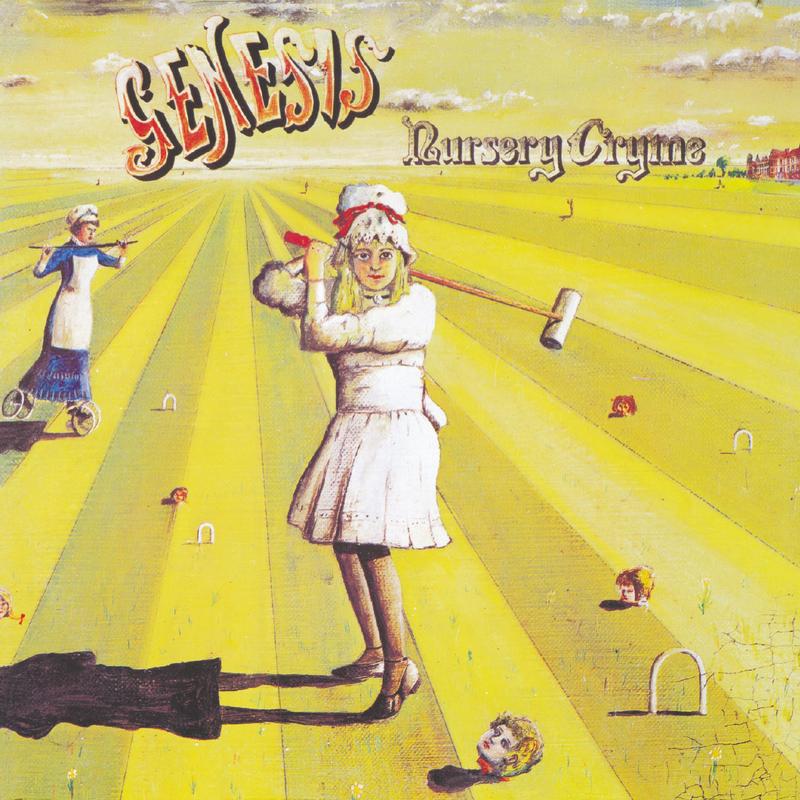
“The Musical Box” opens the record with an extended narrative set in an imagined Victorian world. Some of its musical roots reach back to material developed while Phillips was still in the band. The new lineup continued to reshape those ideas. That makes the opening particularly revealing on an album associated with new members: change also happens through the transformation of existing material. Acoustic guitars, singing and electric instruments belong within the same developing story. The piece supplied the starting point for Paul Whitehead's cover design, connecting the album's visual identity with one of its central compositions.
“For Absent Friends” follows on a much smaller scale and features Collins' first lead vocal on a Genesis album. Gabriel remains the band's principal singer; the individual change of voice has significance within that context. “The Return Of The Giant Hogweed” then returns to a larger fantastical narrative. Hackett used early tapping techniques here, bringing his guitar into close relationship with Banks' keyboard figures. The sequence demonstrates how much the album gains from changes of scale: extended and brief forms, domestic observation and grotesque fantasy, different voices and shifting instrumental emphasis. The compositions are connected by the players without being forced into the same shape.

Taking the Mellotron elsewhere
The later part of the programme moves through “Seven Stones”, “Harold The Barrel” and “Harlequin” towards “The Fountain Of Salmacis”. Smaller pieces again sit beside an extended conclusion. A particular recording story belongs to that final track. Hackett recalled taking the Mellotron to AIR Studios and recording it through amplifiers after a direct input had failed to produce the desired result. The detail brings the band's imagined world back to the practical work of making a record. An instrument had to be presented differently to fulfil its role in the arrangement; an artistic intention led to a change in the recording process.
Released in November 1971, the album reached the British charts later in the band's development. Its standing grew over time. One rewarding approach today is to follow its changes of dimension, giving the short songs the same attention as the long compositions. “Harold The Barrel” and “Harlequin” serve different purposes from “The Musical Box”, but those differences are part of the album's character. Together, the seven tracks show a band exploring the possibilities of its new personnel and connecting several forms of storytelling. The record's identity emerges from that range, as much as from the individual pieces that later became its most discussed landmarks.
The Atlantic 75 double-LP edition
The edition offered here belongs to Analogue Productions' Atlantic 75 Series. It presents the seven original tracks across two 180-gram LPs playing at 45 rpm. Chris Bellman handled mastering and lacquer cutting at Bernie Grundman Mastering. “The Musical Box” occupies the first side alone, with “For Absent Friends” and “The Return Of The Giant Hogweed” together on side B. The four-side arrangement is a particular feature of this release, changing the points at which a listener turns or changes the record while preserving the complete musical programme of the album.
Stoughton Printing supplies an old-style tip-on gatefold with two pockets and textured stock, with the lyrics on the inner panels. The series specifies Quality Record Pressings for the first 2,000 numbered copies; later pressings may be manufactured at QRP or RTI. This edition combines the 45 rpm format with substantial presentation of the original artwork. At its centre remains the 1971 recording: Gabriel, Banks and Rutherford working with the newly arrived Collins and Hackett, seven differently proportioned compositions, and a detailed record of a Genesis lineup beginning to establish the possibilities that lay ahead of it.
You order from Michael 45 in Germany. We arrange the US import and dispatch from Hilden.
Also in another edition: Nursery Cryme
More by Genesis: Selling England By The Pound · Foxtrot
Artist page: All titles by Genesis and Phil Collins
Customer questions: Atlantic 75: which titles are worth buying? · Buying Analogue Productions records in Europe
Series: Atlantic 75 Series – all 75 albums, time journey and the people behind Atlantic
Musicians
Participants and documented credit status. Track references correspond to the tracklist.
| Name | Instrument / role | Participation |
|---|---|---|
| Peter Gabriel | lead vocals, flute, bass drum, tambourine | Track assignments unconfirmed |
| Tony Banks | Hammond organ, Mellotron, piano, electric piano, twelve-string guitar, backing vocals | Track assignments unconfirmed |
| Mike Rutherford | bass, bass pedals, twelve-string guitar, backing vocals | Track assignments unconfirmed |
| Steve Hackett | electric guitar, twelve-string guitar | Track assignments unconfirmed |
| Phil Collins | drums, percussion, backing vocals, lead vocals (B1) | B1 |
Album credits do not assign every instrument to individual tracks. Phil Collins sings lead on B1. The oboe mentioned only in a secondary account is not included here.
How Michael hears this edition
Listening impression · paraphrased from the video
Michael praises the soundstage, instrument separation and dynamics. He discusses Nursery Cryme alongside the Atlantic 75 editions of Selling England by the Pound and The Lamb Lies Down on Broadway, describing the sonic benefits of these 45 RPM releases.
🎧 Review video: 14 Amazing New Reissues
This video is hosted by YouTube (Google). It only loads once you switch on “Functional” in the cookie settings.



Volker Wosik –
Die Musical Box explodiert.Habe den Eindruck,dass dieses Mastering die vorherigen nochmals toppt!Sagenhaft gut!
Roy Brezinski –
Compared to my original Philips pressing from the 70s, this one is a huge disappointment.
The stereo image is nice, but in all other respects, the Dutch Philips pressings sounds 1000% better.
I also bought Selling England by the Pound and The Lamb Lies Down on Broadway from Analogue Productions, these two are absolutely wonderful. But Nursery Cryme, no, disappointing.
Roy Brezinski –
Please discard my previous review. I cleaned both records on my Pro-Ject with L’art du Son, but the first record seemed to contain a lot of wax on the surface.
At first play side A and B sounded pretty bad, but it became better after 3 plays. So I cleaned both records again for 5 times.
This release sounds very good. Beautiful stereo image and depth. Everything sounds very clear. Of course it’s an old recording and an old tape, but it’s really good sounding.
Highly recommended – but please clean them thoroughly before playing them.