Five musicians introduce themselves anew
Fragile presents Yes in an unusual balance: four group pieces sit alongside five shorter contributions originating in the ideas of individual members. Jon Anderson, Steve Howe, Chris Squire, Rick Wakeman and Bill Bruford are heard as a collective, while the album also opens small windows onto their separate interests. The movement between extended forms and concentrated miniatures becomes an organising principle. You can follow the sequence as a journey and then consider what each musician contributes to its direction. Those contributions are not always equivalent to the most prominent solos, and the smaller pieces are more than intervals between the familiar songs.
The album was recorded at London’s Advision Studios in 1971, produced by Yes and Eddy Offord. Rick Wakeman had replaced Tony Kaye, extending the group’s resources through Mellotron, Minimoog and other keyboard instruments. His classical background met Howe’s guitar vocabulary, Squire’s bass, Bruford’s rhythmic ideas and Anderson’s singing. The personnel change does not explain every development, but it alters the conditions of the collaboration. Fragile documents the first album made by these five musicians. Its structure asks a practical question about the band’s identity: what is created together, and what does each participant bring to the partnership?

From “Roundabout” to the miniature forms
“Roundabout” begins with reversed piano chords before the acoustic guitar emerges. Describing the entire opening as guitar harmonics would overlook an important studio process. The piece was recorded in sections and assembled using tape edits. Part of its history also leads back to a journey through Scotland, during which Anderson and Howe developed ideas. Listen to the transitions: how do the sections connect, and which instruments take responsibility for moving between them? The familiar opening is only the first part of a construction whose continuity is made from contrasting kinds of movement, rather than a single repeated gesture.
The shorter pieces reveal other working methods. Wakeman adapts material from Brahms’s Fourth Symphony for keyboards in “Cans And Brahms”. Anderson layers his own voice in “We Have Heaven”, while Howe steps forward with flamenco guitar on “Mood For A Day”. Squire’s “The Fish” and Bruford’s “Five Per Cent For Nothing” establish different priorities again. An individual contribution does not necessarily mean an unaccompanied performance: Bruford’s miniature is played by the group. That distinction matters. Personal authorship and collective execution can belong together on Fragile, just as one musician can create several overlapping parts rather than a single exposed line.

Transitions remain part of the album
“South Side Of The Sky” and “Heart Of The Sunrise” join “Roundabout” in providing the larger structures. Between them, “Long Distance Runaround” leads into “The Fish”. Such connections make the running order significant; the shorter contributions are not interchangeable fillers. On this 45 RPM edition, “We Have Heaven” and “South Side Of The Sky” remain together on side B. “Long Distance Runaround” and “The Fish” share side C. The distribution across four record sides consequently preserves those two transitions even while changing the original album’s two-sided physical format. Understanding that arrangement is useful before assuming that every side break has the same effect.
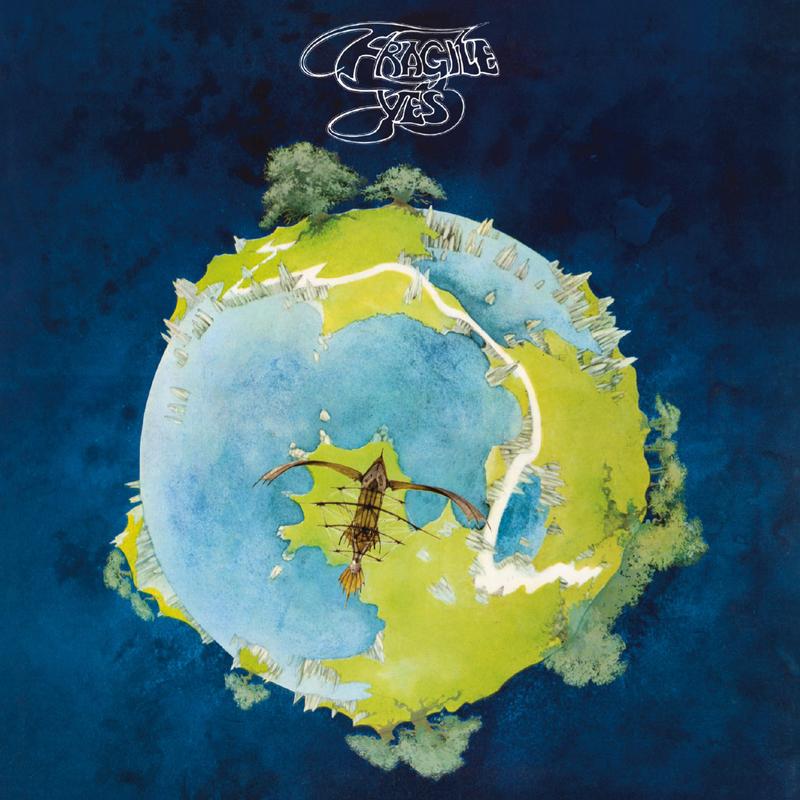
“Heart Of The Sunrise” occupies the whole of the fourth side. Its hidden return to “We Have Heaven” brings an earlier idea back into the closing sequence. The visual presentation has its own place in the story: Fragile was Roger Dean’s first Yes cover. The reproduction of the original booklet combines his imagery with pages devoted to the five musicians. Dean’s later, familiar Yes logo was created afterwards. The record can therefore be heard and viewed as a moment when several elements of the group’s identity were coming together, without suggesting that everything had already reached the form now associated with the band.
The Atlantic 75 two-LP edition
The release offered here is AAPA 014-45, the Analogue Productions edition on two 180-gram LPs running at 45 RPM. The publisher identifies Kevin Gray at Cohearent Audio as responsible for mastering and cutting the lacquers from the original master tape. Documented “KPG@CA” inscriptions on all four sides support that attribution. A conflicting credit to Chris Bellman is therefore not adopted. This release must also be distinguished from earlier Analogue Productions pressings and the SACD. The album title alone cannot identify the mastering engineer or establish which technical treatment applies to a particular product.
The publisher lists Quality Record Pressings and a Stoughton double-pocket tip-on gatefold, with a reproduction of the original colour booklet. Initial numbered copies are distinct from subsequent unnumbered pressings; an individual number or the pressing plant of a later batch is not promised without checking the copy. For the musical programme, the actual side sequence is the essential detail. It accommodates the longer pieces while retaining the transitions described above. Fragile remains a deliberately structured whole whose individual contributions can be explored both independently and through their relationships with the rest of the album. Michael 45 dispatches orders from Hilden, Germany, so you do not need to arrange your own US import. Please refer to the stated availability and delivery time for this item.
You order from Michael 45 in Germany. We arrange the US import and dispatch from Hilden.
More from the series: Atlantic 75 Series
Also on SACD: Fragile
More by Yes: The Yes Album · 90125
Artist page: All titles by Yes
Customer questions: Atlantic 75: which titles are worth buying? · Buying Analogue Productions records in Europe
Series: Atlantic 75 Series – all 75 albums, time journey and the people behind Atlantic
Musicians
Documented participants in this recording. Track references correspond to the tracklist.
- Jon Andersonlead vocals, all vocal parts on B1Participation: A1, B1, B2, C2, D1
- Steve Howeelectric guitar, acoustic guitar, vocalsParticipation: A1, B2, C1, C2, C4, D1
- Chris Squirebass, vocalsParticipation: A1, B2, C1, C2, C3, D1
- Rick WakemanHammond organ, grand piano, electric piano (RMI 368 Electra-Piano), electric harpsichord, Mellotron, synthesizer (Minimoog)Participation: A1, A2, B2, C1, C2, D1
- Bill Bruforddrums, percussionParticipation: A1, B2, C1, C2, D1


The short pieces originate with individual members, but are not all unaccompanied. “Five Per Cent For Nothing” is performed by the group.
How Michael hears this edition
Listening impression · paraphrased from the video
Michael already values the powerful, dynamic first UK pressing. On the AP 45, he particularly hears clearer midrange: instruments gain body and detail, and the overall presentation sounds more coherent.

Pedro Gonzalez –
Wow… what an album. And the sound on this record… it’s absolutely magnificent. I know that that this is true for the whole Atlantic 75 pressings, but the acoustic guitar on Roundabout is being played in your room. Great job. Well done Acoustic Sounds.