Three musicians starting with an empty page
When Tony Banks, Phil Collins and Mike Rutherford returned to their own studio in Surrey in spring 1983, they brought a different working method with them. Instead of arriving with completed songs, they developed the material together. A drum machine would start, somebody would play a figure, and the other two would respond. All three consequently share the writing credits. Calling the resulting album Genesis makes particular sense in that context: the identity of the group lay in the act of creating the music together.
The sessions followed the Three Sides Live tour and a break for individual projects. Their converted farm building offered time to explore, abandon and revisit ideas. Hugh Padgham worked alongside the group on recording and production. Studio technology became part of the composition process, shaping the songs while they were still taking form.

The distance between “Mama” and “That's All”
“Mama” grew from a drum-machine pattern played by Rutherford. Reverb and a distorted amplifier helped turn that pattern into the unsettling foundation of the song. Collins' characteristic laugh had another source: Grandmaster Flash's “The Message”, which Padgham had brought into the studio. The connection reveals how willingly Genesis absorbed ideas from outside their own established musical world. Banks' electronic textures helped the arrangement expand around its rhythmic starting point.
“That's All” offers another route entirely. Banks supplied a straightforward piano riff, the musicians acknowledged the Beatles, and Collins approached the drums with Ringo Starr in mind. The contrast is central to the album: an extended, theatrical opening sits next to a compact pop song. Neither cancels out the other. Together they show how the trio could pursue accessible melodies while continuing to treat sound, structure and repetition as compositional tools.

A ghost story built from improvisation
Banks' “Home by the Sea” concerns a burglar trapped in a house by its ghostly inhabitants. “Second Home by the Sea” carries that narrative into an instrumental passage assembled from much longer group improvisations. The musicians selected promising sections, joined them together and learned the resulting piece again. What began as an open-ended studio exercise became an organised two-part composition. Following both tracks as a single sequence makes their dramatic relationship easier to appreciate.
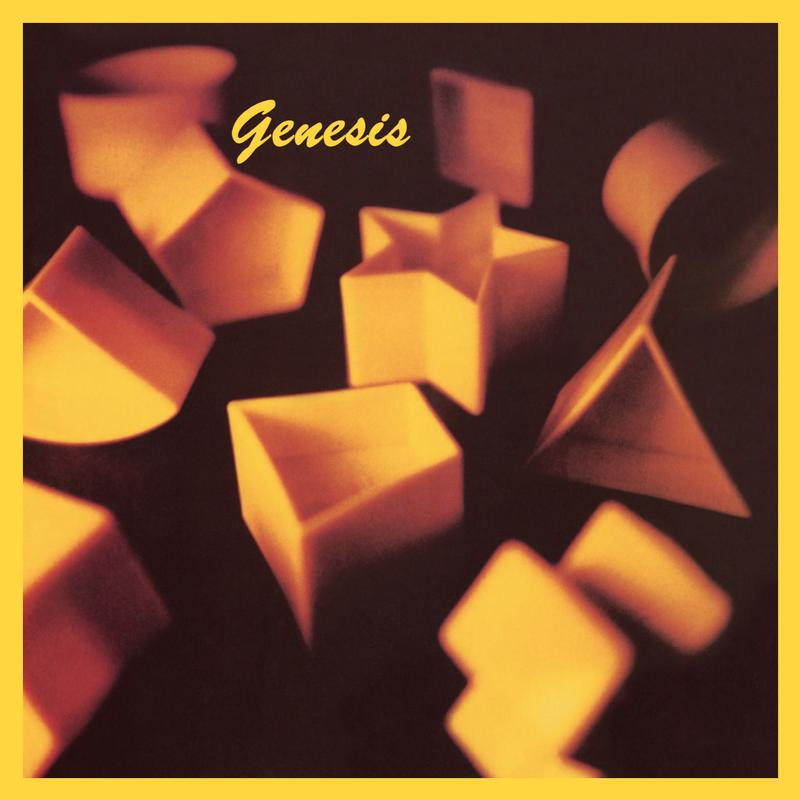
The second half changes scale. “Taking It All Too Hard”, “Just a Job to Do” and “Silver Rainbow” work as individual character pieces, each adjusting the balance between story, rhythmic identity and melody. Even the sleeve has a small domestic origin: designer Bill Smith used shapes from his young son's toy. The apparently ordinary object became a carefully arranged image, much as a simple figure could become an elaborate song during the sessions.
This edition: Atlantic 75 at 45 RPM
AAPA 043-45 presents the album on two 180-gram records running at 45 RPM. “Home by the Sea” and “Second Home by the Sea” remain together on one side. Analogue Productions specifies Quality Record Pressings and a Stoughton gatefold jacket. Documented cutting credits and CB inscriptions identify Chris Bellman, while the publisher's product page does not disclose the precise mastering source.
That distinction matters here. In a 1984 interview, Padgham described mixing the analogue multitracks directly to a Sony 1610 digital system. The production therefore cannot simply be described as an all-analogue chain. This edition should also be distinguished from the separate single-LP release carrying Nick Davis' later remix. When comparing copies of Genesis, the identity of the mix and the specific edition are at least as relevant as vinyl weight or playback speed. Those details provide a firmer basis for comparison than a general mastering slogan.
You order from Michael 45 in Germany. We arrange the US import and dispatch from Hilden.
More from the series: Atlantic 75 Series
Also on SACD: Genesis
More by Genesis: The Lamb Lies Down On Broadway · Nursery Cryme
Artist page: All titles by Genesis and Phil Collins
Customer questions: Atlantic 75: which titles are worth buying? · Buying Analogue Productions records in Europe
Series: Atlantic 75 Series – all 75 albums, time journey and the people behind Atlantic
Musicians
Documented selection of participating musicians. Personnel may vary by track; this list does not claim to be complete.
| Name | Instrument / role |
|---|---|
| Phil Collins | Percussion, Vocals, Drums |
| Tony Banks | Keyboards |
| Mike Rutherford | Guitar, Bass |
How Michael hears this edition
Listening impression · paraphrased from the video
Michael describes this Atlantic 75 edition of the self-titled Genesis album as dynamic and powerful. Following the sample of “That’s All”, he praises the sonic presentation of this 45 RPM edition. He does not make a direct comparison with an original pressing in this passage.


Reviews
There are no reviews yet.