

Ellington and Hodges in close company
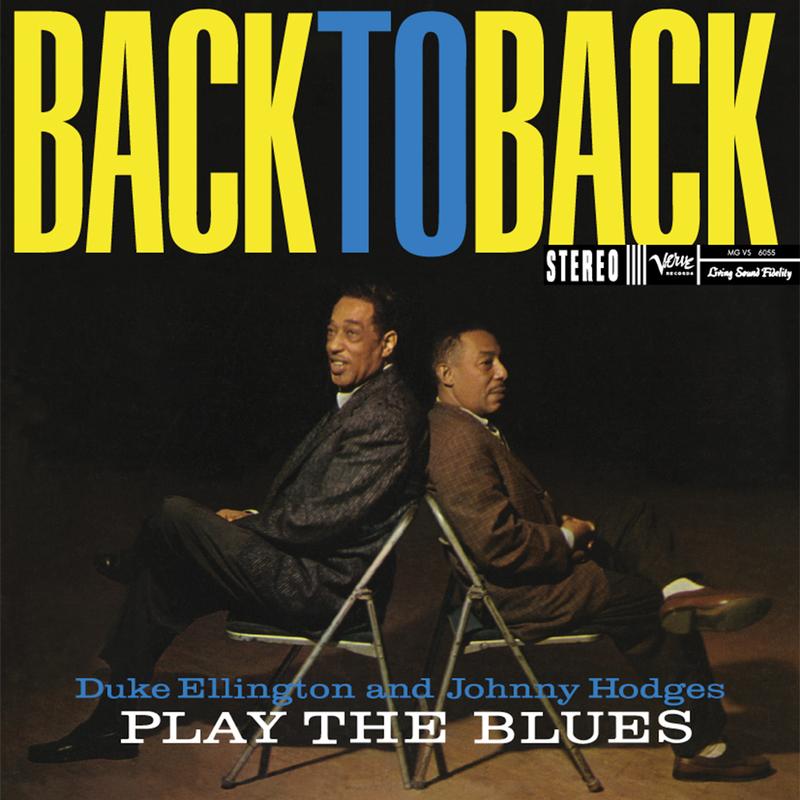
Duke Ellington at the piano and Johnny Hodges on alto saxophone: the names alone suggest a long shared history. On Back To Back, they meet in New York in February 1959 within a small group. Large-scale orchestral architecture gives way to the blues as a common starting point. Released by Verve in 1959, the album bears the subtitle Duke Ellington And Johnny Hodges Play The Blues. It describes exactly what matters here: familiar forms, strongly individual voices and the freedom to say a great deal with relatively little.
Recorded under Norman Granz’s supervision, the music gains something special from this change of perspective. Ellington is encountered directly as a pianist, while Hodges has room for the flexibility and vocal character of his alto sound. Knowing the history of the Ellington orchestra is not a requirement for enjoying the exchange. Those who do know it hear two central voices of that world at closer quarters. The small ensemble makes clear how much personality can inhabit a melodic turn or a harmonic response.

Seven players, two bassists
Harry “Sweets” Edison adds trumpet, Les Spann plays guitar and Jo Jones supplies the drums. Sam Jones and Al Hall share the bass duties. Hall is documented on “Wabash Blues” and “Weary Blues,” with Jones on the other five tracks. This is therefore not a seven-piece group playing throughout: the changing bass personnel are part of the recording’s history. The drummer’s name also deserves precision. This is the musician known as “Papa Jo,” a distinctive presence in his own right.
The instrumentation offers several colours without overcrowding the music. Edison’s trumpet stands alongside Hodges’ alto as an independent voice, while Ellington and Spann can respond in both harmonic and rhythmic terms. A rewarding approach is to follow the horn conversation first, then listen to what happens behind it. Where does the piano insert a comment? How much movement is created when nobody is delivering a major solo? These questions lead straight to the craftsmanship and pleasure of a well-balanced small jazz group.

A journey through blues memory
The programme contains seven selections. “Wabash Blues” opens the record, followed by “Basin Street Blues” and “Beale Street Blues.” Side two brings “Weary Blues,” “St. Louis Blues,” “Loveless Love” and “Royal Garden Blues.” Even the titles suggest a cultural memory of streets, cities and musical encounters. Several compositions by W. C. Handy reach back well before the album’s recording date. The musicians treat this repertoire as a living language, still open to alteration and personal inflection.
Familiar forms turn attention towards the manner of performance. A slight delay before an entrance, a change of colour or a differently placed chord can shift the weight of a melody. Back To Back does not require a dramatic concept to sustain interest. Its tension grows from experienced musicians working together without needing to use every possibility at once. It is welcoming company for a relaxed evening, yet attentive listening reveals enough detail to make returning to the same passages worthwhile.
The Verve Acoustic Sounds Series edition
The edition offered here, AVER 512449, is a stereo 180-gram LP playing at 33⅓ RPM in the Verve Acoustic Sounds Series. Mastering is credited to Bernie Grundman. The publisher identifies the original analogue tapes as the source, and pressing is by Quality Record Pressings. It is distinct from separately issued 45 RPM and SACD versions carrying different mastering credits. When choosing a copy, the catalogue number, format and engineer should therefore be considered together. Here, the complete album remains spread across two sides of a single record.
Stoughton Printing supplies the tip-on gatefold jacket. The substantial presentation suits a record whose real luxury is the attention it invites us to give small musical differences. For listeners wishing to explore Ellington and Hodges beyond their large-orchestra recordings, this is an unusually direct introduction. Back To Back honours the older material while retaining the pleasure of reshaping it in the moment. Experience gives the musicians space to move, and the music benefits from that freedom at every scale.
You order from Michael 45 in Germany. We arrange the US import and dispatch from Hilden.
More by Duke Ellington and Johnny Hodges: Side By Side
Musicians
Participants and documented credit status. Track references correspond to the tracklist.
- Johnny Hodgesalto saxophone, bandleaderParticipation: Album personnel
- Duke EllingtonpianoParticipation: Album personnel
- Harry EdisontrumpetParticipation: Album personnel
- Les SpannguitarParticipation: Album personnel
- Sam JonesbassParticipation: A2, A3, B2, B3, B4
- Al HallbassParticipation: A1, B1
- Jo JonesdrumsParticipation: Album personnel


Johnny Hodges (alto saxophone), Duke Ellington (piano), Harry “Sweets” Edison (trumpet), Les Spann (guitar), Jo Jones (drums) – on all seven tracks; bass: Sam Jones (A2, A3, B2–B4), Al Hall (A1, B1). Recorded in New York in February 1959 (sources differ on the date of the Al Hall tracks). Under the supervision of Norman Granz. Liner notes: Leonard Feather; cover photo: Burt Goldblatt; art direction: Sheldon Marks. This edition: mastered and cut by Bernie Grundman; pressed at Quality Record Pressings; jacket by Stoughton Printing; supervised by Chad Kassem.

Reviews
There are no reviews yet.