Two ways of telling a story on the violin
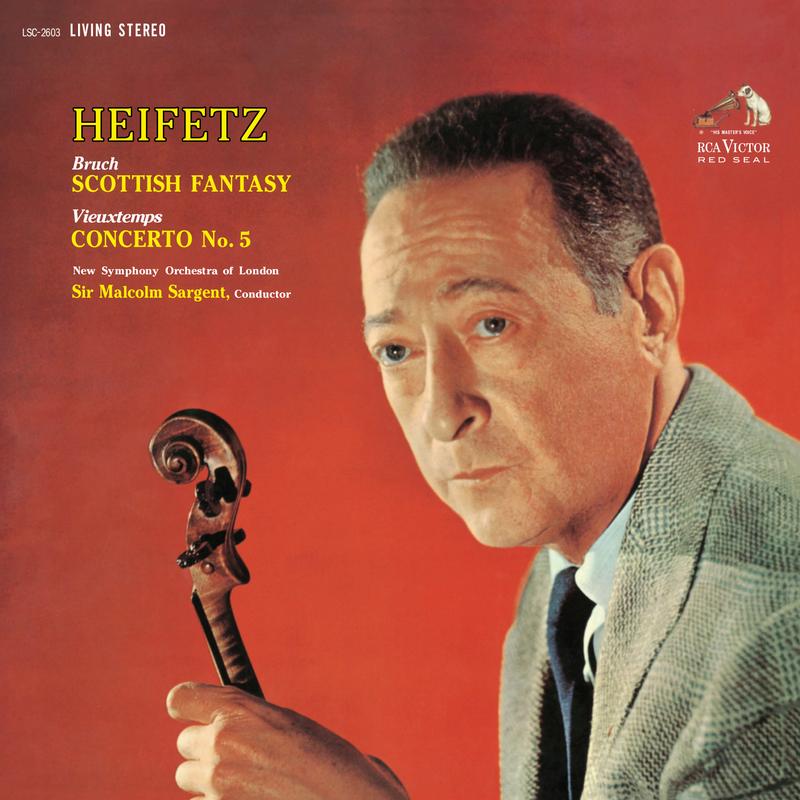
Bruch’s Scottish Fantasy and Vieuxtemps’ Fifth Violin Concerto place the same instrument at their centre, but ask different things of it. In Bruch, the violin encounters folk melodies and an orchestra in which the harp has a special role. Vieuxtemps compresses his concerto into a continuous arc. Jascha Heifetz brings these worlds together with Sir Malcolm Sargent and the New Symphony Orchestra of London.
The rewarding question is not simply what a violinist can accomplish technically. It is how a melody is carried: how the bow gives it direction, how clearly a turn is articulated, and how a larger shape remains audible. This coupling offers two contrasting opportunities to follow those questions rather than treating virtuosity as an end in itself.

RCA on the label, Decca at the sessions
The recordings were made in Walthamstow in May 1962. Acoustic Sounds identifies Kenneth Wilkinson and the Decca recording team. For listeners who automatically associate Living Stereo with American RCA sessions, this is a useful piece of background. The route here leads to London and a different established recording practice.
The concrete combination matters more than a broad sonic label: a particular soloist, conductor, London ensemble and named recording team. It also helps us keep the history of the performance separate from the mastering of a later pressing. Those two layers belong together, but they are not interchangeable facts.

The harp is in the title
Bruch’s full title specifies violin, orchestra and harp, with the free use of Scottish folk melodies. The harp is therefore not a decorative afterthought. It belongs to the conception of the work. Listen for its entrances as a partner to the violin: what happens when a plucked sound joins the sustained line of a bowed instrument?
Composed in 1879–80, the Fantasy was dedicated to Pablo de Sarasate. Yet its first performance, in Liverpool in 1881, featured Joseph Joachim with Bruch conducting. The dedicatee and the first soloist were different musicians. That small distinction opens a window onto the violin world Bruch was writing for, long before Heifetz made this recording.
A competition piece with a singing voice
Vieuxtemps wrote his Fifth Concerto for the Brussels Conservatory competition. Its three sections proceed without a pause. Technical demands are not arranged as disconnected demonstrations; they have to make sense within a continuous musical argument. Maintaining that continuity is part of the challenge.
The nickname Le Grétry refers to a melody from Grétry’s opera Lucile that appears in the slow section. Behind the virtuoso task is a connection with vocal music. That relationship helps explain why the coupling works: in both compositions, the origin and shaping of a melody deserve as much attention as the fast passages.
One practical detail is easily missed. Despite the order in the album title, this edition opens with Vieuxtemps. Bruch’s Scottish Fantasy occupies the second LP. The first side therefore introduces the tightly connected concerto before the programme opens into Bruch’s freer sequence of melodies, giving the two works a clear and thoughtful contrast.
Also on SACD: Bruch: Scottish Fantasy / Vieuxtemps: Concerto No. 5
More by Jascha Heifetz: Bruch: Concerto In G Minor / Mozart: Concerto In D Major
Customer question: Buying Analogue Productions records in Europe
Series: RCA Living Stereo – all 25 titles, conductors and soloists
Musicians
Named soloists, conductors and ensembles. The album credits do not individually name every orchestra member.
- Jascha HeifetzViolin
- Malcolm SargentConductor
- New Symphony Orchestra of LondonOrchestra
- Osian EllisHarp (Scottish Fantasy)



Reviews
There are no reviews yet.