Four works, four ways of telling a story
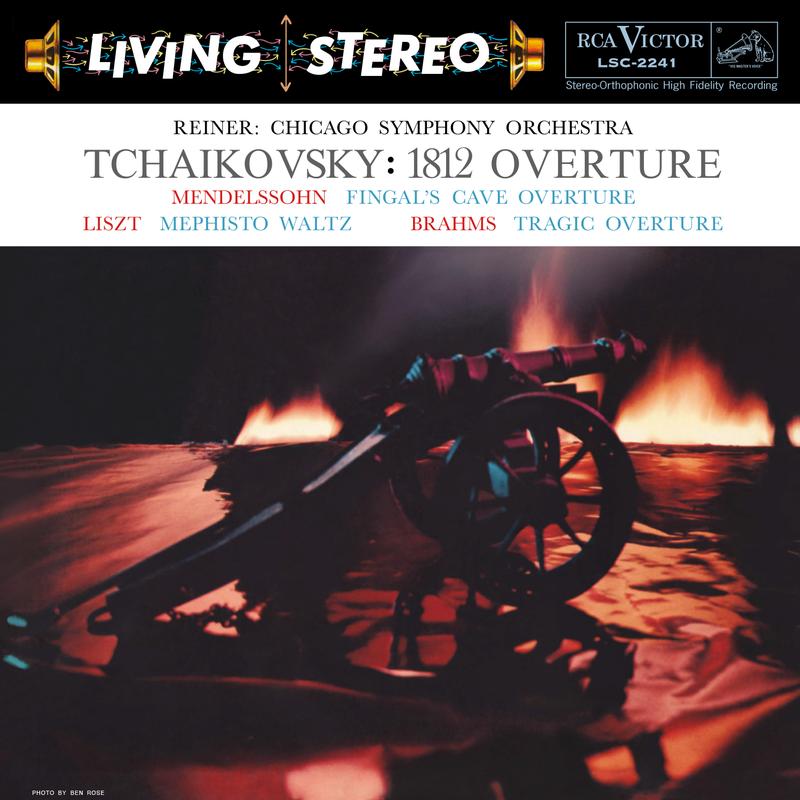
The large date on the cover draws attention to Tchaikovsky’s 1812 Overture, but this RCA program reaches further. Mendelssohn’s The Hebrides, also known as Fingal’s Cave, Liszt’s first Mephisto Waltz and Brahms’ Tragic Overture accompany it. Fritz Reiner and the Chicago Symphony Orchestra connect four different approaches to orchestral music: a historical scene, a landscape, a literary episode and a work without a specified narrative. The record can therefore be heard as a compact program about the possibilities of musical storytelling.
The performances were recorded in Chicago’s Orchestra Hall across three dates. Liszt was taped in December 1955, Tchaikovsky and Mendelssohn in January 1956, and Brahms in December 1957. The album brings separate sessions together rather than documenting one continuous occasion. Reiner had been the orchestra’s music director since 1953. This program captures their partnership in repertoire requiring precise transitions and contrasting kinds of motion as well as large climaxes. Each new selection asks the same musicians to take on a different task.

History, the sea and an unsettling dance
Tchaikovsky composed 1812 in 1880 to commemorate Russia’s resistance to Napoleon’s invasion. Its themes act as opposing forces before the music reaches an extended conclusion. The quiet opening and gradual accumulation deserve attention in their own right. Waiting only for the finale means overlooking much of the drama. The ending’s effect depends on the route the orchestra has taken to reach it, including changes of texture and scale that prepare the final expansion rather than simply announcing it.
Mendelssohn’s Hebrides overture leads back to his 1829 Scottish journey and the island of Staffa. The recurring opening figure makes movement itself the starting point. Liszt’s Mephisto Waltz draws instead on an episode from Nikolaus Lenau’s Faust: Mephistopheles takes up a violin in a village inn while Faust dances. These pieces invite different kinds of imagination. Mendelssohn develops a musical landscape; Liszt allows a dance to move increasingly toward an uncanny scene, with the orchestra carrying the transformation.

Tragedy without a prescribed plot
Brahms composed the Tragic Overture, Op. 81, in 1880, the same year as his Academic Festival Overture. Unlike Liszt’s work, it supplies no specific literary scene. The title describes a character that rhythm, harmony and the progress of the themes must establish. After the other selections, that creates an interesting change of perspective. Imagination becomes less closely attached to named places and figures. The orchestra develops and releases tension through the behavior of the musical material itself rather than through an explicit story.
Across the program, listen again to the transitions within each piece. Where do woodwinds take over an idea previously carried by strings? When does accompaniment become a determining motif? Reiner’s Chicago orchestra appears here in four different settings, extending well beyond the familiar conclusion of 1812. The compilation makes those differences available within a single program. Its movement from public gesture to landscape, dance and tragedy gives the record a shape that is worth following alongside the individual works.
This edition
Analogue Productions presents the program as a RCA Living Stereo double LP on 180-gram vinyl at 45 RPM, catalog number AAPC 2241-45. Bernie Grundman is credited for mastering, with the original master tape named as the source by the publisher. Quality Record Pressings handles the pressing, and a two-panel insert is included. The four works come from the historic Chicago stereo recordings.
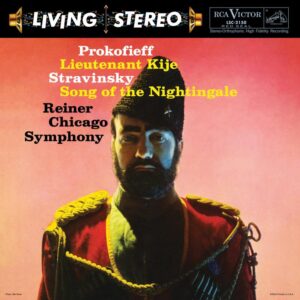
More by Fritz Reiner: Bartok: Music For Strings, Percussion And Celesta / Hungarian Sketches · Prokofiev: Lieutenant Kije / Stravinsky: Song of the Nightingale
Artist page: All titles by Fritz Reiner
Customer question: Buying Analogue Productions records in Europe
Series: RCA Living Stereo – all 25 titles, conductors and soloists
Musicians
Documented selection of participating musicians. Personnel may vary by track; this list does not claim to be complete.
| Name | Instrument / role |
|---|---|
| Fritz Reiner | Conductor |
| Chicago Symphony Orchestra | Orchestra |
How Michael hears this edition
Listening impression · paraphrased from the video
Michael describes particularly powerful bass toward the end of the 1812 Overture and dynamics that he finds breathtaking. His assessment concerns the 45 RPM edition in the Living Stereo series.
🎧 Review video: 5 Extraordinary Audiophile Reissues For Your Collection
This video is hosted by YouTube (Google). It only loads once you switch on “Functional” in the cookie settings.

Reviews
There are no reviews yet.