
A singer chooses her own programme
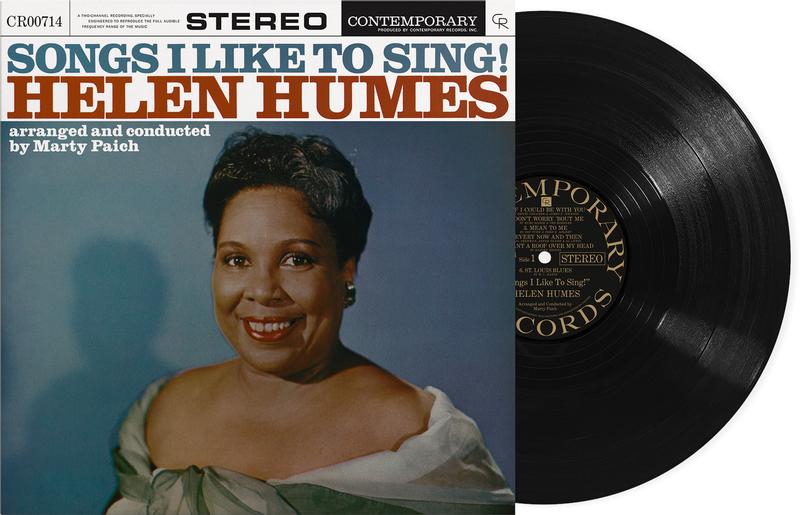
The title Songs I Like To Sing! suggests a straightforward personal selection. Behind it stands a singer whose experience already crossed several musical worlds. Helen Humes had worked with Count Basie, enjoyed rhythm-and-blues success and established herself as an interpreter in her own right. When she recorded for Contemporary in September 1960, she brought that history into a programme of twelve songs. Standards and blues share the album with “Million Dollar Secret”, one of her own compositions.
Lester Koenig produced the sessions, while Marty Paich arranged and conducted. André Previn was the pianist. Those separate responsibilities matter: Paich's task was to shape the instrumental setting around Humes, and he did not use a single unchanging large ensemble. Instead, two different groups were recorded and their performances interwoven across the finished LP. The accompaniment changes within each side, with Humes' voice providing the continuous presence through the different arrangements and choices of repertoire.

Two ensembles across three recording days
Eight tracks were recorded on 6 and 7 September 1960 with a substantial horn section. Its members included Art Pepper, Teddy Edwards and Ben Webster, alongside trumpeters Al Porcino, Jack Sheldon, Ray Triscari and Stu Williamson. On the following day, Paich moved to a smaller setting with a string quartet. James Getzoff and Joseph Stepansky played violins, Alvin Dinkin viola and Eleanor Slatkin cello. Four ballads received this different instrumental treatment.
Webster was the only horn player to appear in both configurations. Previn, Barney Kessel, Leroy Vinnegar and Shelly Manne also connected the two groups. That continuity offers an enjoyable listening route: follow the familiar rhythm section while the surrounding instrumentation changes. “If I Could Be With You” opens the first side with strings, before “Don't Worry 'Bout Me” introduces the horn ensemble. The contrasting sessions were deliberately distributed through the programme rather than presented as two self-contained album halves.

Returning to “Million Dollar Secret”
Humes had already enjoyed an American R&B chart success with “Million Dollar Secret” in 1950. A decade later, she returned to the song with Paich's horn arrangement. Its presence contributes more than another recognisable title. It brings her own earlier recording history into the programme and reminds us that she was not working exclusively with other writers' material. Her name appears on the album as a composer as well as its featured singer.
Elsewhere, the selection extends from W. C. Handy's “St. Louis Blues” to Jimmy Van Heusen and Johnny Burke's “Imagination”. “My Old Flame” belongs to the four string-session performances, while “Love Me or Leave Me” uses the larger horn group. Following the instrumentation therefore also reveals the album's sequencing. Recorded in 1960 and first released in 1961, it was engineered by Howard Holzer and carried a cover photograph by William Claxton. Those credits identify the particular Contemporary production behind this apparently unassuming collection of favourite songs.
The source behind this reissue
ACONC 714 is a single 180-gram LP in Craft's Contemporary Records Acoustic Sounds Series. Bernie Grundman cut the lacquers, Quality Record Pressings manufactured the record, and the edition is presented in a tip-on jacket. Its twelve tracks follow the original album programme. The alternate “Don't Worry 'Bout Me” issued on a later CD is not included. This release therefore returns to the album sequence rather than assembling an expanded account of the recording sessions.
Craft describes the cutting chain as AAA, while its detailed product text identifies the source more precisely as a flat quarter-inch tape copy of the original master. Shorter references elsewhere to original tapes should not obscure that distinction. An analogue copy is compatible with the manufacturer's all-analogue claim, but it is not the same thing as cutting directly from the original master itself. Keeping both pieces of information together gives a more useful account of this edition than repeating the abbreviated source description alone.
You order from Michael 45 in Germany. We arrange the US import and dispatch from Hilden.
Series: Contemporary – all 24 records: sunny jazz from Los Angeles
Musicians
Personnel for this album version are documented. Track-specific participation is shown in the final column.
| Name | Instrument / role | Participation |
|---|---|---|
| Helen Humes | vocals | Album personnel |
| Marty Paich | arrangement, conductor | Album personnel |
| Ben Webster | tenor saxophone | Album personnel |
| André Previn | piano | Album personnel |
| Barney Kessel | guitar | Album personnel |
| Leroy Vinnegar | bass | Album personnel |
| Shelly Manne | drums | Album personnel |
| Al Porcino | trumpet | A2, A3, A5, A6, B1, B3, B4, B6 |
| Jack Sheldon | trumpet | A2, A3, A5, A6, B1, B3, B4, B6 |
| Ray Triscari | trumpet | A2, A3, A5, A6, B1, B3, B4, B6 |
| Stu Williamson | trumpet | A2, A3, A5, A6, B1, B3, B4, B6 |
| Harry Betts | trombone | A2, A3, A5, A6, B1, B3, B4, B6 |
| Bob Fitzpatrick | trombone | A2, A3, A5, A6, B1, B3, B4, B6 |
| Art Pepper | alto saxophone, clarinet | A2, A3, A5, A6, B1, B3, B4, B6 |
| Teddy Edwards | tenor saxophone | A2, A3, A5, A6, B1, B3, B4, B6 |
| Bill Hood | baritone saxophone | A2, A3, A5, A6, B1, B3, B4, B6 |
| James Getzoff | violin | A1, A4, B2, B5 |
| Joseph Stepansky | violin | A1, A4, B2, B5 |
| Alvin Dinkin | viola | A1, A4, B2, B5 |
| Eleanor Slatkin | cello | A1, A4, B2, B5 |
A2, A3, A5, A6, B1, B3, B4, B6: horn sessions, September 6–7, 1960. A1, A4, B2, B5: string session, September 8. Art Pepper’s instrument changes are not documented track by track.



Reviews
There are no reviews yet.