San Francisco meets the blues
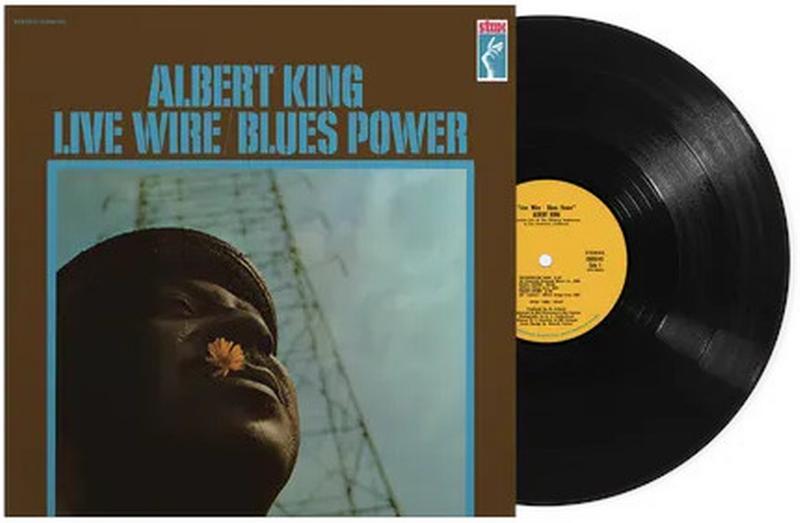
In June 1968, Albert King steps onto the stage of San Francisco’s Fillmore Auditorium. This audience knows electric guitars and extended solos; King brings a musical language in which one bent note can carry an entire story. Live Wire/Blues Power draws on performances recorded on June 26 and 27. Released by Stax later that year, it became his first live album: an encounter between an experienced blues musician and a concert culture discovering his influence with fresh enthusiasm.
Its appeal lies in the relationship between authority and patience. King does not need to hurry his music to reach the room. His guitar can answer, argue and leave a thought hanging in the air. A concert recording also preserves things that a tightly timed studio single has little room for: spoken addresses, anticipation and the space between entrances. For listeners who know King mainly through his Stax studio records, this album shows how far the same unmistakable musical personality can stretch onstage.

A band that leaves room
King is joined by Willie James Exon on guitar, James Washington on organ, Roosevelt Pointer on bass and Theotis Morgan on drums. The compact lineup makes the individual roles easy to follow. A second guitar and organ support the soloist, while bass and drums keep the music moving. In blues, much depends on whether an accompaniment simply marks time or listens to the storyteller. This recording rewards attention to both scales: King’s expansive gestures and the smaller responses happening around them.
The repertoire opens another window onto the music. Herbie Hancock’s “Watermelon Man” begins the record with a theme that came from jazz and developed a life of its own in rhythm and blues and dance music. The second side includes “Please Love Me,” associated with B.B. King. Albert King folds both into his own concert vocabulary. These connections reveal how freely the music travels. Individuality comes as much from the treatment of familiar material as from the choice to perform an original composition.

The life of a sustained note
“Blues Power” forms a centre of gravity on the first side. King’s spoken address and guitar playing belong to the same unfolding performance. The title expresses an attitude that takes shape over time: blues as an experience shared by musicians and audience. “Night Stomp” returns more directly to physical momentum. The second side brings “Blues At Sunrise,” “Please Love Me” and finally “Look Out.” Six tracks are enough because each performance has room to establish its own tension and release.
For attentive listening, the length of a solo is only a starting point. Follow the instant when King finishes a phrase and the band carries the music forward. How long does a note remain suspended? When does the organ occupy space that the guitar has just left? The pleasure of a record like this lives in those relationships. You can surrender to the energy of the concert, then discover an overlooked response on the next play. That gives the recording a life beyond its historical importance.
The 180-gram Bluesville edition
This reissue belongs to Craft Recordings’ Bluesville series, produced in collaboration with Acoustic Sounds. It presents the stereo album on one 180-gram LP playing at 33⅓ RPM. Matthew Lutthans handled mastering and lacquer cutting at The Mastering Lab. Craft identifies the original master tapes as the source and describes the edition as AAA. Pressing is by Quality Record Pressings. Those are concrete details about the source, mastering engineer and manufacturing, helping listeners identify the edition they are choosing.
A Stoughton Printing tip-on jacket and blue obi with notes by Scott Billington complete the presentation. The attention to the physical object extends beyond the groove, while the music remains the reason to return: a guitarist building tension through tone, silence and carefully placed accents. Live Wire/Blues Power invites us to give that language time. For anyone drawn to blues as a conversation between voice, instrument and audience, this is a record whose lasting measure is the force of its expression.
You order from Michael 45 in Germany. We arrange the US import and dispatch from Hilden.
Musicians
Participants and documented credit status. Track references correspond to the tracklist.
- Albert Kingguitar, vocalsParticipation: Album personnel
- Willie James ExonguitarParticipation: Album personnel
- James WashingtonorganParticipation: Album personnel
- Roosevelt PointerbassParticipation: Album personnel
- Theotis MorgandrumsParticipation: Album personnel

Albert King (guitar, vocals) · Willie James Exon (guitar) · James Washington (organ) · Roosevelt Pointer (bass) · Theotis Morgan (drums). Recorded live at the Fillmore Auditorium, San Francisco, on June 26 and 27, 1968. Personnel per the obi and discography of this edition, not assigned by track; the original jacket did not name the band. Writers: Herbie Hancock (Watermelon Man); Albert King (Blues Power, Blues At Sunrise, Look Out); Albert King with Al Jackson Jr. (Night Stomp, co-writer disputed); B.B. King and Jules Taub (Please Love Me). Original: produced by Al Jackson Jr. · engineers Bill Halverson, Ron Capone · liner notes by Pete Johnson · cover photo by Ivan Nagy. This edition: mastering and lacquer cutting by Matthew Lutthans (The Mastering Lab) · obi notes by Scott Billington · pressed at Quality Record Pressings.
How Michael hears this edition
Listening impression · paraphrased from the video
Michael considers this edition one of his favourites in the Bluesville series up to that point. He is particularly excited by the power, liveliness and atmosphere of the live performance. His recommendation is explicitly aimed at listeners who enjoy blues and energetic live recordings; he does not compare it with older pressings here.
🎧 Review video: 12 Amazing New Reissues!
This video is hosted by YouTube (Google). It only loads once you switch on “Functional” in the cookie settings.

Reviews
There are no reviews yet.