When percussion takes the leading role
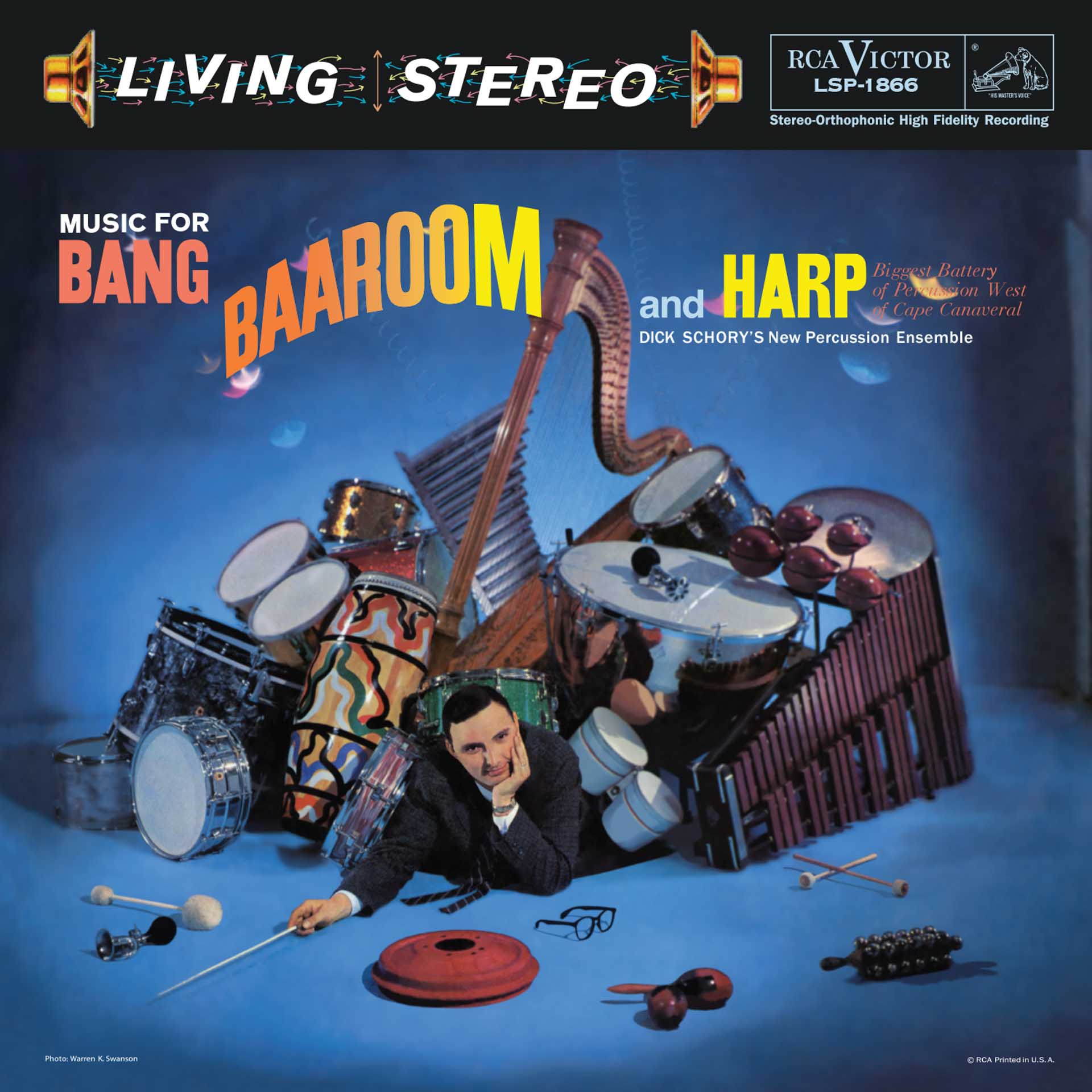
The title Music for Bang, Baaroom and Harp makes it clear that this is not an ordinary orchestral album. Dick Schory’s New Percussion Ensemble brings together a wide range of percussion with piano, double basses, guitars, banjo and harps. Recorded on 2 and 3 June 1958 in Orchestra Hall, Chicago, it belongs to the early stereo period in which RCA was exploring spatial recording with particular enthusiasm. Its subject, however, is not a symphony but a twelve-piece programme whose playfulness rests on carefully organised arrangements.
Dick Schory directs the ensemble, while Bob Bollard is credited as producer and author of the liner notes. The publisher describes eight percussionists working with additional players, including musicians associated with the Chicago Symphony Orchestra. This distinguishes the project from a simple collection of sound effects. Its possibilities are ordered, distributed and shaped into musical sequences by performers. The interest lies not only in something being loud, deep, metallic or surprising, but in the moment a particular sound arrives and the answer that follows it.
The historical RCA release is LSP-1866. Sources disagree about its release year: the publisher gives 1958, while a documented catalogue entry for the original edition gives 1959. The two established recording dates in June 1958 are a separate matter. Keeping that distinction visible is more useful than presenting an apparently seamless chronology. What is clear is the connection with late-1950s enthusiasm for stereo and with an album that explores a large percussion ensemble over a complete programme rather than a brief demonstration selection.
The recording equipment also belongs to the story. The publisher describes two Ampex 300-3 three-track machines using half-inch tape, running at 15 and 30 inches per second respectively. Equipment from RCA’s classical Red Seal operation was employed. This helps explain the meeting of popular repertoire, unusual instrumentation and a working environment used for major orchestral recordings. It does not establish a particular listening result by itself. It does show the resources committed to a project whose humour and entertainment value can make its musical organisation easy to overlook.

Harps, drums and the people behind the sound
The title specifically mentions the harp, and the album credits name Carol Baum and Russell Crandall on that instrument. They are part of the ensemble’s distinctive palette rather than a decorative footnote among the percussionists. Willis Charkovsky plays piano; Harold Siegel and John Frigo are listed on double bass; John Gray and Earl Backus on guitar, with Backus also credited on banjo. These instruments extend the ways rhythmic figures can connect with harmony and melodic movement. Album credits alone do not reliably establish which individual is heard in every bar or on every selection.
The documented percussion personnel are Bobby Christian, Bob Wessberg, Dale Anderson, Edward Metzenger, Frank Rullo, Hubert Anderson, Jim Ross and Thomas L. Davis. On a record of this kind, their names deserve to remain visible rather than disappearing into a collective description. The ensemble depends on coordination between individual players. The exact allocation of instruments to tracks is not established, so no conspicuous sound has been turned into an unsupported solo attribution. The complete personnel section below preserves the documented participation.
The arrangers provide another important layer of identity. Mike Simpson is credited for National Emblem March, April in Paris and Buck Dance. Skitch Henderson arranges Holiday in a Hurry and September in the Rain. Willis Charkovsky contributes Ding Dong Polka and Tiddley Winks and collaborates with Schory on Baía. Bobby Christian arranges selections including Way Down Yonder in New Orleans, Duel on the Skins and The Sheik of Araby. Typee is associated with Christian and Schory together. A programme drawn from varied material consequently contains several different musical imaginations.
One particularly telling detail in the publisher’s account is an exhaust manifold from a 1946 Chevrolet among the sound sources used. It is an intriguing album-level fact, but it does not establish which audible strike on which selection comes from that object. Instead, it demonstrates the project’s openness to sounds beyond a conventional instrument list. What matters is what the arrangers and players do with them. An unusual object becomes a musical event through timing, rhythm and context, rather than through its novelty alone.

Twelve selections between march, song and percussion dialogue
Side one opens with “National Emblem March” by E. E. Bagley. “Baía”, by Ary Barroso, then introduces another musical point of reference. That juxtaposition already shows that the album does not repeat one stylistic formula twelve times. It combines established repertoire with material contributed from within the project, each bringing different possibilities. A march organises movement differently from a song; an arrangement can preserve that origin or change the weight of individual elements. Listen for how much of a familiar piece remains recognisable and which instrumental group changes its character.
Way Down Yonder in New Orleans, Ding Dong Polka, April in Paris and Holiday in a Hurry complete the first side. Different traditions are placed close together. Identifying every historical connection is not necessary to enjoy the changing musical responsibilities. Concentrate on the opening of a selection: does it introduce a melody first, or establish a rhythmic pattern as the frame? Which instruments maintain an idea while others comment on it? The relationship between attack and resonance can be as informative as a particularly forceful accent.
Side two begins with Buck Dance and proceeds to “Duel on the Skins”, composed and arranged by Bobby Christian. The title itself directs attention towards percussion’s possibilities for dialogue. September in the Rain, Tiddley Winks, The Sheik of Araby and “Typee” follow. The final piece was written by Christian and Schory. The record therefore closes with material from its own creative circle rather than simply another established melody. Twelve selections provide twelve opportunities to bring instrumentation and musical form into a different relationship.
For listeners drawn to unusual studio productions, that creates a particular collector’s appeal. This is part of the history of stereo entertainment, but also an example of the planning that can support apparently effortless musical fun. It can be played for the surprise of changing colours and revisited for the arrangements. The second approach does not invalidate the first. Humour, craft and interest in recording technique have a shared place on this record. Its programme invites movement between these perspectives while repeatedly returning attention to the individual pieces.
The Analogue Productions LP and its edition details
The product offered here is AAPP 1866, a single Analogue Productions stereo LP at 33⅓ RPM. The current publisher description identifies the original three-track master tapes, credits Ryan K. Smith at Sterling Sound for remastering and lacquer cutting, and names Quality Record Pressings as the manufacturer. These are the publisher’s present specifications for the reissue. They should not automatically be applied to every earlier release carrying a related catalogue number. A long-lived album can have an edition history that differs from its current product description.
An older documented AP edition from 2016 is listed at 200 grams and carries a remastering credit for Bernie Grundman. The current publisher instead specifies 180 grams and Ryan Smith. The available documentation does not conclusively resolve that discrepancy. This description therefore promises neither a particular older pressing nor a weight established by inspection of the stocked record. Collecting an exact historical variant requires identification of the physical edition and its markings. The present manufacturer statement remains clearly distinguished from the older catalogue entry.
The 33⅓ format is practical for an album that can be experienced as two connected programme halves: six selections on side A, six on side B, one turn and one disc. That is a useful everyday listening consideration, rather than a general claim about sound quality. The separately available SACD remains its own edition, even though the album history and illustrations can accompany the same music in both formats. For this LP, AAPP 1866, stereo and 33⅓ are the essential points of identification. You order from Michael 45 in Germany. We arrange the US import and dispatch from Hilden.
Customer question: Buying Analogue Productions records in Europe
Musicians
Participants and documented credit status. Track references correspond to the tracklist.
- Dick SchorydirectionParticipation: Album personnel
- Bobby ChristianpercussionParticipation: Album; track assignments unconfirmed
- Willis CharkovskypianoParticipation: Album; track assignments unconfirmed
- Carol BaumharpParticipation: Album; track assignments unconfirmed
- Russell CrandallharpParticipation: Album; track assignments unconfirmed
- Harold Siegeldouble bassParticipation: Album; track assignments unconfirmed
- John Frigodouble bassParticipation: Album; track assignments unconfirmed
- John GrayguitarParticipation: Album; track assignments unconfirmed
- Earl Backusguitar, banjoParticipation: Album; track assignments unconfirmed
- Bob WessbergpercussionParticipation: Album; track assignments unconfirmed
- Dale AndersonpercussionParticipation: Album; track assignments unconfirmed
- Edward MetzengerpercussionParticipation: Album; track assignments unconfirmed
- Frank RullopercussionParticipation: Album; track assignments unconfirmed
- Hubert AndersonpercussionParticipation: Album; track assignments unconfirmed
- Jim RosspercussionParticipation: Album; track assignments unconfirmed
- Thomas L. DavispercussionParticipation: Album; track assignments unconfirmed
Recorded 2–3 June 1958, Orchestra Hall, Chicago. Bob Bollard, producer. Album credits; exact instruments on individual tracks not established. Label credits Ryan K. Smith/Sterling; an older Discogs edition credits Bernie Grundman. Do not conflate editions. Arrangers: Mike Simpson (A1/A5/B1), Dick Schory and Willis Charkovsky (A2), Bobby Christian (A3/B2/B5), Willis Charkovsky (A4/B4), Skitch Henderson (A6/B3), Bobby Christian and Dick Schory (B6).

Reviews
There are no reviews yet.