
A ballet evening for the record collection
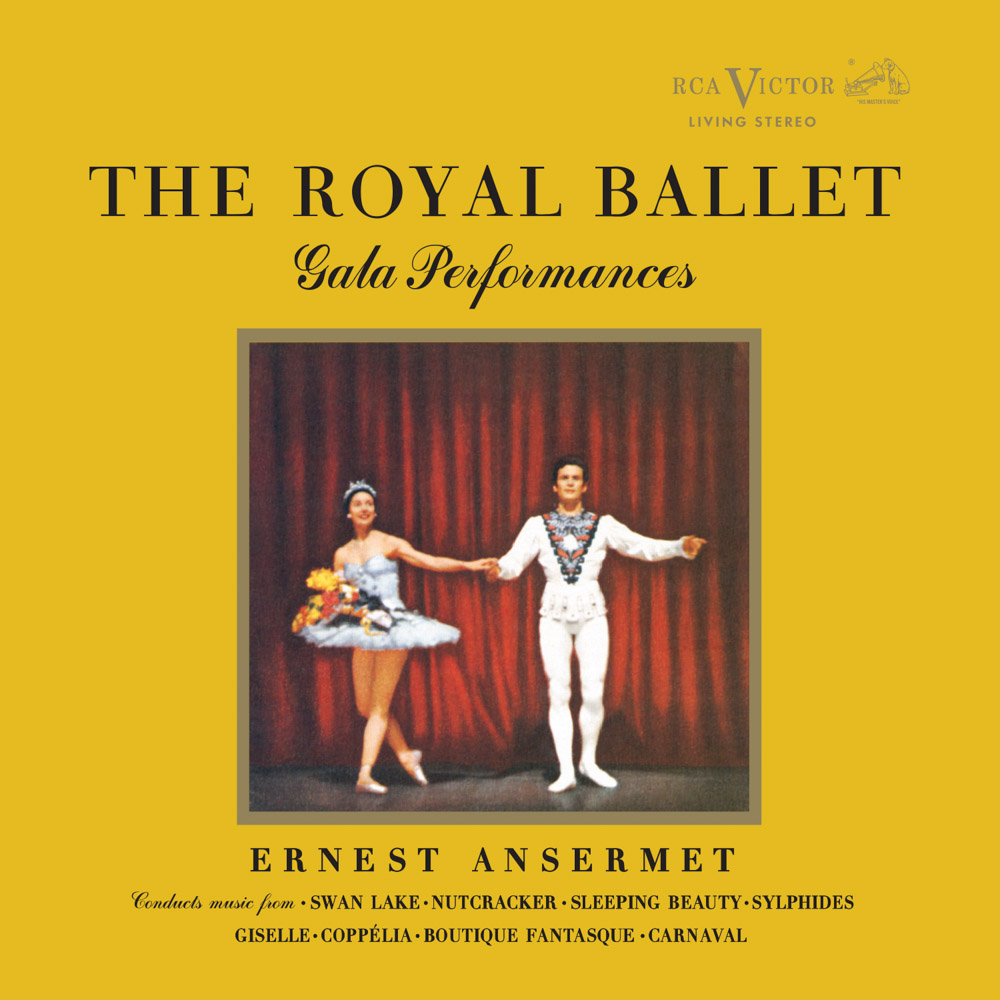
The Royal Ballet Gala Performances brings together two worlds that complement each other particularly well on record: ballet’s colourful storytelling and attention to the orchestra as a musical presence in its own right. Ernest Ansermet conducts the Orchestra of the Royal Opera House, Covent Garden, in a programme drawn from eight ballets. Familiar melodies sit beside shorter character pieces. This is not a complete theatrical work with one continuous plot, but a carefully assembled succession of scenes, dances and contrasting moods.
The recordings were made in London’s Kingsway Hall in January 1959. Decca’s documentation identifies Michael Williamson as producer and Kenneth Wilkinson as recording engineer, while the original album appeared on RCA Victor Red Seal. That relationship places the title within both the RCA collecting tradition and the history of British recording. The original stereo set belongs to the LDS-6065 catalogue family; AAPC 6065 identifies the particular reissue offered here. Recording session, original album and later edition represent distinct stages in its history.
Ansermet had a substantial relationship with ballet, including his work with Diaghilev’s Ballets Russes. Here that background meets an orchestra belonging to an opera and ballet house. The ensemble should be named precisely: this is the Royal Opera House orchestra, not the Orchestre de la Suisse Romande with which Ansermet is so often associated. The distinction supplies a useful starting point for considering the album. These are musicians whose theatrical work connects musical timing with movement on a stage.

Tchaikovsky, Delibes and the character of a dance
The first LP opens with six selections from Tchaikovsky’s The Nutcracker: the March, Dance of the Sugar Plum Fairy, Arabian Dance, Chinese Dance, Dance of the Toy Flutes and Waltz of the Flowers. Their familiarity need not reduce the experience to recognition. It can also encourage closer attention to instrumentation, changes of register and the scale of a musical gesture. A short character dance asks something different from a broadly unfolding waltz, and the sequence offers several ways of hearing that contrast.
Three excerpts from La Boutique fantasque follow: Tarantella, Andante mosso and Can-Can. Rossini’s music enters a new setting through Respighi’s arrangement. The programme consequently connects different ways in which music can arrive on a ballet stage, as well as different ballets themselves. Existing musical ideas can acquire another function through orchestration, selection and their place beside other pieces. A collection like this allows those relationships to become audible within a manageable span, without requiring an encyclopaedic knowledge of the repertoire.
Delibes’s Coppélia introduces another theatrical language through its introductions, Mazurka, Waltz, Csárdás and Doll’s Waltz. Movement and characterisation sit close together in the selection. Adam’s Giselle then brings a different setting, pairing the introduction and waltz from Act I with the pas de deux and variation from Act II. A listener does not need to know every detail of the plots in advance. The excerpts can just as easily become invitations to explore individual works more fully afterwards.
The first LP therefore offers more than a sequence of famous numbers. It suggests the different means by which an orchestra can convey dance: rhythmic definition, melodic breadth, lightness or a carefully paced growth in intensity. Ansermet brings these varied tasks into a shared programme. Alongside the melodies, the transitions deserve attention. A new section can immediately change the scale and perspective of the music, turning an anthology into a succession of clearly differentiated experiences.

From Swan Lake to Chopin’s ballet afterlife
The second LP returns first to Tchaikovsky through selections from Swan Lake: the Dance of the Little Swans, a pas de deux and a waltz. Their proximity brings compact rhythmic figures into contact with more extended melodic lines. On record, the music exists outside its visible stage action, but an awareness of movement can remain a useful companion: a step, a turn, a pause or the coordinated entrance of several dancers. The orchestra carries the continuity that the eye would otherwise help to establish.
Schumann’s Carnaval appears in orchestral form through “Pierrot,” “Reconnaissance,” “Aveu” and “Pantalon et Colombine.” The focus turns towards concise character portraits. The programme then returns to Tchaikovsky with the Lilac Fairy, Rose Adagio and Waltz from The Sleeping Beauty. Encountering the same composer through several ballets brings both recognition and variety. Different pieces ask different things of the orchestra, and the compilation does not allow one mood to define the whole selection.
Les Sylphides closes the programme with Chopin’s music in Roy Douglas’s orchestration. The Prelude in A major, Op. 28 No. 7, Mazurka in C major, Op. 67 No. 3, and Grande valse brillante in E-flat major, Op. 18, carry music associated with the piano into the orchestral world of ballet. After the preceding selections, that change of origin adds another dimension. The album can be understood as a small journey through arrangement and orchestration while retaining the immediate pleasure of a varied musical programme.
The accompanying book is part of the album’s character. This Analogue Productions edition integrates a lavishly illustrated, 22-page book into its gatefold jacket. It introduces Royal Ballet productions and personalities including Margot Fonteyn, Nadia Nerina and Beryl Grey, with Arnold L. Haskell among the writers represented in the accompanying material. The book restores something of the theatrical context surrounding the recorded music. For a collector, it offers an object to return to alongside the records themselves, extending the experience beyond the tracklist and production credits.
Two 33⅓ RPM LPs from Bernie Grundman’s cut
The edition offered here, AAPC 6065, comprises two stereo LPs at 33⅓ RPM, specified at 180 grams and pressed at Quality Record Pressings. Its cut derives from Bernie Grundman’s work with the original analogue tape. The publisher documents the use of existing metal parts and a newly manufactured stamper from that lineage. This distinction matters when identifying the release: a new pressing does not necessarily mean that a new lacquer was cut for it.
Stoughton Printing supplies the elaborate tip-on gatefold presentation with its integrated book. The music and physical package therefore retain the special character associated with the original album. The separately available 45 RPM box and SACD release belong to the same album family, but each has its own format details. Here the focus is the double LP. Its four sides gather the eight groups of excerpts into longer listening sections, giving the programme a different practical rhythm from an edition requiring more frequent record changes.
For collectors of classical stereo recordings, this version joins an identifiable recording history with a particularly engaging repertoire selection. Ballet enthusiasts can revisit familiar moments beside less familiar ones, while listeners approaching the repertoire for the first time have several possible starting points across two records. Much of the pleasure lies in the changing colours, characters and kinds of movement. The famous melodies are part of that experience, but so is the orchestral detail surrounding them: a small theatrical world capable of unfolding even when the dancers themselves are out of sight.
You order from Michael 45 in Germany. We arrange the US import and dispatch from Hilden.
Also on SACD: The Royal Ballet Gala Performances
Customer questions: 45 or 33⅓ RPM: which edition is worth it? · Buying Analogue Productions records in Europe
Musicians
Participants and documented credit status. Track references correspond to the tracklist.
- Ernest AnsermetPortrait: existing portraitconductingParticipation: Complete programme
- Orchestra of the Royal Opera House, Covent GardenorchestraParticipation: Complete programme

Excerpts from eight ballets, not complete ballet recordings. LP1/LP2 and running numbers; no unverified side allocation.

Reviews
There are no reviews yet.