
A festival of contrasts with Fritz Reiner
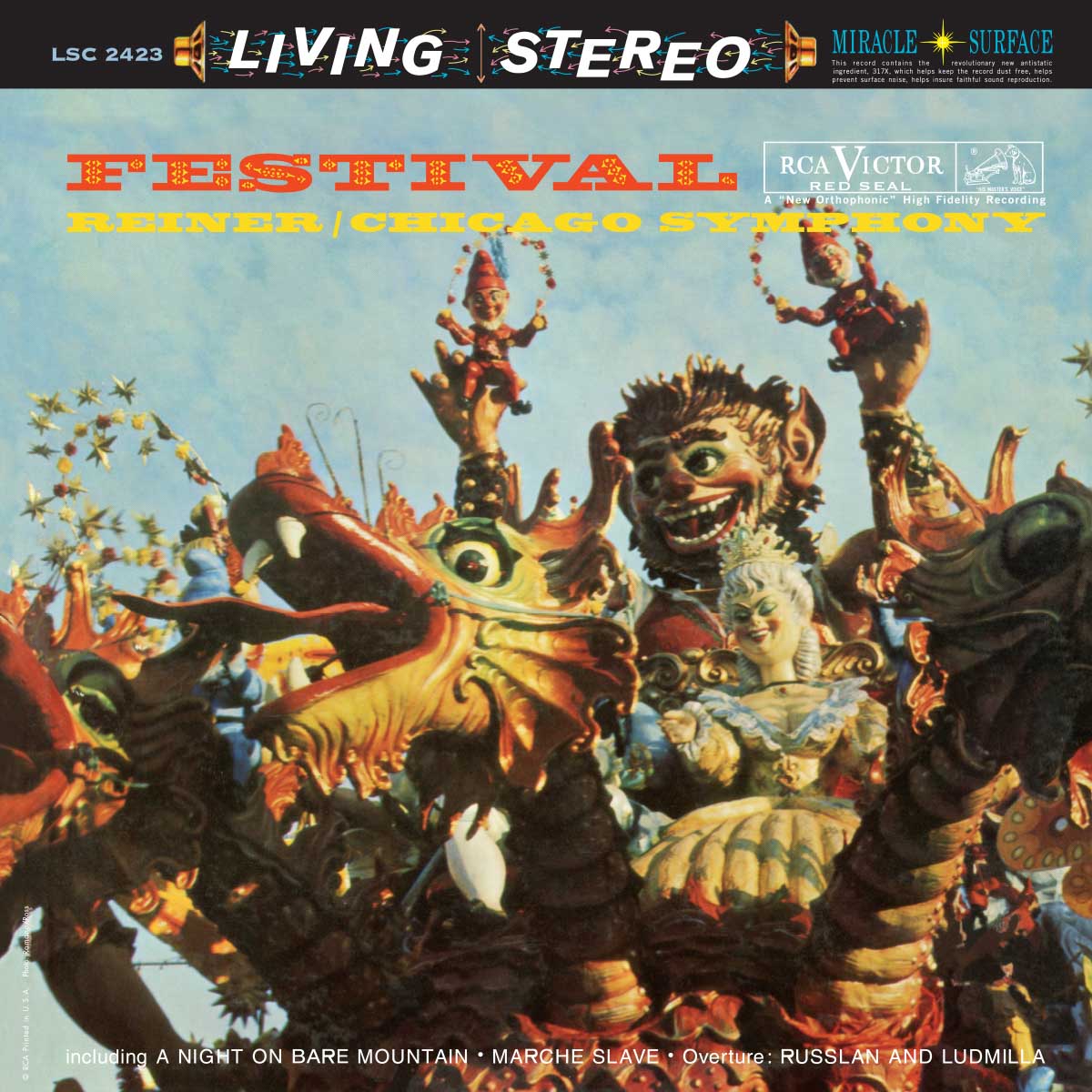
An orchestral programme does not need to revolve around one large work to have a distinctive identity. Festival brings together six pieces by five composers, finding its continuity in their differences. Dmitri Kabalevsky, Pyotr Ilyich Tchaikovsky, Alexander Borodin, Modest Mussorgsky and Mikhail Glinka meet in a programme moving between the opera house, the march and orchestral fantasy. Fritz Reiner and the Chicago Symphony Orchestra provide the connecting thread. Across a single record, the listener can follow a large ensemble as it changes its manner of address, its balance of forces and the scale on which it tells a story.
The title suits that variety, although it should not be mistaken for the location of a live event. This is an RCA Living Stereo album, originally issued as LSC-2423, rather than a documented festival concert. Richard Mohr is credited with production, Lewis Layton with engineering, and Louis Biancolli with the original liner notes. Those names connect the record with RCA’s work in presenting orchestras both as artistic partnerships and as ensembles occupying a real acoustic space. They do not, by themselves, establish a single recording date for all six selections, and none is added here without supporting evidence.
Part of the pleasure of this selection is that orchestral impact can take more than one form. A swiftly unfolding overture asks something different of the listener from a longer march, while a miniature lasting less than two minutes can establish its own proportions between larger neighbours. Festival consequently invites a complete journey through the programme as well as concentrated attention to an individual piece. For collectors of Reiner’s Chicago recordings, it complements the symphonies and extended tone poems: the same partnership facing a succession of shorter tasks, with changes of character that have to communicate without a lengthy introduction.

Six works opening five musical worlds
The programme begins with the overture to Kabalevsky’s opera Colas Breugnon, op. 24. An overture has an especially interesting responsibility: it must open a door, create a satisfying course of its own and suggest the larger theatrical world beyond it. Here it can be enjoyed as an independent orchestral piece. Tchaikovsky’s Marche slave follows, introducing a more extended structure and a different weight to the first side. The sequence allows both works to speak without making their purposes interchangeable. One establishes an opening flourish; the other develops a longer relationship between recurring ideas, changing emphasis and the underlying movement of a march.
Borodin’s contribution is the Polovtsian March from Act III of Prince Igor. The exact title matters for this release. The opera’s equally familiar Polovtsian Dances are a separate selection and are not substituted for the march on this record. Borodin closes the first side, giving its journey through Kabalevsky and Tchaikovsky a distinct final point. This may sound like a small discographical distinction, but it determines which music the listener can expect. A major opera often produces several popular orchestral excerpts; keeping their identities clear preserves the particular programme Reiner and RCA assembled rather than replacing it with a more familiar one.
Side two opens with Mussorgsky’s A Night on Bare Mountain. Tchaikovsky’s Marche miniature from the First Orchestral Suite in D minor, op. 43, comes next, followed by Glinka’s overture to Ruslan and Lyudmila. The miniature creates a deliberate change of scale between two more expansive neighbours. It can be appreciated as a complete small form rather than treated as a pause between the main attractions. Tchaikovsky is the only composer represented twice, adding another useful comparison: a single musical personality can call on an orchestra for very different kinds of movement, proportion and character within the same album.

Following the orchestra as its role changes
One rewarding way into this record is to notice the differences between pieces instead of expecting one unchanging orchestral image. How does each new scene begin? Which group of instruments makes the opening gesture, and which takes over when the argument moves forward? In a march, the regular tread is only part of the story. A line above it may gather tension, broaden or pull against the apparent stability of its accompaniment. These relationships can be followed without reading a score. They turn the general impression of a large orchestra into a sequence of decisions made by individual players and instrumental sections.
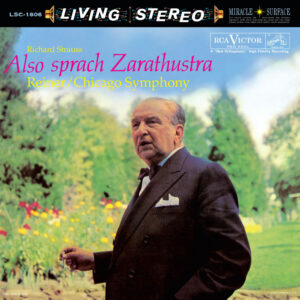
Mussorgsky’s title invites another kind of attention. Its nocturnal world gives the imagination something to work with, without requiring every musical turn to be assigned to a fixed action. The changing density of the writing, the movement between activity and restraint, and the arrival of a contrasting colour can provide an equally direct route. The accompanying mountain illustration responds freely to that night-time imagery. It is not presented as a historical stage design or a depiction of the recording venue. Reiner’s portrait identifies the conductor behind the programme, allowing music and illustration to accompany one another without inventing a documentary session scene.
The Chicago Symphony Orchestra is documented as the performing ensemble, but a complete list of individual players at these sessions has not been established from the album credits used here. Their collective contribution remains central without filling the gaps from general orchestra rosters. Shorter works can be particularly revealing when exploring Reiner’s recorded catalogue: a transition has to find its place immediately, a character must become clear quickly, and a brief increase in intensity needs its own sense of proportion. This album supplies six different settings in which to follow that shared work. The orchestra remains the same, while its immediate task continually changes.
The complete programme on one Living Stereo LP
This edition is Analogue Productions AAPC 2423, a stereo LP running at 33⅓ RPM. The publisher credits Ryan K. Smith at Sterling Sound with cutting from the original master tape, Gary Salstrom with plating and Quality Record Pressings with manufacturing. Those details describe the reissue. Mohr and Layton belong to the historical RCA recording, and keeping the two stages distinct helps explain what this particular record represents. For a collector, both matter: the original performance and recording decisions, followed by the later work of transferring that preserved material to a newly manufactured vinyl edition.
The current publisher listing specifies 180-gram vinyl, while a documented earlier pressing under the same catalogue number is listed at 200 grams. Weight alone therefore cannot identify the exact stock copy. The secure format distinction is the single LP: three pieces on each side, the complete six-work programme and one side change. That arrangement has an evident appeal for listeners who enjoy a group of shorter orchestral works as a continuous programme. At 33⅓ RPM, the contrasts remain gathered into two substantial sides. Choosing this format can be about the shape of the listening session as much as any individual production specification.
For admirers of Russian orchestral repertoire, Reiner collectors and listeners moving between opera and the concert hall, Festival offers a specific and varied destination. Mussorgsky’s familiar nocturnal fantasy sits alongside a compact suite movement, an operatic march and two very different overtures. The tracklist identifies each work precisely, while the personnel section credits Reiner and the Chicago Symphony Orchestra without adding undocumented soloists. The result remains the album’s actual programme, rather than a generic selection of spectacular orchestral moments. You order from Michael 45 in Germany. We arrange the US import and dispatch from Hilden.
Artist page: All titles by Fritz Reiner
Customer question: Buying Analogue Productions records in Europe
Musicians
Participants and documented credit status. Track references correspond to the tracklist.
- Fritz ReinerPortrait reference 1958conductorParticipation: All six selections
- Chicago Symphony OrchestraorchestraParticipation: All six selections; individual players unconfirmed

Richard Mohr: producer; Lewis Layton: engineer; Louis Biancolli: liner notes. Six selections; A3 is the Polovtsian March from Prince Igor, not the Polovtsian Dances. Session dates and individual orchestral personnel unconfirmed.
Also on SACD: Festival

Reviews
There are no reviews yet.