Broadway in the form of a piano trio
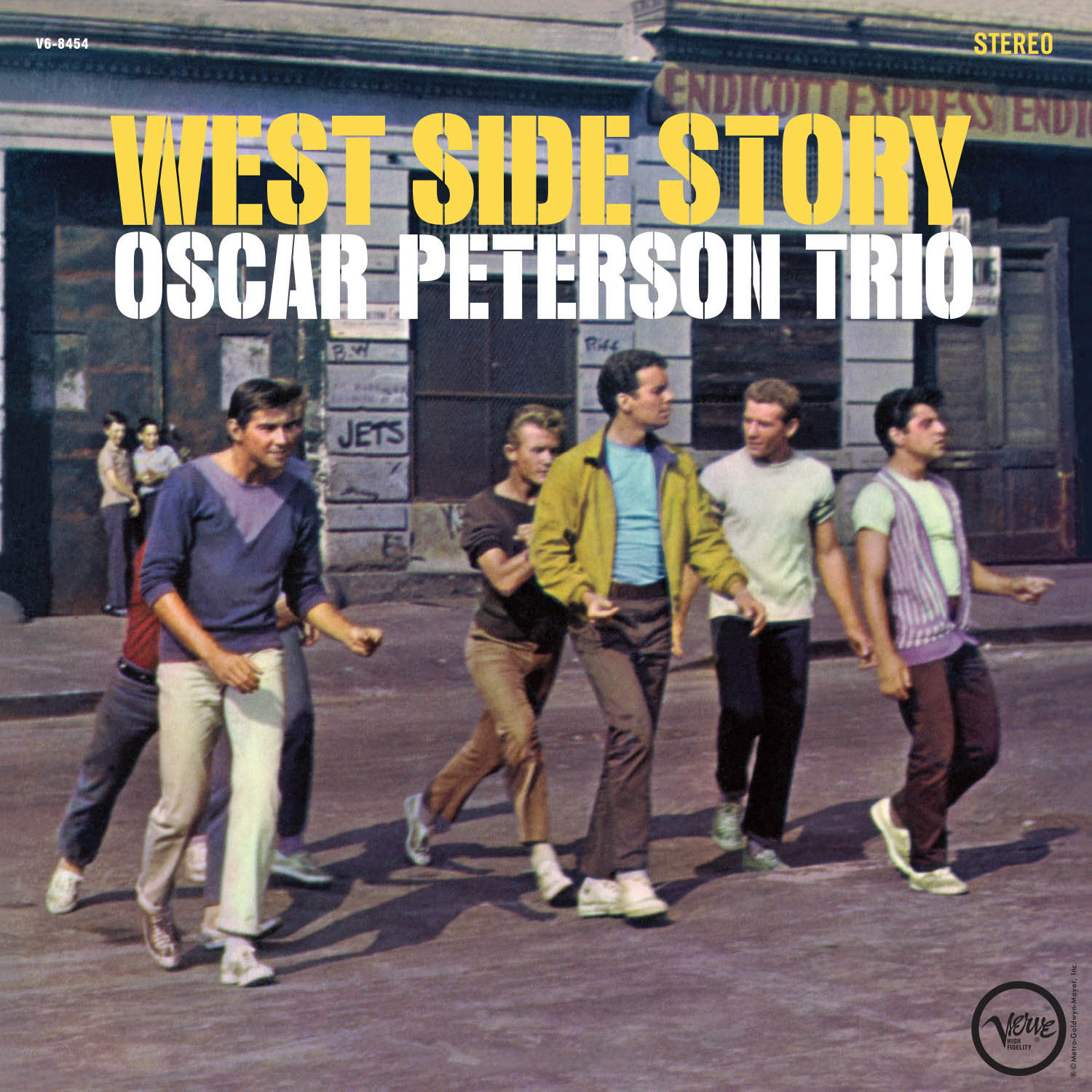
West Side Story meets three musicians who turn a familiar stage work into a self-contained jazz programme: Oscar Peterson on piano, Ray Brown on double bass and Ed Thigpen on drums. Leonard Bernstein’s music provides the themes, while the trio determines their shape within this recording. If you want to buy Oscar Peterson on vinyl and enjoy his work with recognisable melodies, the album offers a focused selection of seven pieces. Analogue Productions presents this 1962 Verve album here as a double LP at 45 RPM.
The musical has its own narrative world, but an instrumental trio recording does not need to reproduce it scene by scene. These melodies can stand without sung lyrics and serve as starting points for musical development. Somewhere, Tonight, Maria and I Feel Pretty are among the selections. Their familiarity makes the programme approachable, while the small ensemble directs attention towards what happens between piano, bass and drums. Recognising a tune can be the beginning of listening rather than its entire purpose.
Bernstein’s music and Stephen Sondheim’s lyrics belong to the original work. There is no singing on this record, however. The themes are interpreted by a jazz trio whose resources differ from those of a theatre orchestra. Within a smaller ensemble, a chord, a bass line or a rhythmic accent takes on a greater share of responsibility. That change of scale is central to the attraction: familiar material opens another perspective on the musicians and on the relationship between their individual contributions.
The programme begins with Something’s Coming and ends with Reprise. Between them are several celebrated melodies and the more extended Jet Song. This is a selected album programme rather than a complete performance of the musical. It can be enjoyed with knowledge of the stage work or without that background. Both approaches have a clear point of reference: the themes themselves and the work of three players bringing those themes together within a consistent instrumental setting and an independent sequence.

Oscar Peterson, Ray Brown and Ed Thigpen
Peterson’s piano occupies the centre, but the featured name should not obscure his two colleagues. Ray Brown and Ed Thigpen participate on all seven selections. The double bass connects harmonic grounding with rhythmic movement; the drums can place accents, mark transitions and help shape the course of a phrase. In a group this small, accompaniment is already a substantial part of interpretation. The piano’s effect also depends on what the other musicians provide alongside it and how their contributions interact over time.
Familiar melodies make this collaboration particularly accessible. Recognition provides orientation while attention moves towards the detail of the accompaniment. Where does the bass remain close to the foundation, and where does its line become an attraction in its own right? How does a rhythmic accent affect the course of a piano phrase? Questions of this kind do not require a score or specialised theoretical knowledge. They offer a way of hearing shared work whose individual musical voices can become clearer with each return to the record.
The piano fulfils several functions at once. It can carry the melody, spread out harmonies and supply rhythmic impulses of its own. Combined with bass and drums, those possibilities create a flexible framework capable of shifting the emphasis within a song. A familiar theme does not have to remain continuously in the foreground to act as a reference point. Listeners who associate Peterson primarily with virtuoso playing may find a coherent repertoire project especially useful for noticing how the whole performance is organised.
Brown and Thigpen therefore deserve equally clear identification. The personnel overview below lists all three players, their instruments and the full extent of their participation. It keeps the nature of the recording visible: this West Side Story is a trio album. Composer and lyricist credits are distinguished from performing personnel, as are recording and mastering details. That separation helps connect the original musical material, the people actually heard on the recording and the manufacture of this particular edition without confusing their different roles.

Seven pieces with their own progression
Something’s Coming opens side A, followed by Somewhere. Even the pairing of those titles brings together different ideas of expectation and longing. Listeners familiar with the musical will bring memories of their own; those encountering the songs through Peterson can begin with the instrumental form. Neither approach requires the trio album to be treated as a substitute for a stage or film recording. It has its own emphasis and a selection of material appropriate to that purpose.
The Jet Song, with a documented playing time of 7:40, occupies the second side on its own. It consequently receives more space than any of the other individual pieces. That distinction becomes tangible when handling the record: an entire side is devoted to one musical development. Instead of regarding it merely as another item in a long list, you can hear the section as a chapter in itself. The side changes before and after it reinforce its particular position within the album’s sequence.
Side C pairs Tonight with Maria. I Feel Pretty and Reprise then complete the final side and the record. The programme remains concentrated on seven entries. That limitation can be appealing when getting to know an album: there is enough material to offer several points of entry, without an extensive appendix continually stretching the frame. Returning to the record means returning to the same clearly defined sequence, allowing attention to move more deeply into a familiar arrangement of pieces.
The concept is useful when choosing a jazz record. Listeners seeking recognisable melodic points of contact have them, while those primarily interested in a piano trio encounter a consistent line-up throughout. The stage work supplies a thematic framework, and the instrumental interpretation creates room for the players. On a subsequent listen, a different musician can become the focus of attention without taking you outside the album’s musical world. That possibility is one of the enduring attractions of a small jazz ensemble working with a coherent repertoire.
The Verve reissue at 45 RPM
This Analogue Productions edition carries catalogue number AVRJ 8454-45 and comprises two stereo LPs playing at 45 RPM. George Marino at Sterling Sound is credited for mastering, with Quality Record Pressings identified for pressing. The original Verve catalogue number is V6-8454. Bob Simpson is documented as recording engineer and Dom Cerulli for the liner notes. These details provide clear points of reference for the recording and edition, without transferring mastering credits from unrelated Peterson releases to this particular album.
The allocation across four sides is a significant feature of the edition. It involves more side changes than a single LP, but gives the seven pieces clearly marked sections. The side devoted solely to Jet Song is especially important to that listening pattern. When comparing versions, catalogue number and playing speed therefore deserve attention alongside the album title. This product is specifically the 45 RPM double LP, rather than another Verve reissue presented in a different physical format or with a different running configuration.
West Side Story belongs naturally in a collection that brings established compositions together with individual jazz interpretation. It offers a manageable introduction to Peterson’s trio work while providing ample reason to listen consciously to Ray Brown and Ed Thigpen. The full tracklist and personnel credits appear directly below the story. They make the programme clear before buying and provide a convenient way to reconnect names with instruments while listening. The familiar material can then become a route towards greater appreciation of all three musicians.
You order from Michael 45 in Germany. We arrange the US import and dispatch from Hilden.
Musicians
Participants and documented credit status. Track references correspond to the tracklist.
- Oscar PetersonPortrait reference: 1977pianoParticipation: All seven tracks
- Ray BrownPortrait reference: 1976double bassParticipation: All seven tracks
- Ed ThigpenLater portrait reference; date unspecifieddrumsParticipation: All seven tracks


Oscar Peterson: piano; Ray Brown: double bass; Ed Thigpen: drums, on all seven tracks. Leonard Bernstein: music; Stephen Sondheim: lyrics for the original musical; this recording is instrumental. Bob Simpson: engineering; Dom Cerulli: liner notes. George Marino / Sterling Sound: mastering of this 45 RPM edition; QRP: pressing. Original catalogue Verve V6-8454. Jim Davis is credited as producer in this reissue’s documentation; this has not been transferred to the original session.

Reviews
There are no reviews yet.